A Q&A with Cordy Swope, Designer and Strategist in MedTech and Human Experience
Spotlight articles shine a light on designers and engineers we admire, asking leaders in the field about their work and their creative journey. This month’s Spotlight explores MedTech through the perspective of designer and strategist Cordy Swope — whose career has moved from automotive and consumer products into healthcare innovation, global consulting, and corporate leadership.
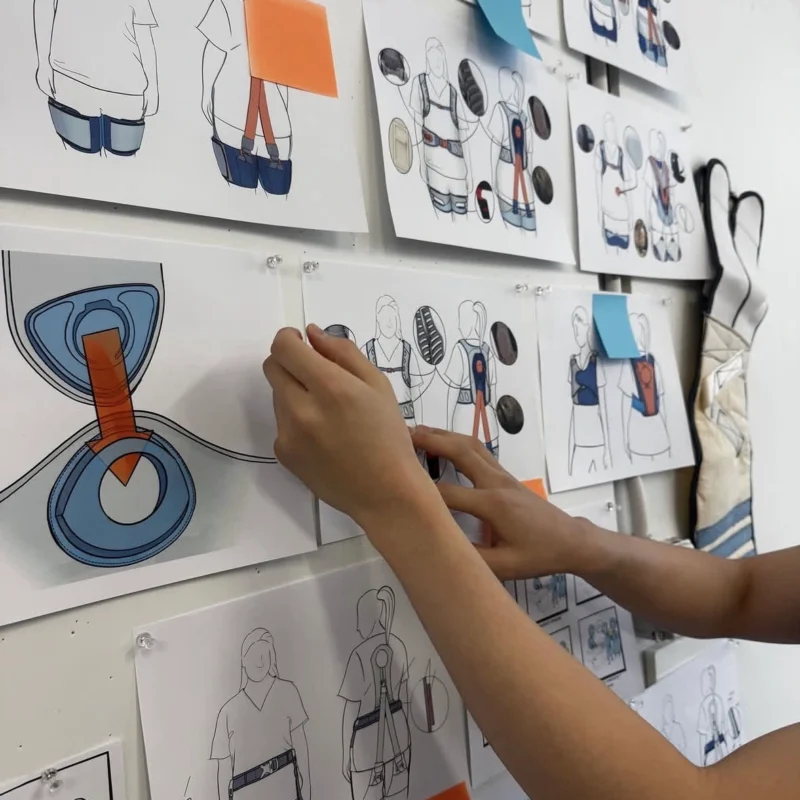
From IDEO to Johnson & Johnson, Novartis, BMW, Toyota, and now Seven19, Cordy has spent decades navigating the intersection of design, systems thinking, and human experience. In this conversation, we discuss the complexity of designing for healthcare, the realities of bringing human-centered design into large organizations, the influence of living abroad, and why optimism may be the defining trait of every designer.
Q:
Your career has spanned IDEO, healthcare, automotive, consulting, and international work. How did you first find your way into MedTech?
A:
I wouldn’t say that I’m a MedTech or healthcare native by any stretch. I grew up personally terrified of hospitals and anything to do with doctors until I was well into my thirties. Then, when I was working at IDEO and got assigned to a pharma project for Eli Lilly. Part of the project involved developing injection devices, but the part I was leading focused on adherence — how to help women in their late sixties stick to a treatment that required daily self-injections and refrigeration. We built prototype kits with fake pens and visited patients in their homes in places like Georgia and Florida. We’d interview them, leave the kits with them for about ten days, then come back to see what actually worked for them — not necessarily what they liked, but what worked. Up until then, I had mostly worked on projects centered around desirability — BMW, Coca-Cola, consumer brands. This was different. These treatments had the potential to prolong life or significantly improve quality of life. That’s really when I fell in love with healthcare and MedTech.
Q:
What separates a medical product that simply works from one that truly improves a patient’s life?
A:
The design process in healthcare is a multistakeholder ecosystem. To put it another way — it’s damn complex. There are layers of competing needs between doctors, patients, caregivers, payers, manufacturers, regulatory requirements, and business concerns. You have to disentangle those competing needs and reformulate them into something workable. In a way, it’s the ultimate design problem. I’ve always been attracted to problems that are greater than any one person’s ability to solve. In healthcare, every project requires a team of people who know more than you in different areas. Otherwise, you’re going to be very limited in what you can do. There’s real satisfaction in producing something that gets into the hands of doctors, patients, and caregivers and genuinely changes someone’s experience — even if you’re not the person inventing the medicine itself.

Q:
IDEO is famous for design thinking and human-centered design. What changed when you moved into large corporations like Johnson & Johnson and Novartis?
A:
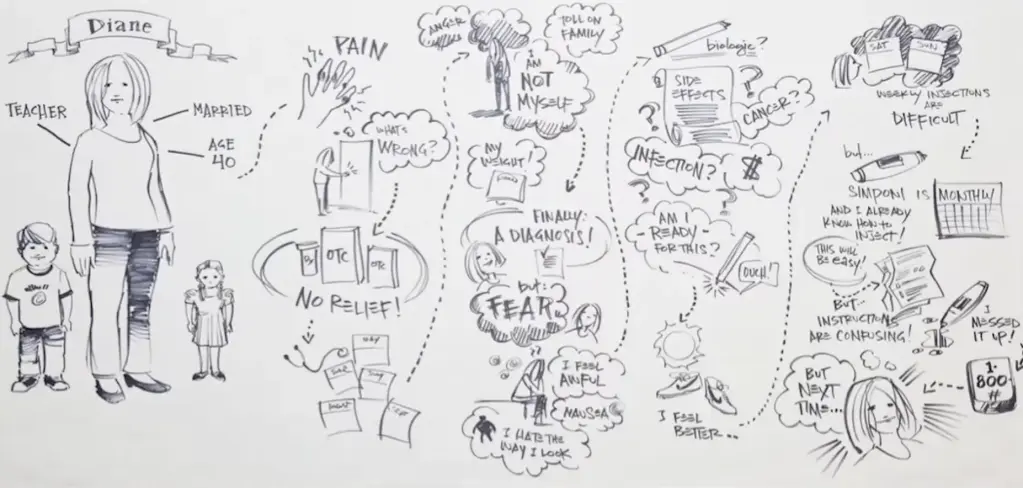
The hardest adjustment was around access to users and patients. At IDEO, we had systems around how data was collected, protected, and managed. We could do deep ethnographic research because the patient owned the data and we owned the process. Inside a corporation, especially a pharmaceutical company, everything becomes much more regulated. You’re really limited in your interactions with patients, so we had to hire outside researchers or find workarounds.
The other big shift is that in consulting you’re judged on the impact you create for the client and the customer. Inside a corporation, success depends much more on internal relationships. You have direct access to the means of production, which is amazing, but getting things implemented requires relationship-building. From the outside, people might call it politics. Inside, it’s how things move forward. One executive once gave me a piece of advice I’ve never forgotten. She said, “I want you guys to do the work. I don’t want you teaching marketers and engineers how to do design thinking because they’ll learn just enough to crash the plane into the side of a mountain — and then they’ll blame you. She was absolutely right.
Q:
We’ve seen a huge rise — and now some backlash — around design thinking, AI, and innovation culture inside corporations. From your perspective, what happened?
A:
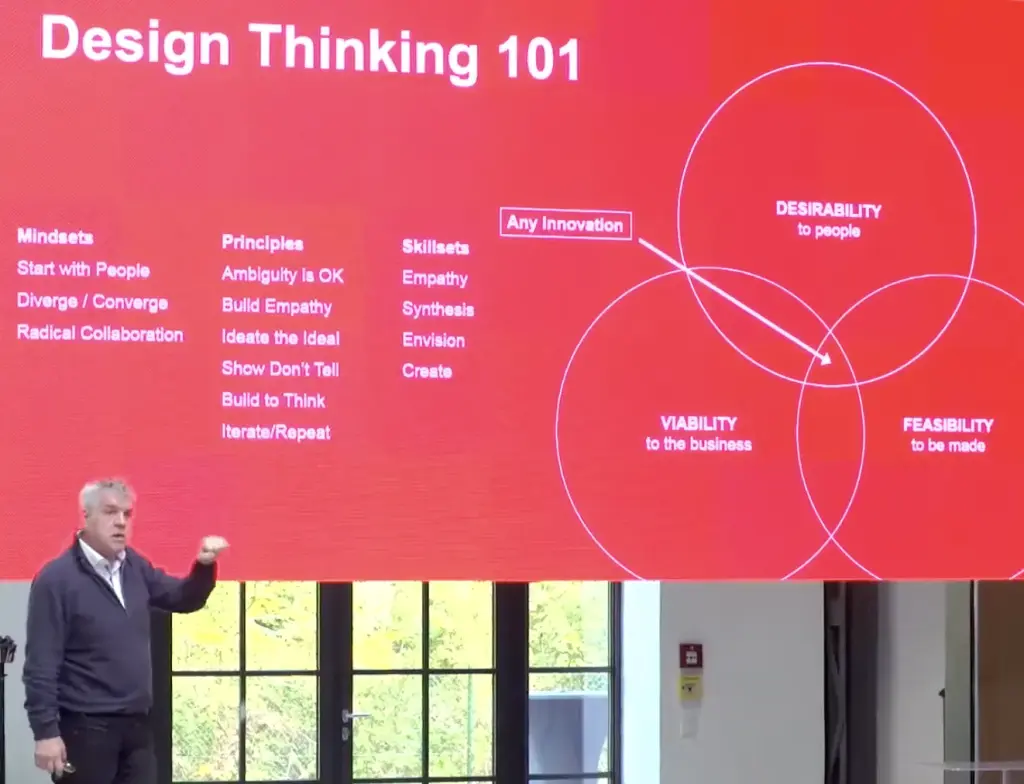
I think there was a period where companies were falling all over themselves to bring in designers and redesign their processes and workflows. But a lot of it was poorly managed. You had people halfway learning design thinking, claiming to be experts, selling services, and often misunderstanding what design actually is. There’s a reason there’s been backlash over the last few years. The way designers work is fundamentally different from how corporations work.
Corporations are often in the business of being inevitable — wanting to own everything, standardize everything, reduce risk. Designers are exploratory. Designers are trying to figure out a preferred future. That tension is always going to exist. In some ways it’s productive because it defines where designers add value, but it also creates friction. Now with AI, people are asking whether design itself is going away. Personally, I don’t think so. Some days it feels overwhelming, but other days AI just feels like another tool in the toolbox. I still remain optimistic despite all the turmoil.
Q:
You’ve now gone full circle — from consulting to corporate and back into consulting again. How has that changed your perspective?
A:
Going back into consulting feels a little bit like coming home. A lot of the methods and practices I used fifteen years ago were still there like muscle memory, even if I had to work the kinks out. It’s liberating in some ways because you don’t have to constantly compromise or go along with things you know are going to be mediocre — which everybody does in the corporate world at some point. I once heard someone say that when you go from consulting to corporate, you’re trading insecurity for frustration. And when you go back to consulting, you trade frustration for insecurity. That’s pretty accurate. In consulting, you’re always thinking about the pipeline. But you also get the excitement of solving new problems and working across industries.
Q:
You’ve also spent significant time living and working abroad. How did those experiences shape your approach to design?
A:
One of my first jobs was at Toyota. I had lived in Japan before that, and the role involved future-focused storytelling for designers — looking at culture, architecture, fashion, and behavioral trends and translating them into inspiration for automotive design. Later, at Continuum, I worked extensively with BMW in both Europe and North America. A lot of the features we developed back then are still in BMWs today because the work was so deeply human-centered. Eventually, I met my wife through that work, moved to Munich, and lived in Germany for years. I think you can learn a language relatively quickly. But learning a culture — the unwritten rules, the mentality, the references — can take a lifetime. It’s similar to learning the culture inside a corporation. You have to understand the invisible systems. People often focus on the linguistic challenge of living abroad, but I think it’s really the cultural challenge that gets you.
Q:
As fellow Pratt graduates, I have to ask — what stayed with you from your Pratt education throughout your career?
A:
I came into Pratt from an English literature background, so I felt like a bit of a black sheep. But one thing that stayed with me forever was the fearlessness of prototyping. At Pratt, there was this mentality of: what if we just build something immediately? It might be mostly wrong, but maybe it’s not all wrong — and we can use it to ask better questions. Later at IDEO, I recognized the same philosophy. “Build to think.” Using a physical prototype or mockup to ask better questions is still one of the most valuable design tools I know. You don’t always need the perfect words to formulate the perfect question. Sometimes you just put something in front of people and learn from the reaction.
Q:
Final question. From Pratt to Germany, from IDEO to Seven19 — what’s the thread that connects everything you’ve done?
A:
I think it’s dissatisfaction with the current state combined with an optimism that the future can be better. About eighteen years ago, when my first child was born, I realized that since I had the privilege of working as a designer, I wanted to help design the kind of world I’d want my kids to live in. So I look around, and usually I’m dissatisfied with what I see. Then I use the tools of design — prototyping, visualization, whatever tools my team and I have — to build momentum toward some kind of preferred future. Designers are uniquely equipped to visualize what could be before most people can. And honestly, I still remain optimistic.
At the end of our conversation, Cordy and I found ourselves reflecting on something that feels increasingly important right now: optimism. Despite rapid technological change, AI disruption, corporate upheaval, and the growing complexity of the systems designers work within, there remains a shared belief that things can be improved. That belief may ultimately be one of the defining characteristics of design itself. As Cordy put it, designers are in the business of “figuring out the preferred future.” And perhaps that ability — to imagine something better before it exists — is exactly what makes design such a powerful force within healthcare, technology, and beyond.