A Q&A with Cordy Swope, Designer and Strategist in MedTech and Human Experience

A Q&A with Cordy Swope, Designer and Strategist in MedTech and Human Experience

Spotlight articles shine a light on designers and engineers we admire, asking leaders in the field about their work and their creative journey. This month’s Spotlight explores MedTech through the perspective of designer and strategist Cordy Swope — whose career has moved from automotive and consumer products into healthcare innovation, global consulting, and corporate leadership.

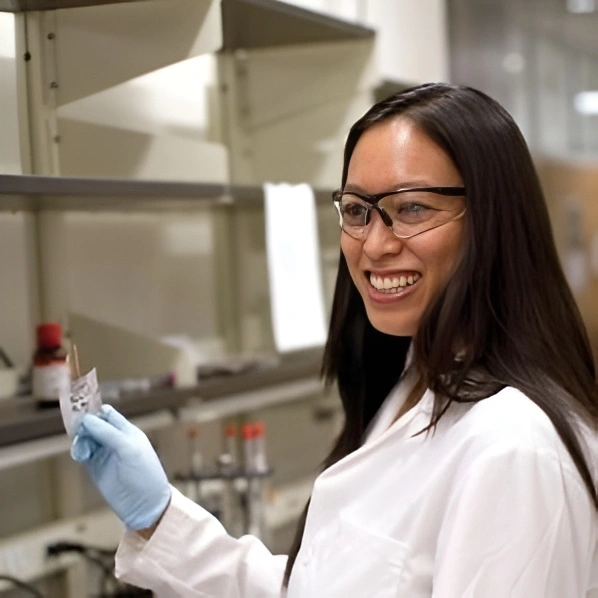
Portrait of Cordy Swope, designer and strategist at Seven19 and Pratt Institute graduate.
Cordy Swope, designer and strategist at Seven19 and Pratt Institute graduate.

From IDEO to Johnson & Johnson, Novartis, BMW, Toyota, and now Seven19, Cordy has spent decades navigating the intersection of design, systems thinking, and human experience. In this conversation, we discuss the complexity of designing for healthcare, the realities of bringing human-centered design into large organizations, the influence of living abroad, and why optimism may be the defining trait of every designer.

Q:

Your career has spanned IDEO, healthcare, automotive, consulting, and international work. How did you first find your way into MedTech?

A:

I wouldn’t say that I’m a MedTech or healthcare native by any stretch. I grew up personally terrified of hospitals and anything to do with doctors until I was well into my thirties.  Then, when I was working at IDEO and got assigned to a pharma project for Eli Lilly. Part of the project involved developing injection devices, but the part I was leading focused on adherence — how to help women in their late sixties stick to a treatment that required daily self-injections and refrigeration.  We built prototype kits with fake pens and visited patients in their homes in places like Georgia and Florida. We’d interview them, leave the kits with them for about ten days, then come back to see what actually worked for them — not necessarily what they liked, but what worked.  Up until then, I had mostly worked on projects centered around desirability — BMW, Coca-Cola, consumer brands. This was different. These treatments had the potential to prolong life or significantly improve quality of life. That’s really when I fell in love with healthcare and MedTech.

Q:

What separates a medical product that simply works from one that truly improves a patient’s life?

A:

The design process in healthcare is a multistakeholder ecosystem. To put it another way — it’s damn complex. There are layers of competing needs between doctors, patients, caregivers, payers, manufacturers, regulatory requirements, and business concerns. You have to disentangle those competing needs and reformulate them into something workable. In a way, it’s the ultimate design problem. I’ve always been attracted to problems that are greater than any one person’s ability to solve. In healthcare, every project requires a team of people who know more than you in different areas. Otherwise, you’re going to be very limited in what you can do. There’s real satisfaction in producing something that gets into the hands of doctors, patients, and caregivers and genuinely changes someone’s experience — even if you’re not the person inventing the medicine itself.

Q:

IDEO is famous for design thinking and human-centered design. What changed when you moved into large corporations like Johnson & Johnson and Novartis?

A:

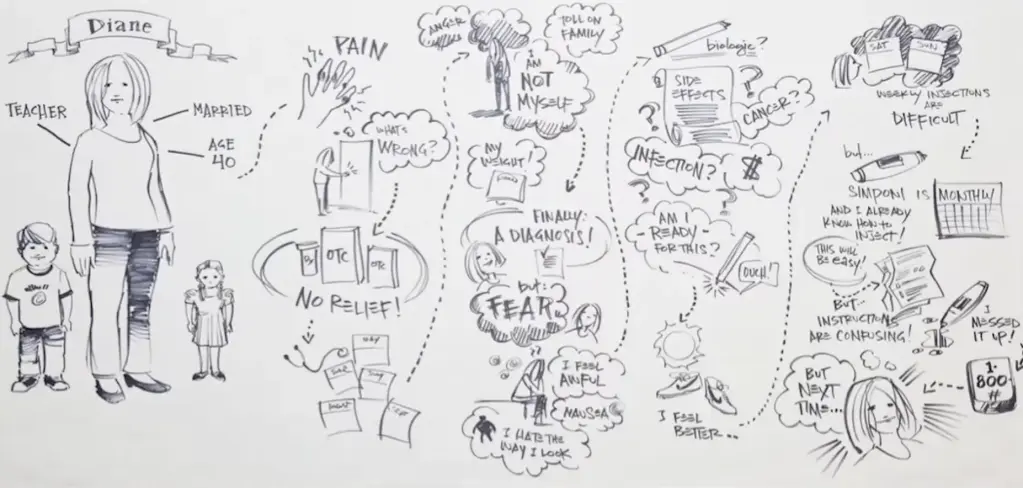
Hand-drawn patient journey map titled Diane, illustrating a 40-year-old teacher's experience moving from pain and diagnosis to fear, side effect concerns, and the difficulty of weekly self-injections.
A patient journey map exploring the realities of self-injection therapy.

The hardest adjustment was around access to users and patients. At IDEO, we had systems around how data was collected, protected, and managed. We could do deep ethnographic research because the patient owned the data and we owned the process. Inside a corporation, especially a pharmaceutical company, everything becomes much more regulated. You’re really limited in your interactions with patients, so we had to hire outside researchers or find workarounds.

The other big shift is that in consulting you’re judged on the impact you create for the client and the customer. Inside a corporation, success depends much more on internal relationships. You have direct access to the means of production, which is amazing, but getting things implemented requires relationship-building. From the outside, people might call it politics. Inside, it’s how things move forward.  One executive once gave me a piece of advice I’ve never forgotten. She said, “I want you guys to do the work. I don’t want you teaching marketers and engineers how to do design thinking because they’ll learn just enough to crash the plane into the side of a mountain — and then they’ll blame you. She was absolutely right.

Q:

We’ve seen a huge rise — and now some backlash — around design thinking, AI, and innovation culture inside corporations. From your perspective, what happened?

A:

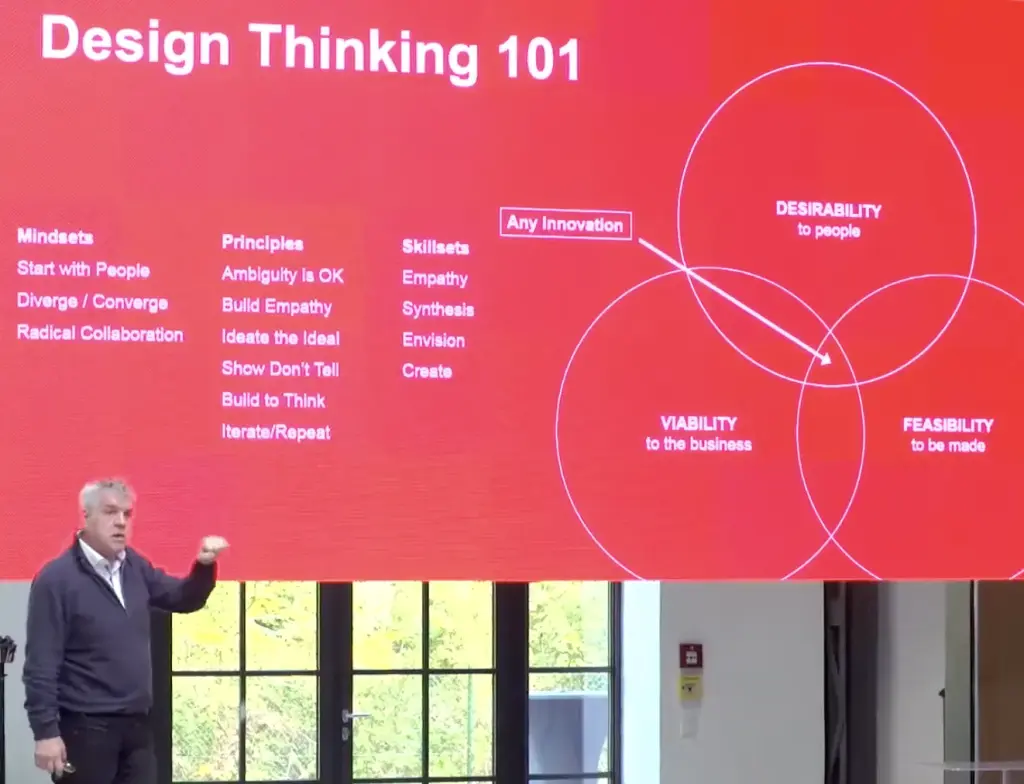
Cordy Swope giving a lecture on design thinking fundamentals in front of a red slide showing mindsets, principles, skillsets, and a Venn diagram of desirability, viability, and feasibility.
Cordy Swope presenting the fundamentals of design thinking.

I think there was a period where companies were falling all over themselves to bring in designers and redesign their processes and workflows. But a lot of it was poorly managed. You had people halfway learning design thinking, claiming to be experts, selling services, and often misunderstanding what design actually is. There’s a reason there’s been backlash over the last few years. The way designers work is fundamentally different from how corporations work.

Corporations are often in the business of being inevitable — wanting to own everything, standardize everything, reduce risk. Designers are exploratory. Designers are trying to figure out a preferred future. That tension is always going to exist. In some ways it’s productive because it defines where designers add value, but it also creates friction. Now with AI, people are asking whether design itself is going away. Personally, I don’t think so. Some days it feels overwhelming, but other days AI just feels like another tool in the toolbox. I still remain optimistic despite all the turmoil.

Q:

You’ve now gone full circle — from consulting to corporate and back into consulting again. How has that changed your perspective?

A:

Going back into consulting feels a little bit like coming home. A lot of the methods and practices I used fifteen years ago were still there like muscle memory, even if I had to work the kinks out. It’s liberating in some ways because you don’t have to constantly compromise or go along with things you know are going to be mediocre — which everybody does in the corporate world at some point. I once heard someone say that when you go from consulting to corporate, you’re trading insecurity for frustration. And when you go back to consulting, you trade frustration for insecurity. That’s pretty accurate. In consulting, you’re always thinking about the pipeline. But you also get the excitement of solving new problems and working across industries.

Q:

You’ve also spent significant time living and working abroad. How did those experiences shape your approach to design?

A:

One of my first jobs was at Toyota. I had lived in Japan before that, and the role involved future-focused storytelling for designers — looking at culture, architecture, fashion, and behavioral trends and translating them into inspiration for automotive design.  Later, at Continuum, I worked extensively with BMW in both Europe and North America. A lot of the features we developed back then are still in BMWs today because the work was so deeply human-centered.  Eventually, I met my wife through that work, moved to Munich, and lived in Germany for years. I think you can learn a language relatively quickly. But learning a culture — the unwritten rules, the mentality, the references — can take a lifetime. It’s similar to learning the culture inside a corporation. You have to understand the invisible systems. People often focus on the linguistic challenge of living abroad, but I think it’s really the cultural challenge that gets you.

Q:

As fellow Pratt graduates, I have to ask — what stayed with you from your Pratt education throughout your career?

A:

I came into Pratt from an English literature background, so I felt like a bit of a black sheep. But one thing that stayed with me forever was the fearlessness of prototyping. At Pratt, there was this mentality of: what if we just build something immediately? It might be mostly wrong, but maybe it’s not all wrong — and we can use it to ask better questions. Later at IDEO, I recognized the same philosophy. “Build to think.” Using a physical prototype or mockup to ask better questions is still one of the most valuable design tools I know. You don’t always need the perfect words to formulate the perfect question. Sometimes you just put something in front of people and learn from the reaction.

Q:

Final question. From Pratt to Germany, from IDEO to Seven19 — what’s the thread that connects everything you’ve done?

A:

I think it’s dissatisfaction with the current state combined with an optimism that the future can be better. About eighteen years ago, when my first child was born, I realized that since I had the privilege of working as a designer, I wanted to help design the kind of world I’d want my kids to live in. So I look around, and usually I’m dissatisfied with what I see. Then I use the tools of design — prototyping, visualization, whatever tools my team and I have — to build momentum toward some kind of preferred future. Designers are uniquely equipped to visualize what could be before most people can. And honestly, I still remain optimistic. 

At the end of our conversation, Cordy and I found ourselves reflecting on something that feels increasingly important right now: optimism. Despite rapid technological change, AI disruption, corporate upheaval, and the growing complexity of the systems designers work within, there remains a shared belief that things can be improved. That belief may ultimately be one of the defining characteristics of design itself.  As Cordy put it, designers are in the business of “figuring out the preferred future.” And perhaps that ability — to imagine something better before it exists — is exactly what makes design such a powerful force within healthcare, technology, and beyond.

A Q&A with India Pearlman, Packaging Designer for Beauty and Wellness

A Q&A with India Pearlman, Packaging Designer for Beauty and Wellness

Spotlight articles shine a light on designers and engineers we admire, asking leaders in the field about their work and their creative journey. This month’s Spotlight focuses on the world of wellness and beauty through the lens of India Pearlman, a packaging designer whose work sits at the intersection of industrial design, branding, and product experience.

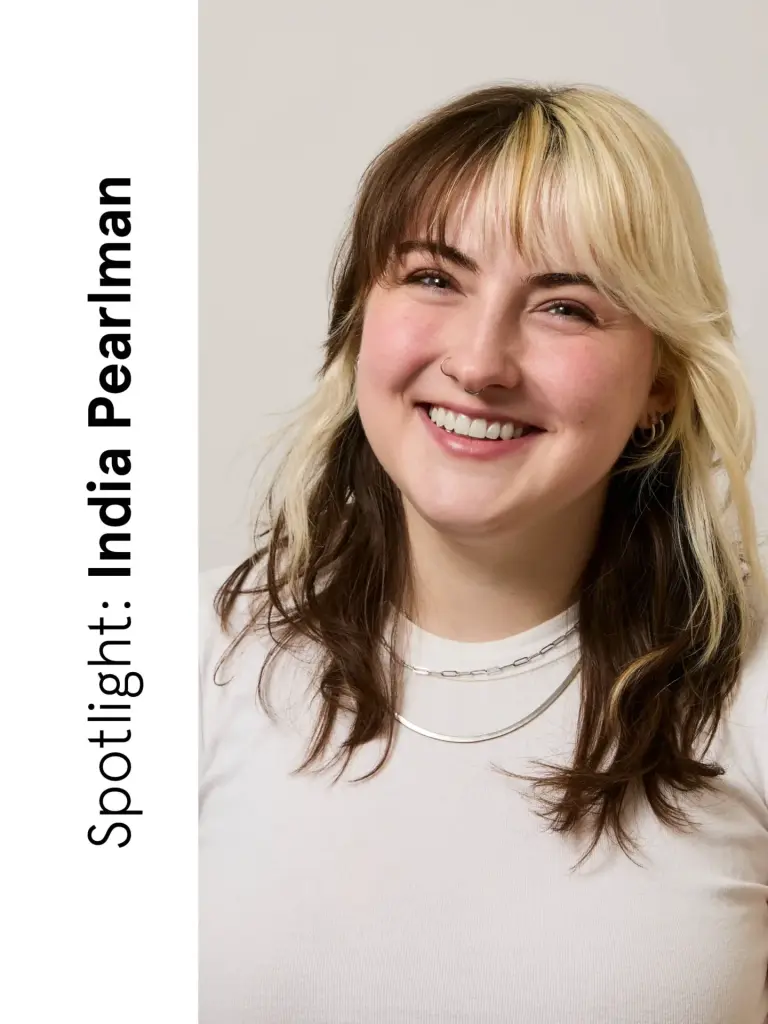
india pearlman spotlight portrait
India Pearlman, packaging designer based in New York and Pratt Institute graduate.

A graduate of Pratt Institute, India brings a distinctly three-dimensional, systems-driven mindset to a field often perceived as purely graphic. Her approach reflects a broader shift in design—where packaging is no longer just a container, but part of a larger ecosystem shaping how products are experienced, displayed, and lived with over time.

We spoke with India about how she found her way into packaging, how industrial design continues to inform her work, and the details she notices that most people miss.

Q:

Can you tell us a bit about your background and what led you into the wellness and beauty space?

A:

I’m a designer based in Queens, currently living in Ridgewood. I graduated from Pratt in 2020 with a degree in industrial design, which was honestly a wild time to enter the workforce. A lot of traditional industrial design roles were hard to find, especially because so much of that work is hands-on.

At the same time, there were a lot of packaging roles opening up. I hadn’t studied packaging in school and wasn’t initially interested in it, but I ended up falling into it because of the timing.

Looking back, it makes sense. My dad works in marketing, and growing up he would show me different pieces of packaging and ask which one I liked more. I think that kind of thinking was always there, even before I realized it.

Eva NYC Freshen Up dry shampoo duo pack featuring stock aluminum cans with custom graphics, an example of hair care packaging design
Eva NYC Freshen Up Invisible Dry Shampoo, a hair care product that combines stock packaging with custom graphics and color application.

Q:

Do you specialize in a particular area of packaging?

A:

I primarily work in beauty and wellness. I got my start in hair care, and the work tends to involve a mix of stock and custom packaging, with a strong focus on graphics, color, and application.

Q:

Do you think industrial design is becoming broader again as categories like beauty and wellness evolve?

A:

I definitely think so. At first, it felt strange to move from identifying as an industrial designer to working as a packaging designer, but over time I’ve seen how closely those disciplines are connected.

There’s a strong overlap between graphic thinking and the physical object—how something exists in space, how it’s held, how it’s experienced. Packaging and industrial design really do belong to the same world.

Q:

How does your industrial design background show up in your work today?

A:

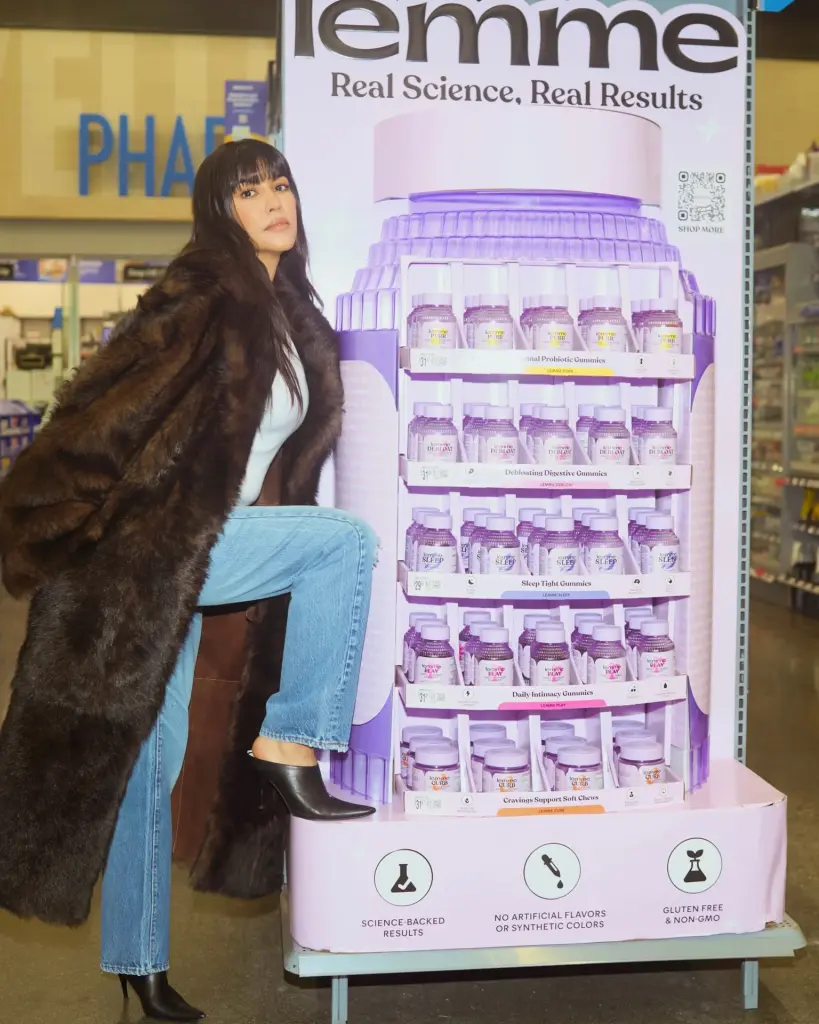
I still rely on it constantly. Having that three-dimensional understanding has allowed me to go further in my role and take on more than just packaging. I often work on retail displays and spatial elements as well, which are very much rooted in industrial design.

Kourtney Kardashian posing with Lemme wellness supplement retail display at Walmart, showing retail packaging and spatial design
Lemme’s Walmart retail display, where packaging extends into spatial and retail design.

My understanding of materials also helps me collaborate more effectively with other teams. I’m able to bring ideas that are creative but also feasible, and sometimes even anticipate challenges before engineering gets involved. That foundation makes a big difference in how projects move forward.

Q:

What usually comes first for you: visual idea, tactile experience, or story?

A:

I typically work under the brand design team, and branding involves a lot more story-based thinking.  I like to start with that because it gives me a direction and purpose. Because I work closely with brand teams, there’s often a strong narrative behind the product, and that gives me direction and purpose.

Packaging design involves a lot more brand thinking. Working within brand guidelines might seem limiting, but I actually find it freeing. It allows me to focus more deeply on the design itself, knowing that I’m working toward a clear and intentional goal.

Q:

Beauty trends move fast. How do you think about what lasts versus what’s fleeting?

A:

It can be tricky. Right now, we’re seeing a lot of minimal, sans-serif typography and simple, blocky forms, and that’s been around for a while.

I look at a lot of references. I scroll through Pinterest, study retail environments, and look at other brands, but I also rely heavily on intuition. One of the biggest considerations for me is how a product will live in someone’s home. Is it something they’ll want to keep and display, or something more temporary?

I also look to interior design trends for inspiration. There’s a movement toward more expressive, colorful spaces, what people call ‘dopamine interiors’, and that’s influencing packaging as well, especially for younger brands.

Q:

What’s a packaging detail most people never notice, but you always do?

A:

I immediately notice when things don’t align across a product line. If packaging isn’t proportionate or the typography shifts from one SKU to another, it really stands out to me.

A lot of my work has focused on refining those details. In one role, I did a full packaging revamp that addressed inconsistencies most people wouldn’t consciously see, but that make a big difference in how cohesive the line feels. I’m always thinking about how everything works together as a system. 

Q:

NEST New York and Drawbertson holiday collection showing cohesive packaging design across candles, diffusers, and gift boxes
NEST x Drawbertson Holiday Collection, an example of packaging that functions as a unified system across an entire product line.

When you’re shopping, are you able to enjoy it? Or are you redesigning everything?

A:

It depends on where I am. In a typical grocery store, I’m definitely redesigning things in my head and questioning a lot of decisions.

But I love going into smaller markets that carry emerging brands. Those spaces tend to have really thoughtful, exciting packaging, and I find them genuinely inspiring. I also take a lot of photos when I’m out, especially in places like Sephora, whenever something catches my attention.

Grocery stores are hard. there’s a lot of packaging that’s been around a long time where I’m like – we could do this better. 

Q:

What materials or sustainability approaches are you most interested in right now?

A:

 Post-consumer recycled plastic has become much more standard, which is great to see. Beyond that, I’m really interested in paper-based and refillable packaging systems.

Refillable design is especially exciting because it allows you to create a more permanent, beautiful object that people want to keep, paired with a more sustainable refill system.

I’m also paying close attention to finishes. For example, traditional foil treatments make packaging harder to recycle, so I try to push toward alternatives that achieve a similar effect while remaining recyclable. You can also get a lot out of embossing and debossing. There’s a lot of innovation happening there right now. 

Q:

If you could collaborate with any brand right now, what would it be?

A:

I would love to work with Prada, especially on fragrance. Their packaging is very architectural, which really resonates with me.

There’s also something interesting about their fashion and accessories, like their bags that translate into form and function. I think there’s a lot of opportunity to bring that same thinking into packaging design. It would be interesting to see how their fashion informs cosmetics, and how something like a handbag, which is itself a functional industrial design object, could inform packaging.

Check out the rest of our Spotlight series to hear more from leaders in the design industry. Sign up for our newsletter and follow us on Instagram and LinkedIn for design news, multi-media recommendations, and to learn more about product design and development!

Please reach out!

A Q&A with Roger Schmitz, Founder of Moxy Monitor

A Q&A with Roger Schmitz, Founder of Moxy Monitor

Rethinking athlete performance through muscle oxygen data

Spotlight articles shine a light on designers and engineers we admire, asking leaders in the field about their work and their creative journey. Roger Schmitz, founder and CEO of Moxy Monitor, has spent more than a decade doing exactly that. A mechanical engineer by training, Schmitz developed a wearable sensor that measures muscle oxygen saturation using near-infrared spectroscopy. The technology gives athletes, coaches, and performance scientists direct insight into how muscles are working under load.

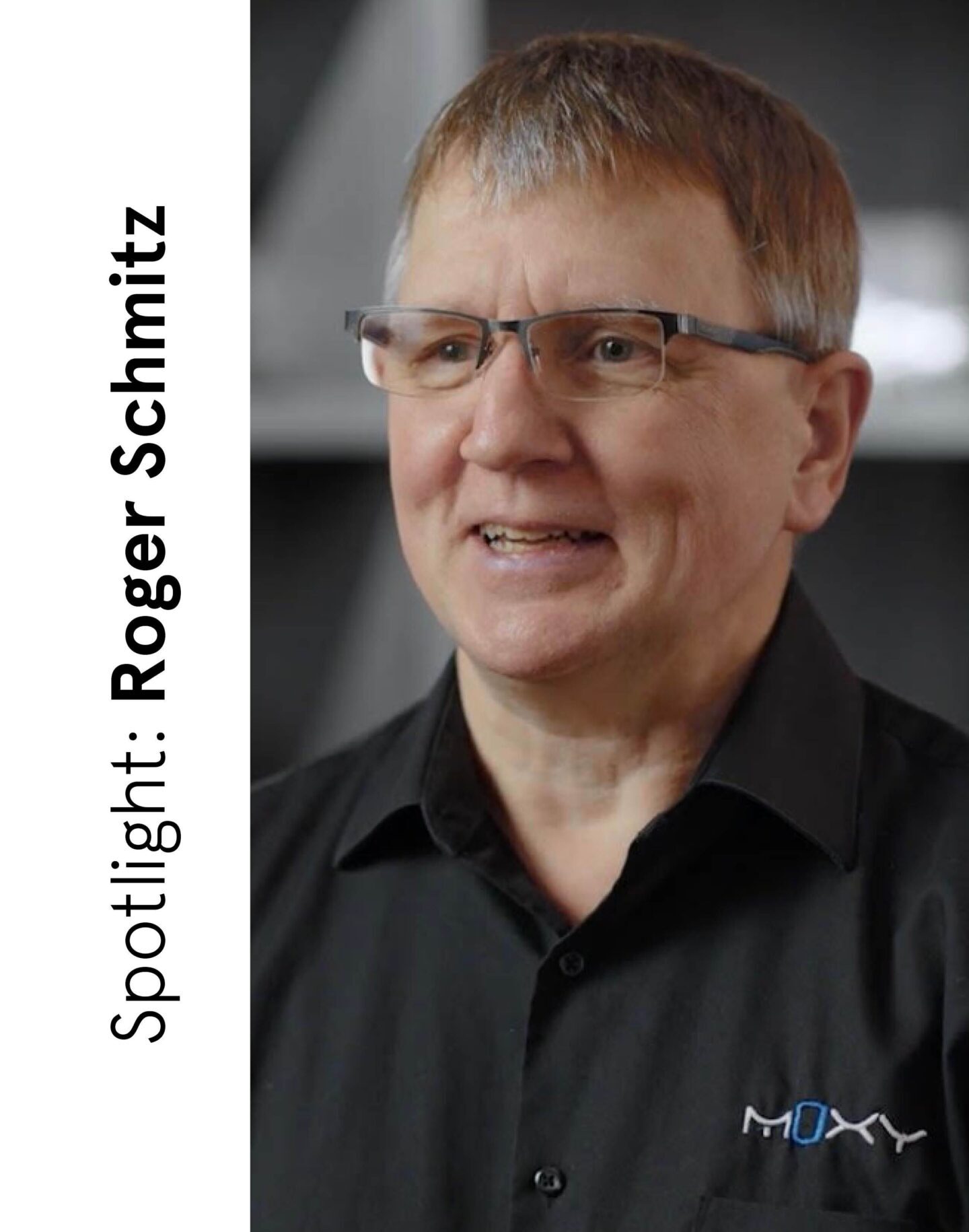
Photo of Roger Schmitz
Roger Schmitz, Founder and CEO of Moxy Monitor

Originally inspired by medical device research, Moxy has become a powerful tool for endurance athletes, professional teams, and researchers studying human performance.

More recently, Schmitz partnered with Interwoven Design Group to solve a particularly difficult challenge: how to integrate a precision sensor into athletic apparel in a way that is reliable, comfortable, and almost invisible to the athlete wearing it.

We spoke with Roger about the origins of Moxy, what muscle oxygen reveals that other metrics miss, and what happens when engineers and designers collaborate to solve hard problems.

Q:

Could you start by telling us about yourself and the story behind Moxy?

A:

My name is Roger Schmitz. I’m the CEO and founder of Moxy Monitor, and I developed the technology that takes muscle oxygen measurements and allows us to do it accurately.

My background is in engineering—I’m a mechanical engineer by training. I worked in the disc drive industry for a while and later in medical devices. Around that time I was working with near-infrared spectroscopy, which is the core technology behind Moxy.

Those devices were large benchtop systems used for trauma patients. They had cables running to the patient and cost about $15,000. After that company failed and I was laid off, I started thinking about how to make the technology much smaller, more accurate, and dramatically less expensive.

The idea was to create a wearable, battery-powered device that cost under $1,000. I originally thought it would become a medical device, but a cardiologist I met with said something that changed everything. He said, “You should make it for athletes. The regulatory burden will be dramatically smaller.”

That’s what we did. And interestingly, a lot of researchers still buy the device today and use it to study heart failure—just not in a clinical setting.

Q:

We often hear about metrics like heart rate, GPS tracking, or power output. What does muscle oxygen reveal that those metrics don’t?

A:

Athlete wearing Moxy Monitor sensor during field performance testing
Moxy Monitor sensor placed on the thigh to measure muscle oxygen during activity.

Those metrics can be divided into two categories: external load and internal load.

External load is how much work the body is doing—things like GPS speed or power meters. Internal load is how hard the body has to work to produce that output.

Heart rate is one measure of internal load, but it has limitations. It responds slowly to changes in effort and it’s influenced by a lot of other factors.

Muscle oxygen is different because it reacts immediately. When you change the load, we see a change in muscle oxygen right away. We’re measuring what’s happening in the muscle in real time. That makes it incredibly useful for adjusting training intensity.

It becomes another tool athletes and coaches can use to understand what’s really happening inside the body based on those deeper insights.

Q:

So athletes and coaches can see that data in real time?

A:

Yes. The data can show up directly on a GPS watch for endurance athletes—we integrate well with Garmin. For team sports we connect with systems like WIMU GPS.

That means trainers or performance staff can monitor muscle oxygen while athletes are actually playing on the pitch. They can watch the data live on the sideline and even monitor the entire team.

It gives them a lot more information than they’ve traditionally had.

Q:

How do coaches actually use that information in training?

A:

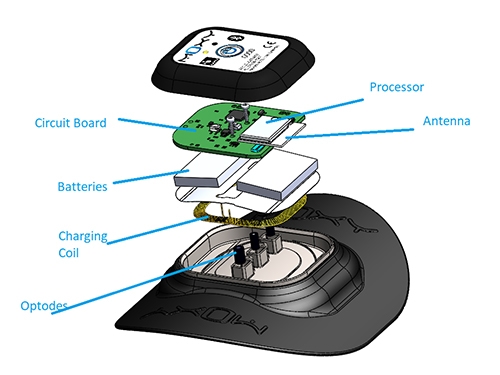
Exploded view diagram of Moxy Monitor sensor showing internal components including circuit board, battery, antenna, and optical sensors
Exploded view of the Moxy Monitor sensor showing its internal components.

One example comes from a professional soccer team in Germany. During practice they alternate between small-sided games—maybe four-on-four—and full-team play. They assumed the full-team drills were more demanding.

But when they looked at the muscle oxygen data they saw that the short-sided play was actually creating more physiological load because of the constant quick bursts of action. It wasn’t showing up in heart rate, but it showed up clearly in the muscle oxygen data.

So they adjusted their training and backed off those drills slightly to avoid overloading the athletes.

Q:

Has Moxy ever contradicted what a coach believed about a player?

A:

Yes, we see that fairly often.

One example involved a professional triathlete who had two bikes—a road bike and a time-trial bike. She kept telling her coach she couldn’t produce the same power on one of them.

The coach initially thought she just needed to get used to the bike. But when they compared the Moxy data between the two bikes, the readings were dramatically different.

At that point the coach said, “This isn’t just in your head—this is a physiologic difference.”

They made some adjustments to the bike fit and her performance improved significantly.

Having objective data can validate what the athlete is feeling.

Q:

Performance staff in elite sports are very data-savvy—but also skeptical of new technology. How did you earn their trust?

A:

That’s a great observation. People approach them with gadgets all the time.

Our approach has been to work closely with both the research community and the high-performance sport community.

Moxy has now been used in hundreds of scientific studies, and those results get published in peer-reviewed journals. Early on people would say the device was too inexpensive to be credible—they assumed it must be a toy.

But as more researchers began publishing results, perceptions changed.

We also host a Moxy Summit, where our power users present how they’re using the technology with athletes. It’s about half researchers and half high-performance sports practitioners.

The key is consistency. Don’t overpromise. Stick to what the science supports.

Over time people start to realize the technology is legitimate.

Q:

With global events like the World Cup, where every performance detail matters, how does muscle oxygen data help teams prepare?

A:

Teams often conduct physiological testing in the lab—treadmill tests, breath analysis, lactate measurements.

The challenge is that you can’t do those tests during an actual match.

But you can measure muscle oxygen on the field. So teams can translate what they learned in the lab to real game situations.

They might know that a certain athlete can sustain a given workload for ninety minutes, while another athlete might only sustain it for sixty or seventy.

At that level, everyone is already operating near their limits. You’re not making huge changes—just small adjustments.

But those small tweaks can be the difference between winning and losing.

Q:

Moxy started in endurance sports. Where else are you seeing it used?

A:

Triathlon probably has the most users because the training is so intense and athletes need careful control of their effort.

Cycling is another big area because we integrate with many data systems already used by cyclists.

We’re also starting to see more use in running and swimming. Swimming is particularly interesting because there’s very little physiological data available when athletes are underwater.

Team sports are expanding too—soccer, hockey, and others—especially as we integrate with GPS systems used by teams.

And there are applications in strength training as well, where coaches want to understand how specific muscles are being loaded.

Q:

Wearables take a beating in contact sports. What was the biggest challenge in making Moxy work on the field cycle?

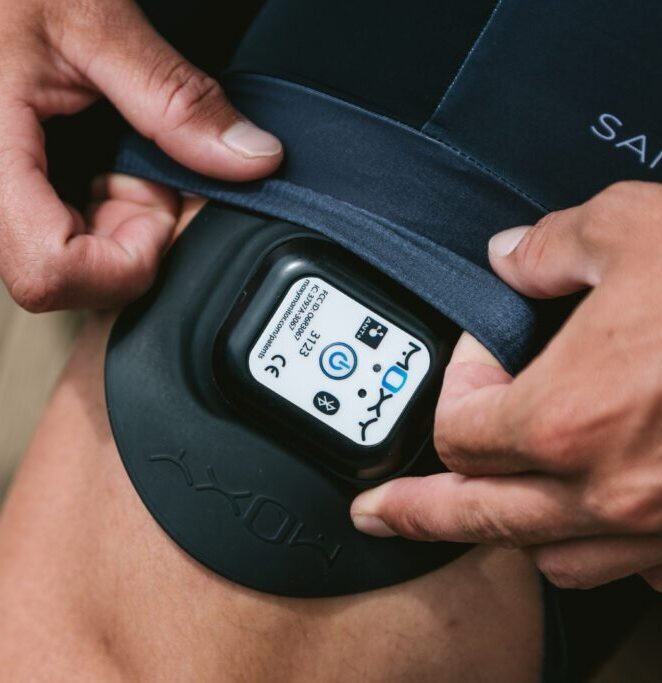
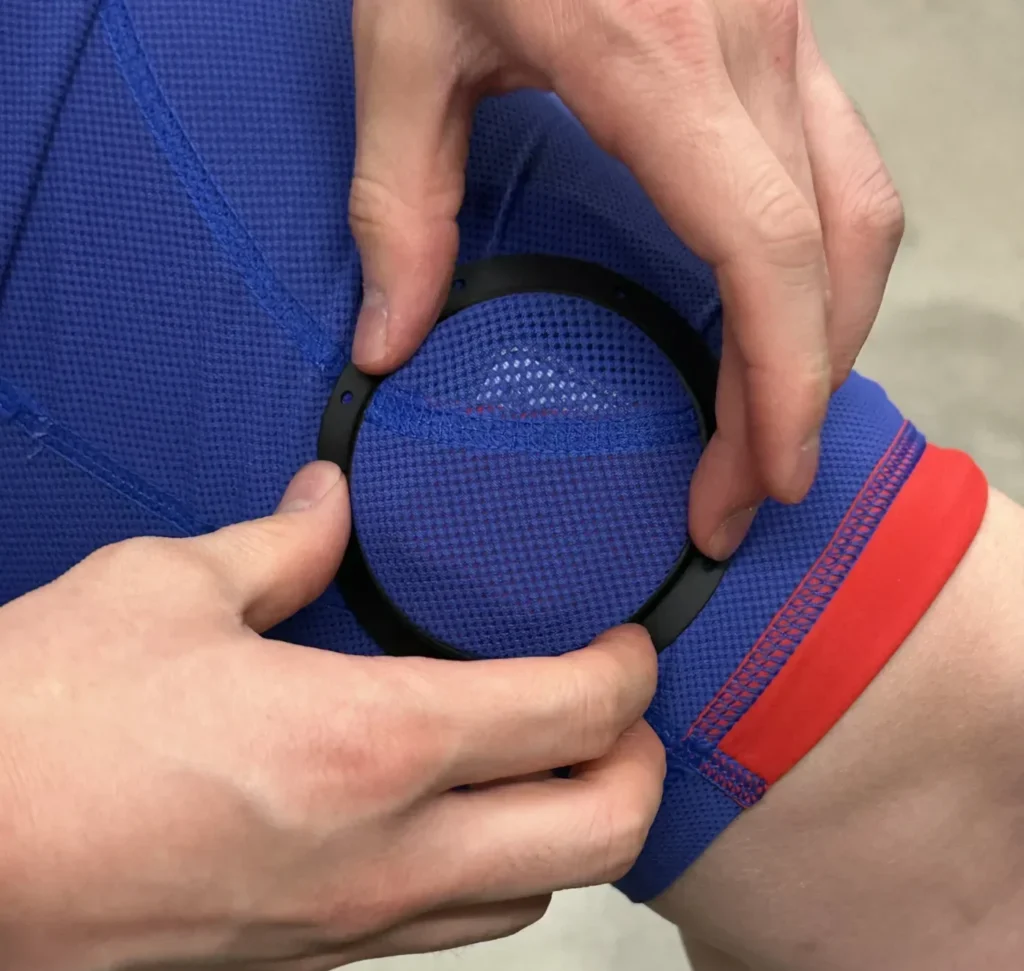
Athlete placing a Moxy Monitor sensor into a custom wearable ring on the thigh
Moxy Monitor wearable system designed by Interwoven Design Group.

A:

Attachment.
We could get the sensor to stay on, but it required tape, wraps, and a lot of effort from trainers. That’s not practical for daily use.

The breakthrough needed to be something that athletes could put on themselves so the sensor
would essentially disappear into the process of getting dressed. The thigh is a very difficult place to locate a sensor. There’s sweat, extreme movement, cutting, sprinting—it’s a tough environment.

We also discovered that muscle placement varies between athletes, so we needed a solution that allowed customized positioning.

Q:

That challenge is what led you to collaborate with Interwoven. What motivated that partnership?

A:

First of all, this is a really hard problem. It seems simple, but we’ve worked on it for ten years.

What motivated the contact with Interwoven was the need for a solution for soccer—something that worked at a team scale. Trainers needed to set the optimal location, but after that the athlete had to be able to place the sensor themselves.

It also needed to be rugged, durable, and easy to use.

To be honest, I was skeptical it was even possible. We had tried so many things already.

But it was a problem we needed to solve.

Q:

What has the feedback been on the design Interwoven developed?

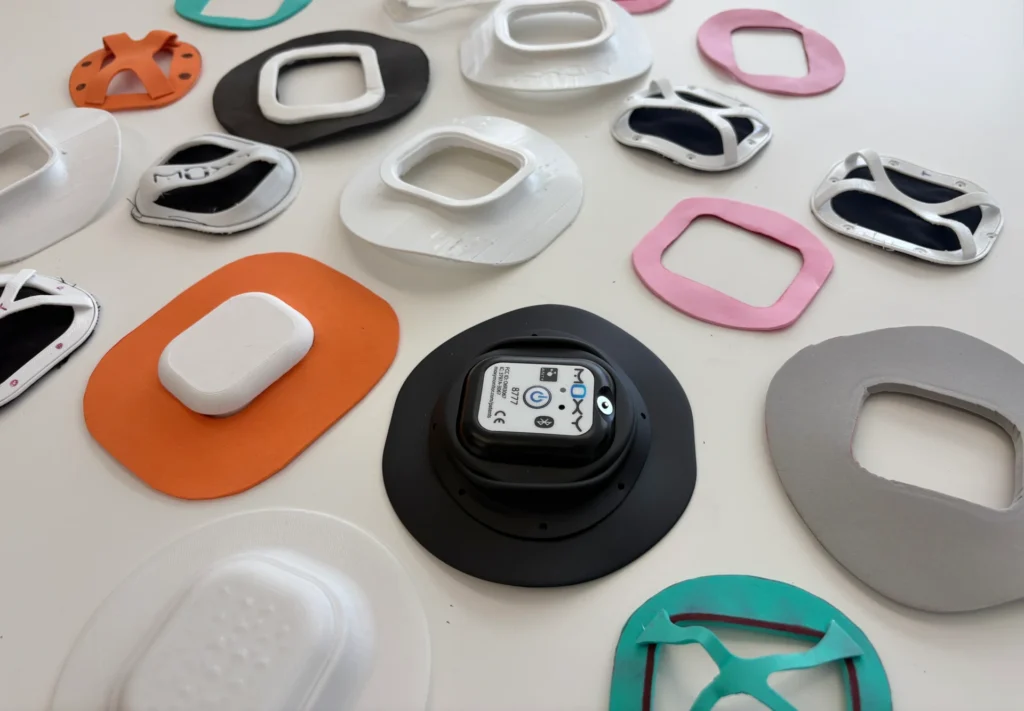
Design iterations of Moxy Monitor sensor light shield and mounting ring components
Design iterations of the Moxy Monitor light shield and ring system developed by Interwoven Design Group.

A:

When people see it, they pause for a moment. You can see the gears turning.

They look at it and say, “That is really good.”

A good design always looks easy in the end. It looks obvious—like of course that’s how it should work.

But it wasn’t obvious before. That’s the hallmark of great design. It looks simple, but getting there is not simple at all.

Q:

Engineers and designers don’t always speak the same language. What did you learn from working with Interwoven?

A:

One thing that stood out was that Interwoven had a system for arriving at creative solutions.

It wasn’t luck. There was a structured method for working through the problem.

I remember coming to the studio for a design session that lasted several hours. At one point I thought we might not get there—but the team kept working through the process.

Eventually the solution emerged.

As an engineer, I tend to focus heavily on functional requirements: the sensor has to stay in place, the data has to be accurate.

But there are other equally important needs—ease of use, adaptability, and even aesthetics.

These athletes earn millions of dollars. They wear expensive gear and jewelry. The product has to look good as well as function well.

Interwoven kept the entire picture in mind. If a product doesn’t meet all of those needs, it isn’t viable.

That was a really valuable part of the collaboration.

Final Thoughts

From laboratory technology to elite sports performance, Moxy Monitor represents a new way of understanding the body under load. By measuring muscle oxygen directly, athletes and coaches gain a window into physiology that traditional metrics often miss.

For Roger Schmitz, the journey has been one of constant iteration—engineering breakthroughs, scientific validation, and collaboration across disciplines.

And as wearable technology continues to evolve, the partnership between engineers, researchers, and designers will remain essential to turning complex ideas into tools athletes can use every day.

Check out the rest of our Spotlight series to hear more from leaders in the design industry. Sign up for our newsletter and follow us on Instagram and LinkedIn for design news, multi-media recommendations, and to learn more about product design and development!

Please reach out!

A Q&A with Functional Prototypes Expert Jacob Turetsky

A Q&A with Functional Prototypes Expert Jacob Turetsky

Spotlight articles shine a light on designers we admire, asking leaders in the field about their work and their design journey. This month’s Spotlight focuses on Functional Prototypes, the working, testing, problem-revealing models that turn ideas into something you can actually use. Functional prototypes rarely look polished. In fact, they often look wrong. But for Jacob Turetsky, that’s exactly the point.

Photo courtesy of Jacob Turetsky.

In this Spotlight interview, Jacob reflects on why functional prototypes matter, how they shape better products, and why failure when designed intentionally can be the most valuable outcome of all. In this conversation, he shares his process, his philosophy, and why functional prototypes are the backbone of meaningful product development.

Q:

Can you describe a moment when functional prototypes failed so clearly that it completely changed the direction of a project?

A:

While working at a large ergonomics-focused product company, we were developing a stacking chair that included a subtle amount of active recline. The idea was to rely on the frame of the chair itself to create that movement, without adding a complex mechanism.

I quickly built a prototype using CNC plywood panels to mimic a kind of spring action happening in the lower corner of the chair leg. Structurally, it made sense. But no matter what we did, every time someone leaned back, it would pull their shirt out of their pants if it was tucked in.

It turns out that recline needs to happen as close as possible to the human hip, which is difficult because that’s exactly where your body is already sitting. Our pivot point was dramatically far from where it needed to be. Even though it worked from a construction standpoint, it completely failed ergonomically.

That prototype forced us to abandon the idea of relying solely on the frame. We moved to more complicated mechanisms that brought the action closer to the body. We built another prototype that had a cluster of potential pivot points in the right region, full of holes and adjustable pins. We could move things a quarter inch at a time and test them with people.

It didn’t look like a finished product at all. It was messy and riddled with holes. But only after that process could we move forward and actually design the chair.

Q:

For readers who may not be familiar with the term, how do you define a functional prototype? What separates it from a model or visual mockup?

A:

To me, a functional prototype is about answering the riskiest questions as early as possible—when those questions are still cheap and easy to fix.

Every design has assumptions. A functional prototype lets you isolate those assumptions and test them before you layer on additional detail. It’s not about surface or appearance yet.

You’re looking at how components relate to each other, how the user interacts with the system, and whether the overall architecture works. Drawings and visual models can only take you so far. When you need to know how something actually feels, moves, or behaves, you have to build it.

Q:

Why are functional prototypes so critical, especially in hardware, wearables, and integrated systems?

A:

Design is hard. And the design process really demands that we get answers to the riskiest questions early.

Functional prototypes allow you to test assumptions when it’s still okay to pivot—when changes don’t feel like mistakes or failures. You’re able to ask, “What are we testing right now?” and “How many versions should we build?” before committing to anything expensive or overly refined.

That’s what functional prototyping is about for me. It’s figuring out how things relate—between components, between the product and the user—before worrying about how it looks.

Q:

What makes functional prototypes successful?

A:

The most important question is whether it gave you the answer you needed.

A successful functional prototype is very well scoped. If something isn’t being tested, it should be over-engineered so it doesn’t interfere with the result. You don’t want flex or instability in one area creating a “mushy” feeling somewhere else and confusing the outcome.

I actually think one of the most boring outcomes is when a prototype works exactly as expected and doesn’t reveal anything new. A good prototype should teach you something—ideally something unexpected.

Q:

You’ve worked across design engineering, product development, and hands-on prototyping. What first drew you toward making things work in the real world?

A:

It’s hard for me to point to one specific moment. It really feels like a chain of experiences mixed with some luck.

I grew up building things and tinkering. Early on, I wanted to be a car designer, which led me to industrial design and then to furniture. I had a furniture internship that went badly—I had a severe allergic reaction to exotic wood and realized I didn’t want to be milling cabinets every day.

At the same time, I was working on a medical design project at Pratt, and that completely shifted my perspective. I loved the process of taking an idea, pinning it up, building on someone else’s thinking, and then making something that actually assembled and functioned.

Suddenly, we were creating things that had never existed before. That was far more interesting to me than just building objects. I still build things with my hands, but now it’s more of a hobby. What really captured me was thinking through how mechanisms work and why one approach works better than another.

Q:

Looking back, what experience most shaped your approach to prototyping?

A:

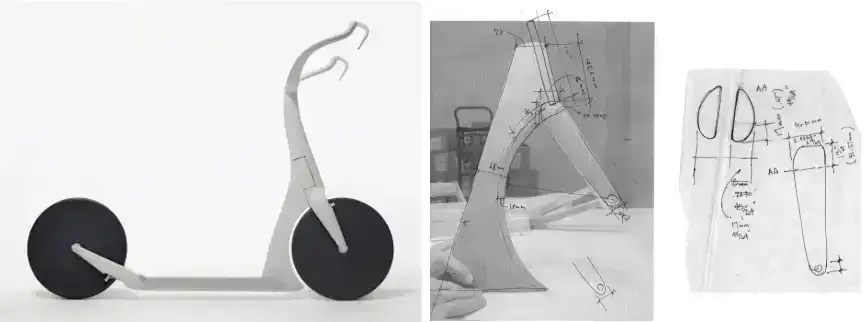
Early on, I learned that designing a prototype is often separate from designing the final product.

Sometimes you need a prototype that’s adjustable. You need to test different lengths, pivot points, or ranges of motion. In environments where the work is mission-critical and function-first, prototyping becomes central to the design process because you can only learn so much from drawings or static models.

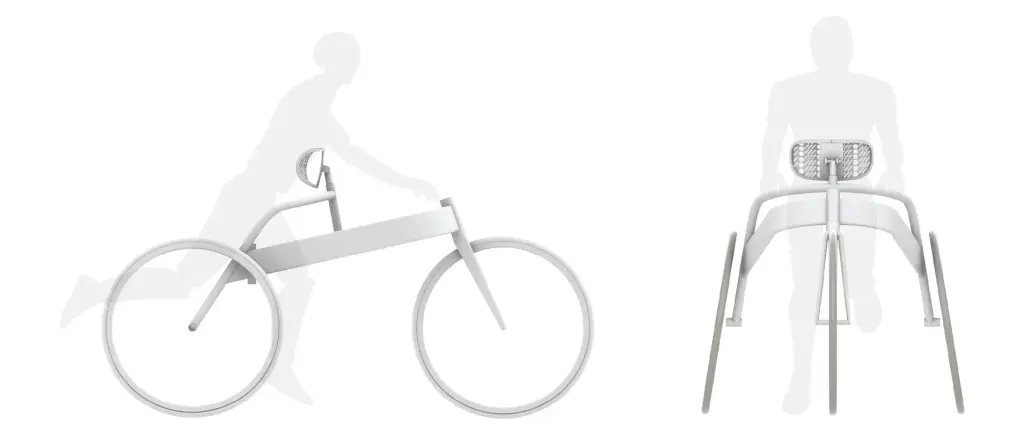
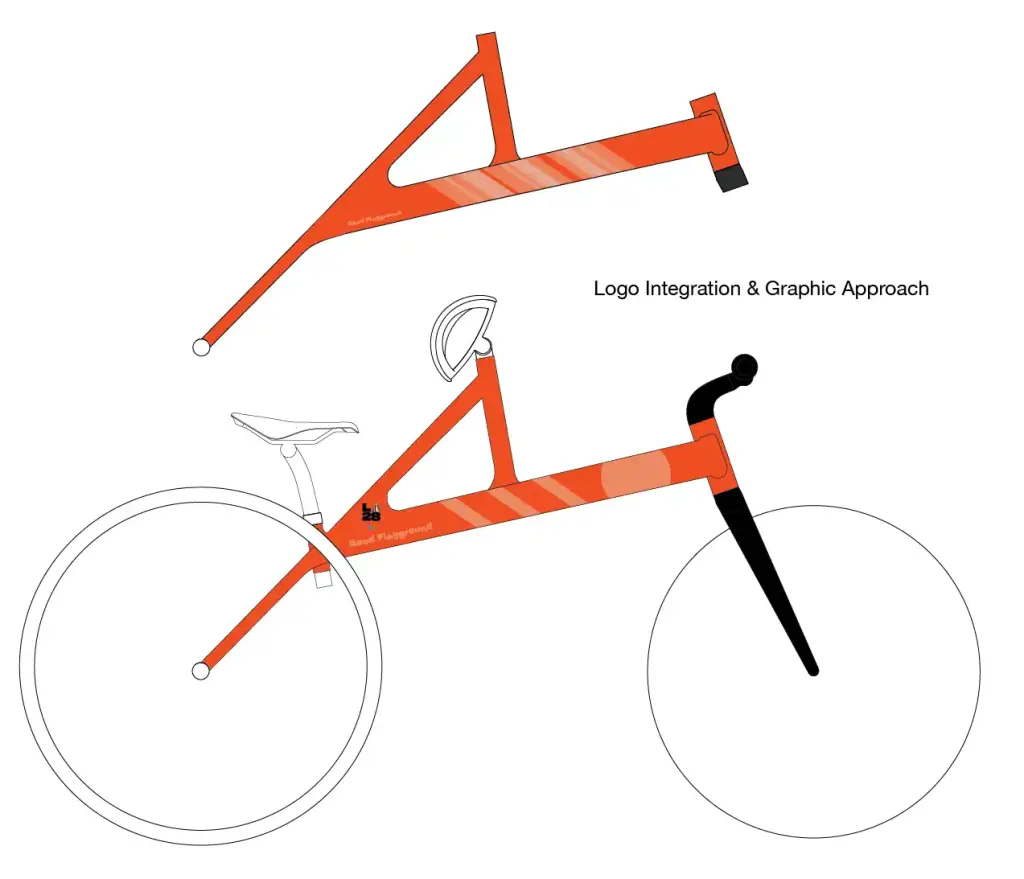
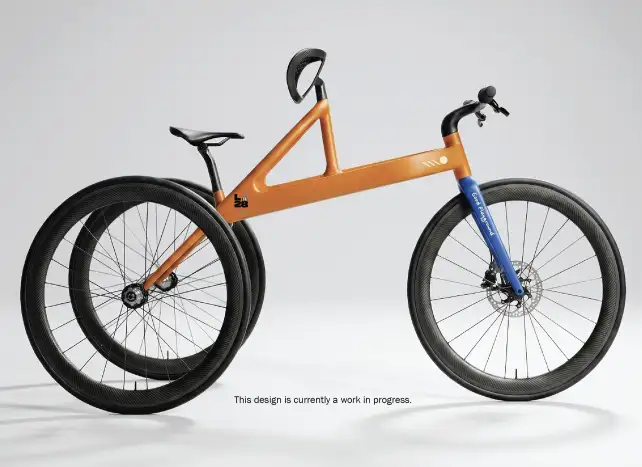
I remember working on a mobility device where everyone had different ideas about wheel placement and handlebar positions. We built a single, highly adjustable prototype using basic extrusions so we could test all of those ideas in one model.

That experience reinforced something I still believe strongly: functional prototypes don’t need to be beautiful, but they do need to be neat, intentional, and well thought through. In many ways, a functional prototype is its own design.

Q:

When starting a project, how do you go from an idea to a working prototype?

A:

I really trust the design process. I usually start by defining what I call the architecture of the product. That means stepping back from materials and finishes and asking more fundamental questions.

Is it vertical or horizontal? How do the components relate to each other and to the user? I try to answer the biggest questions first and then work inward, narrowing the scope as I go.

I’ve learned that trusting this process is far more reliable than waiting for a single stroke of genius. It’s also much more valuable to clients because it creates clarity early on.

Q:

You often work in environments where time is short and the stakes are high. How do you decide what “level of fidelity” is right for each stage of prototyping?

A:

A lot of it comes down to education. Some clients see a prototype that doesn’t work as a failure, so part of the job is framing prototyping as learning.

I always imagine being in the room when the prototype doesn’t work. If I’d feel embarrassed, then it’s too expensive or too high-fidelity for that stage. At that point, I’d rather rewind a week and build two cheaper versions.

Q:

How do you avoid perfecting things too early—or too late?

A:

It’s about knowing where you are in the process and what questions you’re supposed to be answering at that moment.

If your first prototype is machined out of aluminum, you’re in trouble. If it lights up and moves and does everything at once, you’ve gone too far. Early prototypes should be cheap, fast, and iterative.

Letting time, materials, and scope set boundaries is important. Those constraints help you avoid over-investing before you’ve learned what you need to learn.

Q:

You’ve collaborated with designers, engineers, and researchers. What makes a cross-disciplinary team successful when you’re building prototypes under real-world constraints?

A:

On cross-disciplinary teams, I often act as the hub. It’s important to let subject-matter experts focus on what they do best, but designers also need to advocate for the user.

You don’t need to become an expert in everything, but you do need to learn enough of each discipline’s language to collaborate effectively. Ultimately, the designer’s role is to fight for the human experience and make sure the system works for the person using it.

Q:

Looking ahead, what skills or mindsets will the next generation of prototypers need most?

A:

With tools like 3D printing, it’s very easy to add detail too early. You have to learn when to stop.

Print it. Test it. Move on. Don’t keep refining something in CAD just because you can. Earlier in my career, tools naturally limited how far you could go. Now you have to create those limits yourself.

Functional prototyping is about answering questions quickly—about getting things to work or not work as fast as possible. That mindset is more important than any single tool.

Check out the rest of our Spotlight series to hear more from leaders in the design industry. Sign up for our newsletter and follow us on Instagram and LinkedIn for design news, multi-media recommendations, and to learn more about product design and development!
Please reach out!

A Q&A with Technical Designer Ryu Tomita

A Q&A with Technical Designer Ryu Tomita

Spotlight articles shine a light on designers we admire, asking leaders in the field about their work and their design journey. This month’s Spotlight turns to Technical Design — the quiet, intricate work that transforms ideas into products that actually perform. We sat down with Ryu Tomita, a former member of the Interwoven team and one of the most precise technical designers we’ve had the pleasure of working with.

Photo courtesy of Ryu Tomita.

Ryu’s career bridges industrial design, soft goods, wearables, and fashion, his strength lies in the details: how materials behave, how components integrate, and how thoughtful engineering elevates user experience. In this conversation, he reflects on his path, his process, and the craft behind technical design.

Q:

You’ve had a really dynamic career, spanning fashion, industrial design, soft goods, and wearables. What originally drew you into design, and what keeps you excited about it now?

A:

I’ve always just loved making things—assembling pieces, figuring out how they fit together, and then seeing something take shape from nothing. That’s really the common denominator across all those fields. You start with an idea you can’t fully see yet, and through the process you discover what it becomes. That moment when everything comes together is incredibly satisfying. That’s what pulled me into design in the first place, and it’s still what keeps me excited about the work today.

Q:

When you think back on your time at Interwoven—it’s been about four years now, which is wild—what are the projects or moments that really shaped you? What have you carried into your current career?

A:

Ryu’s time at Interwoven taught him to design through ambiguity — a skill that continues to shape how he approaches complex technical challenges today.

Definitely HeroWear and working on the Apex. I had no idea what to expect because we were designing a product none of us had ever seen before, and we had almost no information in the beginning about what it should ultimately be. We had to research everything: going into warehouses, understanding what the end users were doing, what they needed, and how a solution might actually support them.

From there it was really just creating something step by step, little by little, and trusting the process—that if we kept working, we’d eventually land on the right product. Embracing that unknown, and not being afraid of it, was a huge learning experience for me.

Q:

Do you still approach your work the same way today—observing the user, embracing the unknown, and figuring things out step-by-step?

A:

I don’t have as many opportunities now to do direct user observation, but yes—the mindset is still the same. Embracing the unknown and taking things one step at a time was such a valuable lesson, and it’s something I still rely on in my work today.

Q:

What’s one thing people often misunderstand about the work of a technical designer?

A:

People sometimes get caught up in the tiny details and forget that technical designers always have to hold the big picture. You have to step back and think about how everything will come together and what the overall goal is—not just where a piece of Velcro lands. Remembering that bigger vision is really important.

Q:

How would you define technical design for someone outside our industry? People don’t always understand how valuable it is or how it differs from concept design or styling.

A:

Honestly, it’s hard to define because so much of it happens in your head. But for me,

Q:

Why do you think technical design matters, especially in categories like wearables, medical devices, and soft goods?

A:

Everyday items require a lot of thought because people use them constantly. Even something simple—like a belt or a holster—needs a slight curve so it hugs the hips instead of sitting straight. Those small decisions make a big difference when something is worn daily. Technical design is what makes those details functional and comfortable in real life.

Q:

You’re known for being incredibly detail-oriented—something I always appreciated in your work ethic. How does that mindset translate into the work you do now compared to more conceptual work?

A:

Believe it or not, I’m not as detail-oriented as I used to be. Things move so fast here that I’ve had to learn to let go of some of the minutiae. But I still think details are incredibly important. In tailoring, for example—where the hem goes, how the fusible is shaped inside a sleeve—those choices really affect how the final garment looks and performs. Even when the big picture matters more, the details still play a role in shaping the outcome.

Q:

Do you have an example—without breaking any NDAs—of a project where the details really drove the success of the design, or where you had to let go of details?

A:

I do, actually. I’m looking at the sample right now. We were working on a pleated dress, and the director wanted it to fit closely around the hips. With individually pleated pieces, it’s much easier to sew everything straight. But if you add a small dart to each pleat, the dress hugs the body much better. It was more work for the seamstresses and definitely more tedious, but it made a noticeable difference in the final result.

Q:

When you start a new project with big technical unknowns, where do you begin? And how is that process different from the product-focused work you did at Interwoven?

A:

Fundamentally, it’s the same. You lay out all the pieces, look at the sketch, and try to understand the big picture first—how the shape forms, where you need more volume, how things come together. Then you work through the smaller issues as you see the prototype.

The difference now is scale. In fashion, I’m working on collections with 120–140 styles, split between two people, instead of a single deep-dive product. But the mindset is the same: start broad, then solve the details.

Q:

What kinds of fabrics or garment types do you prefer working with?

A:

Wovens. I’ve learned to appreciate them more. Knits can be easier because there’s less room for error, but I work with both.

Q:

Tell me about your iterative process. How do you move from prototype to final sample?

A:

We usually make an initial prototype in a comparable fabric—we almost never use muslin. We fit it, review it, and make adjustments. If there’s a major design change, we start over. If not, we refine it and then move into a final salesman sample.

Q:

How much of the pattern work do you handle, and how long does a garment take?

A:

I draft from start to finish. A simple dress with four or five panels might take two and a half to three hours. A jacket could take three-quarters of a day to a full day. It really depends on the style.

Understanding the hidden architecture of a product — whether a wearable or a tailored jacket — is where technical design becomes almost invisible, yet absolutely essential.

Q:

Most people don’t realize how much inner structure goes into a tailored garment. Can you walk us through that?

A:

I didn’t realize it either until I opened up a men’s jacket. There’s a lot inside: canvas, padded chest pieces, Heimo, shoulder pads to hold the shape, sleeve structuring, and fusible layers that add support.

The heaviest structure is on the upper body—chest and shoulders. Fusible can run through the whole front and usually across the back shoulder blade. Anywhere there’s a turned hem, you’ll often find fusible to hold the shape.

Q:

Is that construction similar between men’s and women’s garments?

A:

The sewing is similar, but the fit is completely different because of physiological differences—especially the bust. You have to alter patterns significantly to account for that.

Q:

Can you give an example of a small technical detail that makes a big impact?

A:

A two-piece sleeve. People don’t notice it, but it feels so much more natural because the sleeve can actually follow the bend of your arm. A one-piece sleeve is basically a tube—it doesn’t guide the arm forward in the same way.

Q:

What’s next for you? What are you exploring personally right now?

A:

I’ve been experimenting with denim washes at home—doing potassium permanganate treatments on my patio, which is probably dangerous but fun. There’s so much science behind wash techniques that I never knew. I’m not inventing a new wash, but I’m trying to create my own personality in how the denim wears and ages.

Q:

What advice would you give to young designers starting out in technical design?

A:

I’d say it’s important to keep one eye on the bigger picture while you’re deep in the details. You have to be able to zoom out and look at the whole garment or product, then zoom back in to solve the small problems. It took me a while to learn that balance, but having both perspectives is essential.

Q:

Last question: if you had to start all over again, would you still choose to be a designer?

A:

Yes, absolutely.

Check out the rest of our Spotlight series to hear more from leaders in the design industry. Sign up for our newsletter and follow us on Instagram and LinkedIn for design news, multi-media recommendations, and to learn more about product design and development!

Please reach out!