Designing for Manufacture: Inside the Soft Goods Tech Pack

Designing for Manufacture: Inside the Soft Goods Tech Pack

From Concept to Creation

Every great product begins with a spark of creativity—a sketch, a mood board, a prototype. But in order for that idea to become a physical object, it needs more than inspiration. It needs precision. Technical design is the step that translates vision into manufacturable reality, turning abstract concepts into clear instructions that factories can execute.

At the heart of this process is the technical design pack, or “tech pack.” It is more than just a set of drawings. A tech pack is a comprehensive roadmap and outlines exactly how a product is built, down to the smallest stitch, seam, or material choice. Without it, even the most innovative wearable or softgoods design are at risk being misinterpreted or poorly executed in production.

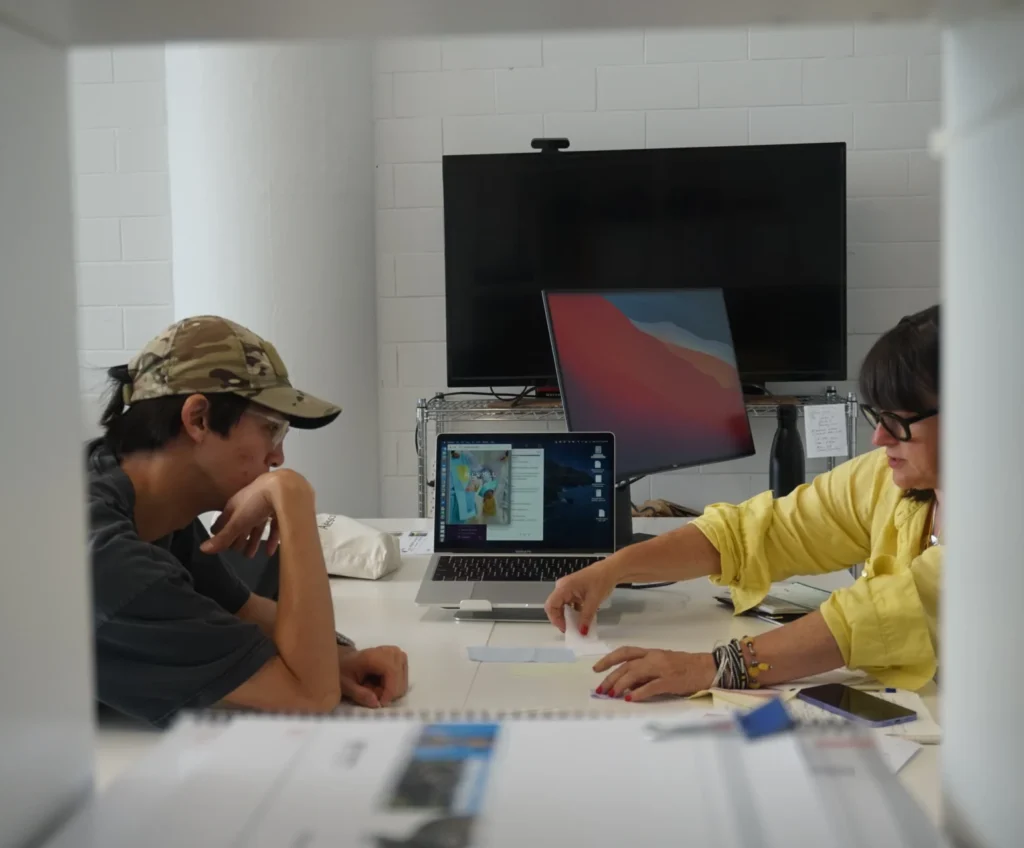
At Interwoven Design, we view technical design as a creative act in itself. It is a discipline that ensures ideas retain their integrity as they move from the studio to the factory floor. In this article, we outline what a tech pack includes, why it matters, and how we use it to bridge the gap between concept and creation.

What is a Technical Design Pack?

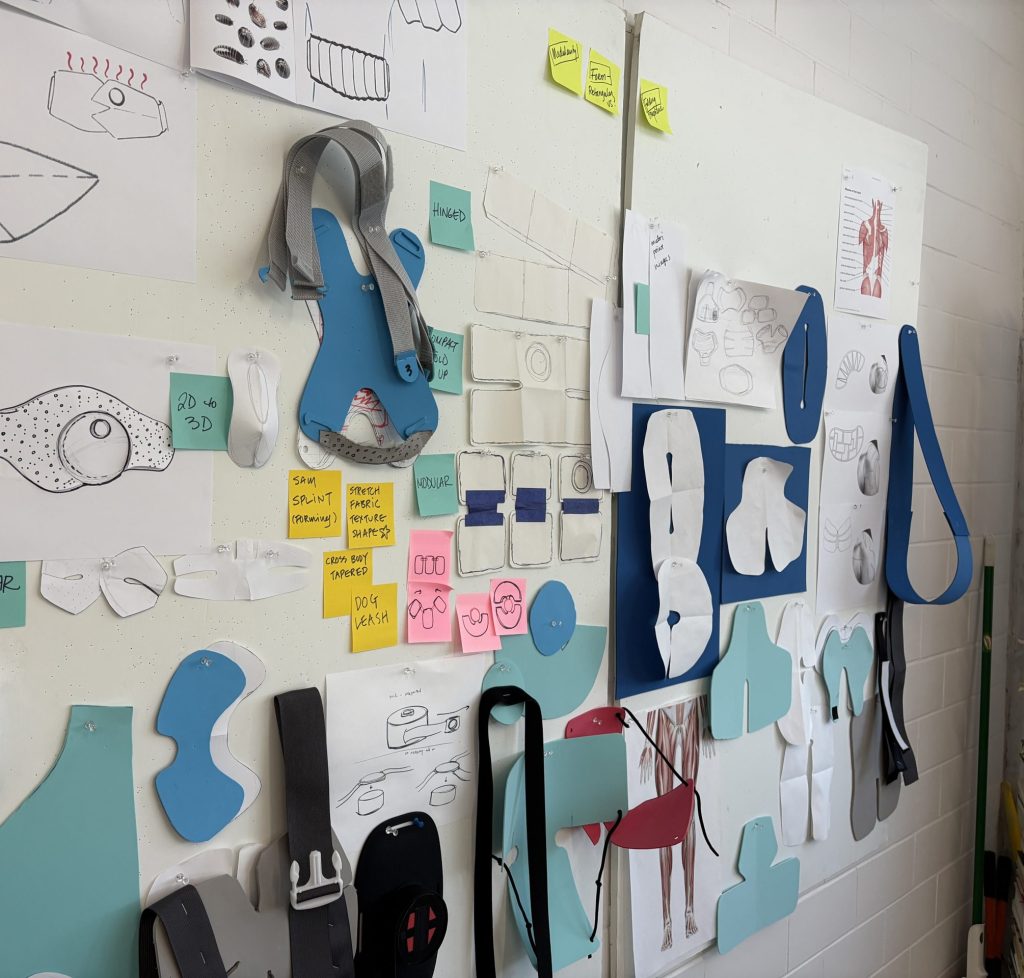
A technical design pack (tech pack) is the universal language between designers and manufacturers. It ensures that everyone—from patternmakers to production partners—shares the same understanding of how a product is meant to look, feel, and function. Think of it as the blueprint for softgoods and wearable technology. A typical tech pack includes:

  • Technical Drawings & Callouts
    Precise line drawings with notes on construction details, stitching, seams, hardware, and placement.
  • Bill of Materials (BOM)
    A complete breakdown of all materials and components. It includes fabrics, foams, fasteners, sensors—required to build the product.
  • Measurements & Grading
    Dimensions, tolerances, and size variations to ensure consistent fit across different body types or product sizes.
  • Assembly Instructions
    Step-by-step construction methods that guide how pieces come together, whether sewn, bonded, or mechanically fastened.
  • Testing & Performance Standards
    Requirements for durability, washability, strength, or medical-grade compliance, depending on the product category.
  • Labeling & Branding
    Placement of logos, care instructions, or certifications that connect the product to its brand identity and compliance needs.
Perci Emergency Preparedness Vest Branding

At its core, the tech pack is about clarity and accountability. It creates a shared framework where manufacturers know exactly what to deliver—and designers can trust the product will match their intent.

Why Technical Design Matters

Without a clear technical foundation, even the most brilliant creative concept risks breaking down in production. Technical design ensures that wearable products are not only beautiful and functional but also manufacturable, repeatable, and safe for users.

For softgoods and wearable technology, this precision becomes even more critical:

  • Integration of Textiles and Hardware
    A garment that incorporates sensors or mechanical components must balance flexibility, comfort, and durability. Tech packs detail how fabrics stretch, where reinforcements are placed, and how electronics are housed without compromising user comfort.
  • Consistency at Scale
    A prototype may be hand-built with care, but manufacturers need exact instructions to replicate that quality across hundreds or thousands of units. Tech packs standardize stitching, finishes, and tolerances so every piece delivers the same performance.
  • Risk Reduction
    By spelling out materials, testing requirements, and construction methods, technical design minimizes costly production errors and prevents miscommunication with suppliers.
  • User-Centered Reliability
    In wearables, failure isn’t just inconvenient—it can mean loss of trust. Technical documentation ensures durability and reliability in real-world contexts, whether that’s a medical device worn 24/7 or a back-assist exosuit in a warehouse.

In short, technical design translates creativity into reality. It bridges the gap between the designer’s vision and the user’s everyday experience, ensuring that innovation holds up in practice.

Inside an Interwoven Design Tech Pack

Every product we design—whether it’s a medical brace or adaptive lingerie—requires a set of technical design assets that guide manufacturers from concept to production.

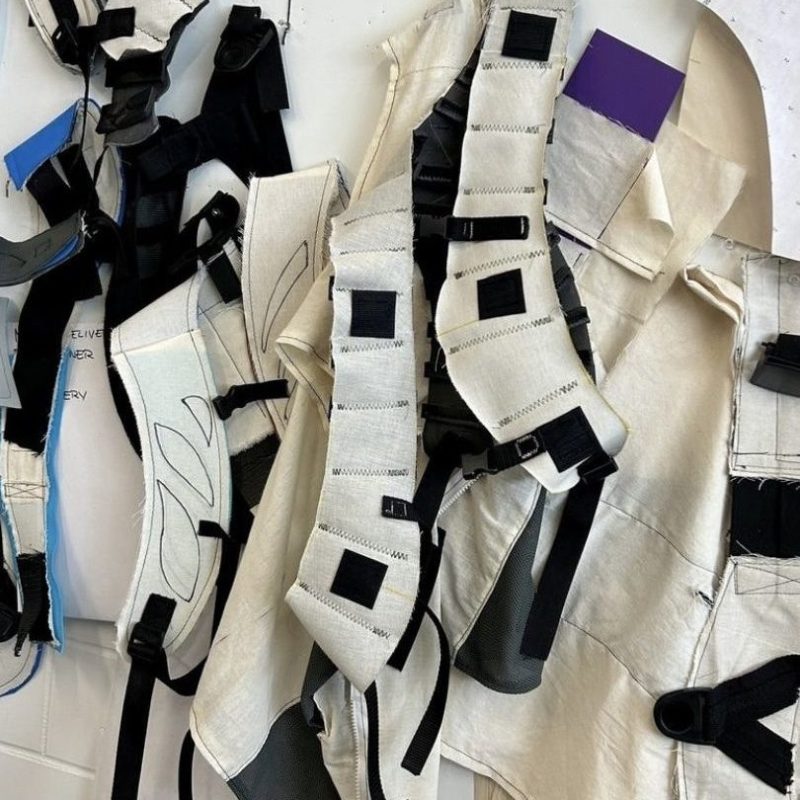
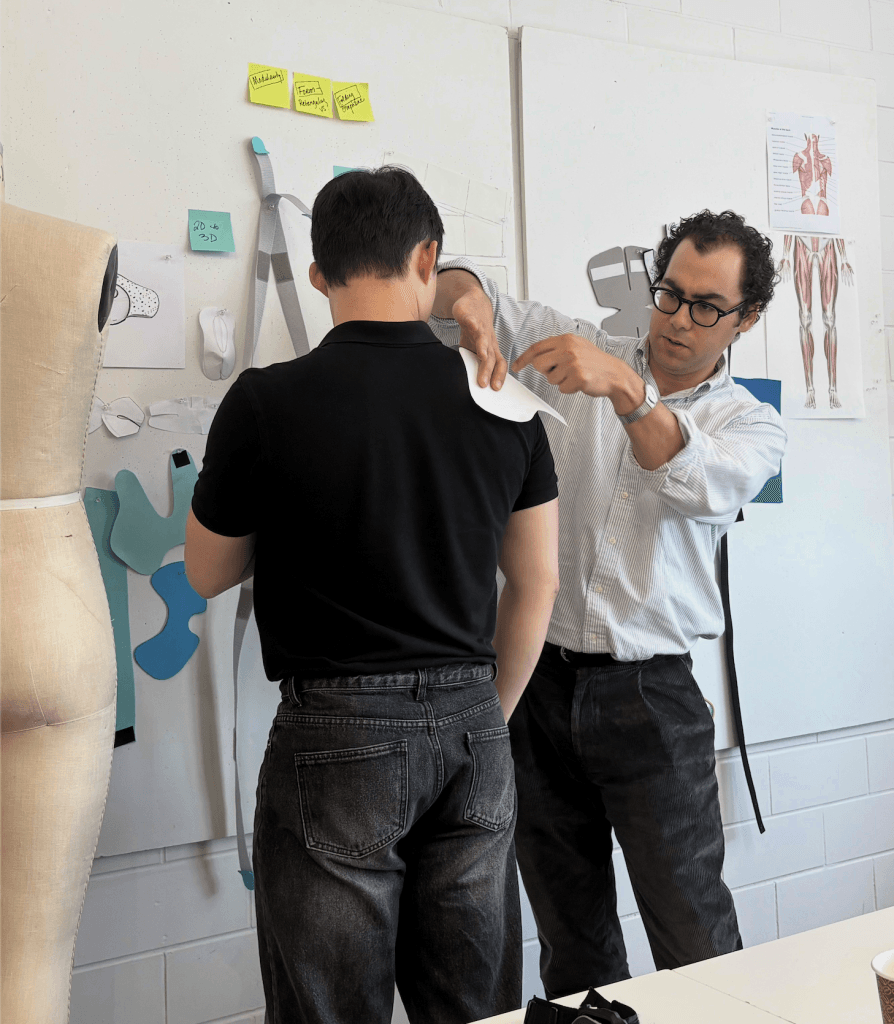
These documents are roadmaps that ensure the integrity of the design across fit, function, and user experience. This matters even more in the case studies below, where we integrate hard goods and soft goods within the same wearable. Alongside the tech pack, we create a high-fidelity mockup that serves as a companion to the technical specs, bringing them into three dimensions and demonstrating complex construction at scale.

Case Study 1: Breg CrossRunner™ Soft Knee Brace

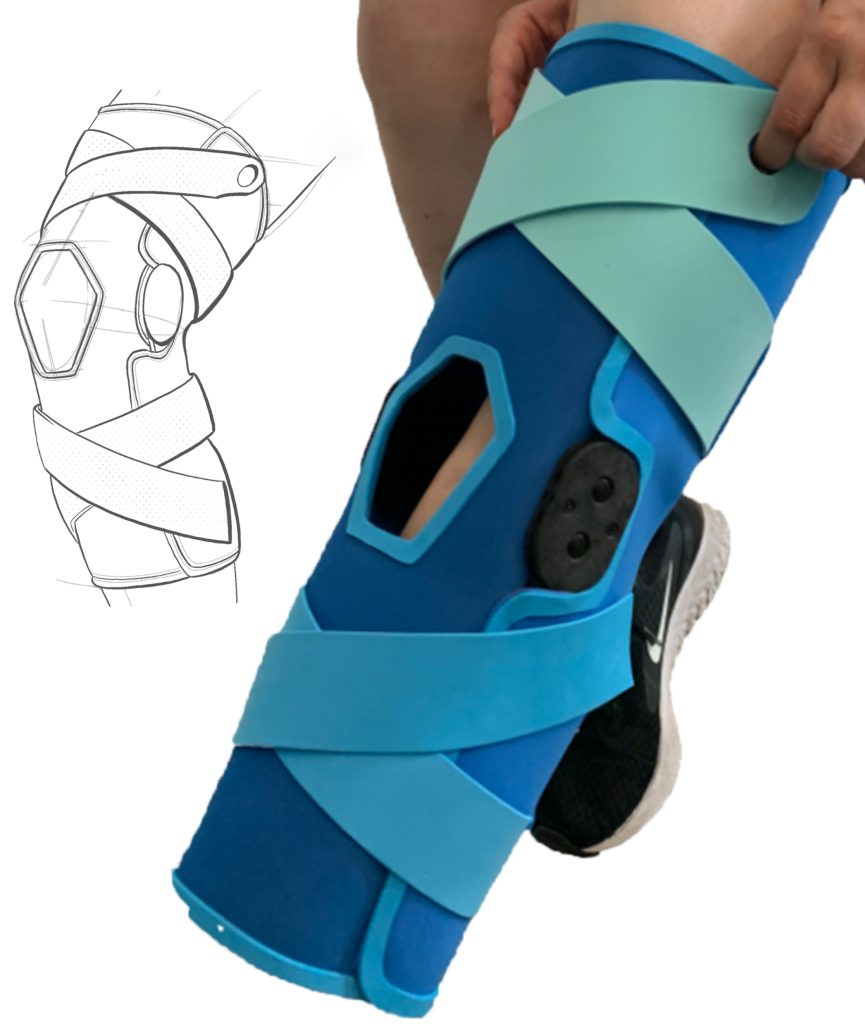
For the Breg CrossRunner™ Soft Knee Brace, precision was non-negotiable. The brace needed to fit a wide range of leg shapes while maintaining consistent hinge placement—essential for safe, effective joint support.

Interwoven Design developed custom leg forms to represent each size, then engineered a size grading system that scaled patterns evenly without shifting key hinge locations. We created multi-layered technical drawings to capture every detail of the brace’s flaps, straps, and fabric panels. By translating these patterns into CAD and supporting the manufacturing team through sample reviews, we ensured the final product matched the vision: a premium brace that’s both supportive and comfortable.

Case Study 2: Even Adaptive Lingerie

For Even Adaptive lingerie, the tech pack became the bridge between inclusive innovation and manufacturable detail. Alongside garment design, we developed a magnetized clasp system that users could operate with one hand.

Our industrial design and garment design teams worked in parallel, using 3D-printed prototypes with embedded magnets to test usability, strength, and comfort. We documented each iteration in technical drawings and specifications so manufacturers clearly understood how to integrate the clasp into the fabric without compromising softness or fit. The result was a low-profile, reliable closure that delivered on both aesthetics and accessibility. 

From Documentation to Collaboration

At Interwoven Design, we see tech packs not only as instructions for manufacturers, but as living tools. These align every stakeholder in the process, from clients and engineers to production partners. A strong pack captures the full intent of a design: the dimensions, construction methods, materials, finishes, and functional details that define how a product should look, feel, and perform. By consolidating all of this into a single, reliable reference, everyone involved—from brand stakeholders reviewing the concept to factory technicians cutting patterns—works from the same shared vision.

But we also know that design doesn’t end at handoff. Even the most detailed tech pack is only part of the equation. Manufacturing is an iterative process, and unexpected challenges can arise when ideas meet real-world production. That’s why success depends on pairing precision documentation with open, ongoing relationships with manufacturers. At Interwoven, we don’t just pass off a tech pack. We stay engaged throughout production, reviewing prototypes, answering questions, and refining details.

This collaborative approach helps bridge logistical gaps, ensures that subtle but important design decisions are preserved, and reduces costly missteps. A well-crafted tech pack minimizes guesswork, but it’s the combination of clear documentation and active partnership that guarantees the best outcomes: products that deliver on both creative vision and practical performance.

Precision as a Creative Act

Technical design is where creativity transforms into reality. The sketches, prototypes, and ideas that spark innovation become manufacturable products through careful documentation and technical rigor. At Interwoven Design, our expertise lies in creating these assets with the same care we bring to concepting and design. So, we ensure every product we hand off is made with accuracy, quality, and intent.

If you’re looking to take your concept from an idea to a market-ready product, we’d love to partner with you. With our vision and professional-grade technical documentation, we turn your ideas into fully realized products.

Interwoven Design is a design consultancy positioned at the intersection of soft goods and wearable technology. Sign up for our newsletter and follow us on Instagram and LinkedIn to learn more about design and development! 

A Q&A with Technical Designer Ryu Tomita

A Q&A with Technical Designer Ryu Tomita

Spotlight articles shine a light on designers we admire, asking leaders in the field about their work and their design journey. This month’s Spotlight turns to Technical Design — the quiet, intricate work that transforms ideas into products that actually perform. We sat down with Ryu Tomita, a former member of the Interwoven team and one of the most precise technical designers we’ve had the pleasure of working with.

Photo courtesy of Ryu Tomita.

Ryu’s career bridges industrial design, soft goods, wearables, and fashion, his strength lies in the details: how materials behave, how components integrate, and how thoughtful engineering elevates user experience. In this conversation, he reflects on his path, his process, and the craft behind technical design.

Q:

You’ve had a really dynamic career, spanning fashion, industrial design, soft goods, and wearables. What originally drew you into design, and what keeps you excited about it now?

A:

I’ve always just loved making things—assembling pieces, figuring out how they fit together, and then seeing something take shape from nothing. That’s really the common denominator across all those fields. You start with an idea you can’t fully see yet, and through the process you discover what it becomes. That moment when everything comes together is incredibly satisfying. That’s what pulled me into design in the first place, and it’s still what keeps me excited about the work today.

Q:

When you think back on your time at Interwoven—it’s been about four years now, which is wild—what are the projects or moments that really shaped you? What have you carried into your current career?

A:

Ryu’s time at Interwoven taught him to design through ambiguity — a skill that continues to shape how he approaches complex technical challenges today.

Definitely HeroWear and working on the Apex. I had no idea what to expect because we were designing a product none of us had ever seen before, and we had almost no information in the beginning about what it should ultimately be. We had to research everything: going into warehouses, understanding what the end users were doing, what they needed, and how a solution might actually support them.

From there it was really just creating something step by step, little by little, and trusting the process—that if we kept working, we’d eventually land on the right product. Embracing that unknown, and not being afraid of it, was a huge learning experience for me.

Q:

Do you still approach your work the same way today—observing the user, embracing the unknown, and figuring things out step-by-step?

A:

I don’t have as many opportunities now to do direct user observation, but yes—the mindset is still the same. Embracing the unknown and taking things one step at a time was such a valuable lesson, and it’s something I still rely on in my work today.

Q:

What’s one thing people often misunderstand about the work of a technical designer?

A:

People sometimes get caught up in the tiny details and forget that technical designers always have to hold the big picture. You have to step back and think about how everything will come together and what the overall goal is—not just where a piece of Velcro lands. Remembering that bigger vision is really important.

Q:

How would you define technical design for someone outside our industry? People don’t always understand how valuable it is or how it differs from concept design or styling.

A:

Honestly, it’s hard to define because so much of it happens in your head. But for me,

Q:

Why do you think technical design matters, especially in categories like wearables, medical devices, and soft goods?

A:

Everyday items require a lot of thought because people use them constantly. Even something simple—like a belt or a holster—needs a slight curve so it hugs the hips instead of sitting straight. Those small decisions make a big difference when something is worn daily. Technical design is what makes those details functional and comfortable in real life.

Q:

You’re known for being incredibly detail-oriented—something I always appreciated in your work ethic. How does that mindset translate into the work you do now compared to more conceptual work?

A:

Believe it or not, I’m not as detail-oriented as I used to be. Things move so fast here that I’ve had to learn to let go of some of the minutiae. But I still think details are incredibly important. In tailoring, for example—where the hem goes, how the fusible is shaped inside a sleeve—those choices really affect how the final garment looks and performs. Even when the big picture matters more, the details still play a role in shaping the outcome.

Q:

Do you have an example—without breaking any NDAs—of a project where the details really drove the success of the design, or where you had to let go of details?

A:

I do, actually. I’m looking at the sample right now. We were working on a pleated dress, and the director wanted it to fit closely around the hips. With individually pleated pieces, it’s much easier to sew everything straight. But if you add a small dart to each pleat, the dress hugs the body much better. It was more work for the seamstresses and definitely more tedious, but it made a noticeable difference in the final result.

Q:

When you start a new project with big technical unknowns, where do you begin? And how is that process different from the product-focused work you did at Interwoven?

A:

Fundamentally, it’s the same. You lay out all the pieces, look at the sketch, and try to understand the big picture first—how the shape forms, where you need more volume, how things come together. Then you work through the smaller issues as you see the prototype.

The difference now is scale. In fashion, I’m working on collections with 120–140 styles, split between two people, instead of a single deep-dive product. But the mindset is the same: start broad, then solve the details.

Q:

What kinds of fabrics or garment types do you prefer working with?

A:

Wovens. I’ve learned to appreciate them more. Knits can be easier because there’s less room for error, but I work with both.

Q:

Tell me about your iterative process. How do you move from prototype to final sample?

A:

We usually make an initial prototype in a comparable fabric—we almost never use muslin. We fit it, review it, and make adjustments. If there’s a major design change, we start over. If not, we refine it and then move into a final salesman sample.

Q:

How much of the pattern work do you handle, and how long does a garment take?

A:

I draft from start to finish. A simple dress with four or five panels might take two and a half to three hours. A jacket could take three-quarters of a day to a full day. It really depends on the style.

Understanding the hidden architecture of a product — whether a wearable or a tailored jacket — is where technical design becomes almost invisible, yet absolutely essential.

Q:

Most people don’t realize how much inner structure goes into a tailored garment. Can you walk us through that?

A:

I didn’t realize it either until I opened up a men’s jacket. There’s a lot inside: canvas, padded chest pieces, Heimo, shoulder pads to hold the shape, sleeve structuring, and fusible layers that add support.

The heaviest structure is on the upper body—chest and shoulders. Fusible can run through the whole front and usually across the back shoulder blade. Anywhere there’s a turned hem, you’ll often find fusible to hold the shape.

Q:

Is that construction similar between men’s and women’s garments?

A:

The sewing is similar, but the fit is completely different because of physiological differences—especially the bust. You have to alter patterns significantly to account for that.

Q:

Can you give an example of a small technical detail that makes a big impact?

A:

A two-piece sleeve. People don’t notice it, but it feels so much more natural because the sleeve can actually follow the bend of your arm. A one-piece sleeve is basically a tube—it doesn’t guide the arm forward in the same way.

Q:

What’s next for you? What are you exploring personally right now?

A:

I’ve been experimenting with denim washes at home—doing potassium permanganate treatments on my patio, which is probably dangerous but fun. There’s so much science behind wash techniques that I never knew. I’m not inventing a new wash, but I’m trying to create my own personality in how the denim wears and ages.

Q:

What advice would you give to young designers starting out in technical design?

A:

I’d say it’s important to keep one eye on the bigger picture while you’re deep in the details. You have to be able to zoom out and look at the whole garment or product, then zoom back in to solve the small problems. It took me a while to learn that balance, but having both perspectives is essential.

Q:

Last question: if you had to start all over again, would you still choose to be a designer?

A:

Yes, absolutely.

Check out the rest of our Spotlight series to hear more from leaders in the design industry. Sign up for our newsletter and follow us on Instagram and LinkedIn for design news, multi-media recommendations, and to learn more about product design and development!

Please reach out!

Building Ideas: The Role of Conceptual Mock-Ups in Soft Goods Design

Building Ideas: The Role of Conceptual Mock-Ups in Soft Goods Design

Thinking in Three Dimensions

Design rarely happens in a straight line. In soft goods design, where products must conform to the body, support movement, and feel comfortable in real-world use, mock-ups are especially crucial. Subtle differences in fit, tension, or material behavior can completely change how a garment or wearable feels, yet these nuances are often invisible in drawings or CAD renderings. Rough 3D models allow designers to evaluate ergonomics, assess how straps, seams, or closures interact with the body, and ensure that the product performs intuitively and comfortably before a higher fidelity prototype is made.

While drawings and digital files are powerful tools, they can only go so far. Sometimes the only way to know whether a curve feels natural in the hand, a hinge aligns with joint movement, or a strap sits comfortably across the body is to build it in the real world, however roughly. That’s where conceptual mock-ups come in. These early, low-fidelity models aren’t meant to be polished or permanent; they’re tools for thinking. They expose hidden challenges, spark unexpected directions, and make the abstract tangible. Just as importantly, they allow both designers and clients to engage with an idea in ways that are more intuitive than a flat image or diagram could ever provide.

At Interwoven Design, we see mock-ups as a bridge between imagination and execution. Building in 3D is how we explore questions that sketches can’t answer, and it’s how we make sure our concepts are grounded in the realities of human use. For us, mock-ups aren’t just a stage in the process; they’re an act of curiosity, iteration, and craft that defines how ideas come to life. In this Insight article, we’ll discuss the value of mock-ups, outline various methods of making them, and share three case studies of studio projects that showcase the ability of mock-ups to elevate the design process at every level of fidelity. 

Why We Build to Think

Design is, at its core, a process of discovery. Even the most carefully considered sketch or digital model can miss details that only emerge when something is built in physical space. By working in three dimensions, designers invite surprise into the process, sometimes confirming assumptions, other times revealing issues that couldn’t have been predicted on paper.

Conceptual mock-ups are powerful because they shift the question from “Does this look right?” to “Does this work in real life?” A quick foam cut-out can reveal that a button is too far for the thumb to reach, or that a curve looks elegant in renderings but feels awkward when held. Fabric mock-ups can show how material drapes, stretches, or resists movement, helping teams anticipate comfort and durability before investing in higher-fidelity prototypes.

Just as importantly, building early and often keeps the design process agile. A mock-up doesn’t have to be precious; in fact, its roughness is part of the point. The less time invested, the easier it is to test, critique, and move on. This freedom encourages exploration rather than perfectionism, giving space for bolder ideas to emerge and evolve.

At Interwoven Design, we use mock-ups not just to validate concepts, but to provoke questions. What happens if this element shifts by an inch? How does the design change if the material is softer, stiffer, lighter? Every build is a chance to learn something new, and often those discoveries become the foundation for the next round of design.

Methods of Mock-Up Making

There’s no one right way to make a conceptual mock-up, only the method that best suits the question at hand. Also, we never make just one! Sometimes the goal is to understand form and scale, other times it’s about testing flexibility, ergonomics, or how a feature behaves when it meets the body. Because of this, the process often spans a wide spectrum of materials and techniques, from the scrappiest cardboard approximation to precision 3D prints.

Paper and Foam Models
When speed matters, nothing beats the simplicity of paper, foam, or cardboard. These materials are quick to cut, shape, and tape together, allowing designers to test proportions, angles, and spatial relationships in minutes. They’re the fastest way to move an idea out of a sketchbook and into the real world. At Interwoven Design, we love paper as a tool, as it behaves a lot like a textile.

Fabric and Soft Goods Constructions
For wearables or textile-based products, mock-ups made from muslin, mesh, or other inexpensive fabrics can reveal how a design drapes, folds, and moves against the body. These rough-sewn models often expose ergonomic insights that drawings can’t capture, like how a strap pulls across the shoulder or how a pocket can be accessed in motion.

Digital-to-Physical Hybrids
Sometimes, precision is the priority. Tools like 3D printing, laser cutting, or CNC machining allow teams to translate digital models into physical parts with exact dimensions. These methods are especially valuable when testing components that interact mechanically or when verifying that multiple parts fit together as intended. Like the design process itself, mock-up making is rarely linear. A paper sketch model may inspire a fabric iteration, which then sparks a 3D-printed test. Each build answers some questions while raising others, creating a feedback loop that moves the design steadily closer to resolution.

At Interwoven Design, we embrace this iterative mix—shifting tools and materials as needed to keep ideas moving and evolving. We are nearly always combining soft goods and hard goods in the same product, and we use a range of construction methods to build the components needed to test the interaction between the two.

Mock-Ups as Communication Tools

Mock-ups are more than internal design aids, they are powerful tools for communication. A sketch can suggest form, and a CAD file can demonstrate function, but nothing replaces the clarity of a physical object. When stakeholders can hold, wear, or manipulate a mock-up, abstract ideas become concrete. The conversation shifts from speculation to lived experience.

For clients, this means gaining confidence that the product is on the right track. Engineers can assess feasibility, materials, and assembly details. Users, meanwhile, provide feedback that is grounded in the reality of use rather than imagination. Each group engages with the same artifact, but through their own lens, creating a richer and more specific dialogue.

This shared understanding is critical. By aligning expectations early in the process, mock-ups reduce the risk of costly misunderstandings later. Questions of scale, ergonomics, or usability are resolved in the physical world rather than in post-production fixes. In this way, mock-ups not only accelerate collaboration but also protect both the integrity of the design and the efficiency of the project timeline.

Case Studies: Mock-Ups in Action

Case Study 1: The Breg CrossRunner™ Soft Knee Brace

When Breg set out to reinvent their soft knee brace line, they partnered with Interwoven Design to merge engineering precision with human-centered comfort. The challenge was to create a premium brace that could address a wide spectrum of injuries and instabilities while remaining easy to use, breathable, and adaptable to different body types. 

Early in the process, mock-ups played a critical role: foam models and fabric constructions allowed the team to explore how hinges aligned with anatomy, how straps wrapped and adjusted, and how materials compressed or released tension in motion.

These quick builds revealed insights that sketches alone couldn’t capture, helping refine ergonomics, donning sequences, and user comfort long before committing to a final design direction. By iterating through mock-ups, the team established a design language that balanced sleek aesthetics with technical performance. The result, the Breg CrossRunner™ Soft Knee Brace, exemplifies how physical mock-ups can bridge vision and execution, ensuring that every detail—fit, function, and feel—was tested and validated in three dimensions.

Case Study 2: The Perci Emergency Preparedness Vest

When INVICTA Ready set out to design a product that could help families face the growing threat of natural disasters, they partnered with Interwoven Design to create something intuitive, wearable, and life-saving: the Perci Emergency Preparedness Vest. The challenge was complex: developing a garment that could store and organize critical supplies, remain comfortable during rapid evacuations, and be universally adaptable across diverse users. 

Early mock-ups were essential in shaping the vest’s design: muslin and fabric prototypes allowed the team to test how tools and essentials could be organized into categories, ensuring each pocket was ergonomic, accessible, and balanced against the body.

These rough builds revealed whether wearers could move freely—carrying a child, lifting luggage, or running—without being restricted by bulk or weight distribution. These iterative mock-ups uncovered design insights that made the vest both practical and confidence-inspiring: reflective icons and graphic labeling clarified what each pocket contained, while ergonomic patterning and stretch panels improved comfort and mobility. The inclusion of a collapsible hood, internal storage systems, and integration with a companion mobile app extended its functionality, making the vest a true system for preparedness rather than just a garment.

Recognized internationally, the Perci Vest won Gold in Industrial and Life Science Design – Safety Designs and Bronze in Design for Society at the 2022 International Design Awards (IDA). The project underscores the value of mock-ups as more than just prototypes: they were the means of simulating real-world scenarios, uncovering challenges, and validating design decisions. For the Interwoven Design delivery team, building in three dimensions was the key to transforming the abstract concept of “preparedness” into a product that is intuitive, wearable, and empowering in moments of crisis.

Case Study 3: The HeroWear Apex Exosuit

Warehouse work places enormous strain on the body. Long shifts, hot environments, and constant bending and lifting often leave workers fatigued and injured, especially in the lower back. When a team from Vanderbilt’s Center for Rehabilitation Engineering & Assistive Technology developed a proof-of-concept for a mechanical exoskeleton, they partnered with Interwoven Design to transform their idea into a fully commercialized product: the HeroWear Apex Exosuit. Mock-ups were central to the exosuit’s design process. Our delivery team built garment and hardware mock-ups to test placement of mechanical components, optimize body heat management, and fine-tune ergonomics in real time.

Dozens of soft goods mock-ups were created and tested, shaping the design’s modular fit system, strength adjustability, and range of motion. By iterating through muslin mock-ups to increasingly high fidelity prototypes, the team ensured that the exosuit was not only effective in reducing strain but also intuitive and comfortable enough to gain worker acceptance, an essential factor for adoption on the job floor.

The final design balances technology with wearability: lightweight, breathable, and easy to don and doff, the Apex relieves more than 50 pounds of strain from the lower back. Its garment-based system manages body heat while remaining easy to clean and maintain, enabling daily use in demanding environments. The Apex Exosuit has been celebrated internationally, winning Gold at the 2021 IDEA International Design Excellence Awards (Commercial & Industrial), Platinum at the 2020 Spark Design Awards, and recognition as a 2021 Core77 Design Awards Notable winner (Commercial Equipment). These honors highlight not only the strength of the final product but also the value of mock-ups and iterative design in transforming breakthrough research into a scalable, worker-centered solution.

Building Toward Better Ideas

In soft goods design, mock-ups are more than a step in the process, they are essential to understanding how a product interacts with the body. They transform abstract concepts into tangible experiences, allowing designers to evaluate fit, tension, mobility, and comfort in ways that sketches or digital models alone cannot. This hands-on approach fosters a studio culture of experimentation, openness to failure, and playful discovery, while balancing intuition with practical constraints. 

At Interwoven Design, building mock-ups, whether for wearable braces, ergonomic vests, or modular exosuits, brings ideas to life, revealing hidden opportunities and guiding iteration. By seeing, touching, and testing concepts in three dimensions, we ensure that every soft goods product is not only functional and durable, but also intuitive, human-centered, and aligned with real-world use. In short, making shapes the trajectory of design, producing solutions that resonate with both people and their bodies.

Interwoven Design is a design consultancy that is positioned at the intersection of soft goods and wearable technology, creating products that function with the body and offer comfort as well as the superb performance that arises through the innovative incorporation of rigid, often electronic and responsive elements. Sign up for our newsletter and follow us on Instagram and LinkedIn for design news, multi-media recommendations, and to learn more about product design and development! 

AI and Creativity in Design

The intersection of AI and creativity

Our generation has a front row seat to the head-on collision of the wild world of artificial intelligence and the infinite realm of human creativity. The intersection yields new ideas and art forms, inspires designers to push boundaries, and revolutionizes the way we approach design. It’s a collaboration that can potentially amplify the power of both AI and human creativity, opening up a universe of possibilities, both promising and ominous, that we are only beginning to explore. In this Insight article we are going to talk about artificial intelligence in a specific realm of creativity: design. AI isn’t just crunching numbers and analyzing data. Through access to vast stores of information, AI can unearth hidden patterns, uncover trends, and present designers with fresh perspectives might not have been considered otherwise. At its best, it prompts designers to think beyond the obvious and explore uncharted territories. There are many levels of intervention, from tools that generate options within a set of given constraints to tools that analyze complex briefs to offer smart, targeted suggestions to tools that can generate complete, considered designs.

Basic AI-Powered Tools

AI-powered design tools have been around for a long time, but they are getting reframed with the growing understanding of AI. These tools can offer powerful short-cuts in the creative world, streamlining workflows and elevating design quality. They can analyze large amounts of data, identify patterns, and suggest design elements. Tools like automated color palette generators that create harmonious combinations and intelligent layout assistants that optimize space have the potential to save time and effort, rapidly running through options that the designer can keep or discard. 

AI Tools for Creativity and Productivity

One good example of an AI tool that stimulates creativity in the design process is Adobe Sensei. Powered by machine learning algorithms, Adobe Sensei is integrated into various Adobe Creative Cloud applications, such as Photoshop, Illustrator, and InDesign. This AI tool analyzes large datasets of images, fonts, and design elements to provide designers with intelligent suggestions and recommendations. It can automatically generate alternative design options, offer font pairing suggestions, and even provide automated image enhancements. By leveraging the power of AI, Adobe Sensei helps designers explore new ideas and experiment with different design directions. This can greatly increase the output of a designer and the number of options available to them.

AI tools for brainstorming and ideation

AI-based brainstorming and ideation tools are changing the way we generate and explore ideas. These tools leverage the power of artificial intelligence to enhance the creative process. By analyzing data, trends, and patterns, AI algorithms can provide designers and teams with valuable insights and inspiration. These tools can suggest unique combinations, identify emerging concepts, and even predict potential user preferences. They have the potential to overcome creative blocks, spark new connections, and encourage out-of-the-box thinking. At their best, they can help to fuel the ideation process, ultimately leading to more innovative and impactful design outcomes.

An example of an AI-based brainstorming and ideation tool is Mural. Mural is a digital collaboration platform that integrates AI-powered features to facilitate brainstorming and idea generation. These features can analyze user input and provide real-time suggestions, prompts, and inspiration to fuel the creative process. It offers a range of interactive visual templates, virtual sticky notes, and design thinking frameworks to facilitate ideation sessions. By leveraging AI, Mural enables teams to collaborate remotely and harness the collective creativity of its members. It encourages diverse thinking, breaks down geographical barriers, and enhances productivity in the ideation phase. 

Successful collaborations with AI

AI can also rise above tool status to serve as an active collaborator in the design process. An example of a successful collaboration between AI and designers is the partnership between NVIDIA and Autodesk. NVIDIA, known for its advancements in AI and graphics processing, collaborated with Autodesk, a leading software company, to develop a tool called Project Dreamcatcher. This AI-powered design tool combines generative design algorithms with human creativity to power the design process.

Project Dreamcatcher enables designers to input design goals and constraints, and the AI algorithm generates design options based on those parameters. The generated designs are then evaluated by the designer, who can provide feedback and further refine the options. This iterative collaboration between the AI and the designer results in optimized designs that meet specific requirements while incorporating innovative and unexpected elements. The tool augments the designer’s creativity and problem-solving abilities, allowing them to push the boundaries of what’s possible. This collaboration between AI and designers not only accelerates the design process but also yields designs that are both functional and aesthetically pleasing. It demonstrates how AI can enhance human creativity and provide designers with the tools to generate innovative solutions.

AI-generated design

So far we’ve seen algorithms that can generate art, craft logos, and even design interiors. AI is redefining the creative industry as we know it. One interesting case study of AI-generated design is the project by the team at OpenAI called DALL-E. They developed an AI model that can generate surreal images from text prompts. With DALL-E, you describe an image you want to see, like “a purple cat with butterfly wings sitting on a rainbow,” and the AI algorithm will generate a unique image that matches your description, though not always in a way you can predict. This innovative application of AI-generated design encourages designers to bring their wildest ideas to life. This is a good example of how AI is pushing the boundaries of creativity and generating original, or, controversially, semi-original designs.

Potential concerns and challenges

While AI has tremendous potential in the field of design, there are also valid concerns and challenges that need to be addressed. One major concern is the potential loss of human creativity and originality. As AI becomes more involved in the design process, there is a risk that designs may become formulaic and lack the unique touch of human ingenuity. Another challenge is the ethical implications of AI-generated designs. Issues such as intellectual property rights, ownership of AI-generated creations, and potential biases embedded in the algorithms used by AI systems need careful consideration. Additionally, the impact on employment is a concern, as some fear that AI could replace human designers, leading to job displacement. Lastly, ensuring the transparency and interpretability of AI-generated designs is crucial, as designers and users need to understand how AI arrived at specific design decisions. Addressing these concerns and challenges is essential to foster a responsible and beneficial integration of AI in the design industry.

Summary

The transformative potential of AI in design is undeniably remarkable. AI has the power to revolutionize the creative process, unlocking new realms of imagination, and enabling designers to push boundaries and explore uncharted territories. From AI-generated designs that inspire to intelligent tools that stimulate creativity, AI is reshaping the design landscape. That said, it is crucial to approach AI in design with thoughtful consideration, addressing concerns around originality, ethics, employment, and transparency. By embracing AI as a tool that complements human creativity rather than replaces it, we can harness its transformative power to create designs that are not only aesthetically pleasing but also sustainable, user-centric, and innovative. As AI continues to evolve, designers must embrace responsible innovation, collaboration, and ethical guidelines to fully harness its potential for the betterment of the design industry and society as a whole.

Looking for more design InsightsSign up for our newsletter and follow us on Instagram and LinkedIn for design news, multi-media recommendations, and to learn more about product design and development!