A Q&A with James Rudolph, Industrial Design Educator and Founder of Rudolph Design Studio

A Q&A with James Rudolph, Industrial Design Educator and Founder of Rudolph Design Studio

Spotlight articles shine a light on designers, engineers, researchers, and creative thinkers we admire and the ideas shaping design today. This month, as students head back to school, we’re turning to industrial design education with a provocative question: Are we teaching young designers the right things?

James Rudolph, Assistant Professor of Industrial Design at the University of Notre Dame and founder of Rudolph Design Studio, smiling in an outdoor headshot
James Rudolf, industrial design educator at the University of Notre Dame and founder of Rudolf Design Studio

We sat down with James Rudolph, Paul Down Assistant Professor of Industrial Design at the University of Notre Dame and founder and principal designer of Rudolph Design Studio. With more than 20 years of industry experience, James brings the perspective of an active practitioner to the classroom.

Our conversation ranged from AI-generated renderings to the enduring value of making, craftsmanship, and putting an idea into someone else’s hands. We talked about what students may be spending too much time learning, whether designers have become too focused on solving problems, and James’s growing interest in what he calls “speculative design for the real world.”

Q:

What’s one skill that students obsess over right now that you don’t think is going to matter as much in five years? And conversely, what’s one “old-school” skill that you think is going to become even more valuable?

A:

A lot of students are obsessed with being able to render at a fidelity that creates engaging, compelling, interesting visuals. In the past, that was such an important skill. If you’re a young designer, your concepts get more attention if they’re visually compelling, have high contrast and perfect perspective, and integrate color, material, and texture in a compelling way.

Some students get stuck on that to the detriment of thinking about the gesture, the overall form, and the general first impression of a physical thing. AI can help young designers create stronger, more compelling visualizations. The designer, in turn, brings the critical thinking and analysis needed to give those visualizations meaning and direction.

Conversely, the more traditional industrial design skill of model making and physical making is an area where I think we could all use a little more time. It doesn’t have to be hand carving, but it has to be the ability to show your idea in a three-dimensional form and put it in somebody’s hand.

And it’s not only model making, but craftsmanship. People respond to craftsmanship. Taking the time to make well-crafted, low-fidelity mockups allows people to evaluate the things you want them to evaluate—the ergonomics, the gesture, the space it takes up, the volume—rather than looking at how poorly something is made.

Q:

Is industrial design education keeping pace with the profession—or is it still preparing students for a version of design that no longer exists?

A:

My research and practice are closely intertwined. I continue to work with industry clients, particularly in healthcare, where I collaborate with engineers, scientists, and researchers to understand people and their needs and bring that perspective to the development of critical technologies. Those experiences also shape my research, giving me an opportunity to reflect and write about the role design can play in advancing healthcare innovation.

Those challenges, processes, and methodologies that I practice are what I try to bring into the classroom. With younger students, I provide more constraints so they can learn some of the fundamentals. As they progress, I give them fewer constraints and more of a framework for the types of questions they should be answering and the work they should be doing from the beginning of a project through the end.

In some ways, I guess it’s going back to an apprentice-style model of education: learning through doing, learning through dialogue, learning through feedback, and learning through interaction with physical things.
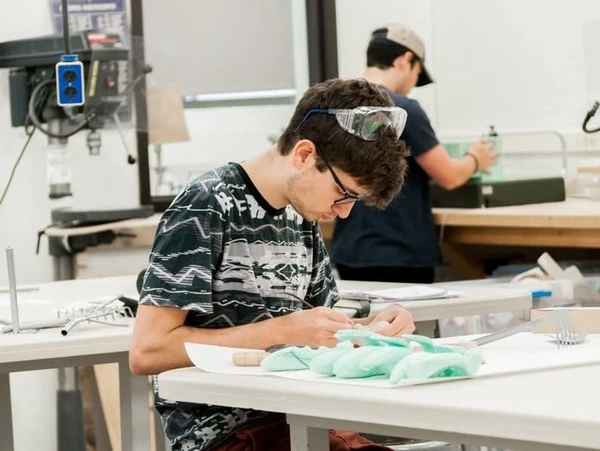
Industrial design student wearing safety goggles working on a project in a design studio workshop at the University of Notre Dame
Design student working on a project in West Lake Hall. Photo courtesy of the University of Notre Dame Department of Art, Art History, and Design.

Q:

Has making become optional? What role does physical making still play in industrial design education?

A:

For me, it’s still so critical. The act of making has obviously expanded.  When I was in school, it was about working directly with materials—shaping foam, building three-dimensional forms in the wood shop, and learning the fundamentals of form through craft. It meant creating physical objects you could hold, interact with, and put into other people’s hands.

That’s still so critical to industrial design and the physical world, but the ways in which we can make things has grown. Now we’re 3D printing a lot. You can iterate quicker, create quick mockups in CAD, and add more content to your models through displays or digital experiences.

I think making is absolutely critical. It’s part of our approach to research and understanding people. You learn by making in a couple of different ways. You learn yourself through a kind of dialogue with the three-dimensional object, and you respond as a designer to what you’re making. But the real power is being able to learn from others through your making.

Q:

Are we graduating designers who know how to make things—or designers who know how to present things really well?

A:

I think every school is a little bit different. Some schools are certainly doing a better job of making sure that the craft of design is still at the forefront of their curriculum. A lot of it has to do with the expertise of the faculty. We tend to teach what we know, so a lot has to do with the values of the different departments and what areas of design they want to highlight.

There are certainly programs that excel at really strong presentations and portfolios—the ability to tell a compelling narrative through the visual storytelling of their projects. There may be some truth to the trend that a lot of the content in those portfolios tends to be more rendering-heavy, more digital-heavy, and less prototyping-heavy.

But I still see a lot of portfolios that show early, low-fidelity prototyping. I love to see that. I think it’s still paramount to the way designers learn from their own mistakes.

Q:

How do you define design research, what impact does it have, and how might we encourage more students to become design researchers?

A:

For me, design research is really about understanding people: their needs, their wants, their desires. Then, if you move beyond that, thinking about people in terms of social dynamics, behavioral dynamics, and common cognitive things that you need to think through from a human factors perspective.

It’s understanding people within a context, and that means understanding what their common goals, activities, and tasks are. When we start a design research project in my class, it’s about understanding a group or groups of people that have a shared task, activity, or goal. 

At Notre Dame, we put a heavy emphasis on design research. In fact, one of the areas of feedback we sometimes receive is that we graduate students who almost have too much design research and less design refinement on the back end.

We start with an area of inquiry and go through the process of: What are the questions we have? How do we frame a research effort around that? What are some of the questions you might want to ask? What are some of the observations you might want to make? What type of people should you include to be more representative of a broader population?

Then, on the back end, how do you turn those observations into insights? How do you communicate what’s important—what you found that was interesting, compelling, and meaningful—to whoever your audience is?

Q:

Has industrial design become too focused on solving problems? Is there still room for work that’s speculative, poetic, or simply asks different types of questions?

A:

I certainly hope so. I grapple with this issue myself all the time. I have a real appreciation for speculative design work and for design work that is not intended only to inform products or practical things in your life. The idea of using the methods, skills, and tools of design to inform dialogue and debate has always been interesting to me. In fact, I wanted to be an artist originally. I went to school for fine art. So the idea of using the object to solicit or evoke dialogue and critical thinking is really compelling to me.

I think that’s a way to inspire students to think beyond practical objects or objects that are meant just to bring utility to your life—introducing projects intended to provoke, prompt, or incite dialogue. There’s this whole other world of design that takes place in art galleries, community settings, and social settings. Students can use their skills in more ways than just developing utilitarian products.

You also have the freedom not to design something. Maybe a product isn’t the right solution. Maybe it’s a system or service, or maybe it’s meant for a gallery or museum setting.

Q:

Everyone is talking about AI replacing designers. Is that the wrong question? Should we really be worried, or should we be excited?

A:

I struggle with AI a little bit because I haven’t found a way in my practice to use it successfully. I go to conferences and watch demonstrations of different workflows for incorporating AI into the design process, and at the end it’s like a coffee maker shrouded in camouflage. The forms don’t make sense and there’s no thought around the workflow or usability.

For more complex healthcare devices—wearables and things that have surgical robotics-like complexity—the results initially look compelling. They’re rendered very nicely, the forms look real, and they have compelling contrast and lighting. But I haven’t been able to use it in a way where I see real value. I can sit down with my partner and brainstorm 20 more reasonable, meaningful ideas. Maybe they’re not perfect or rendered very well, but they actually address the issues that we want to solve.

OneAir Medical and OneAir Environment handheld devices, healthcare and environmental monitoring products designed by Rudolph Design Studio
OneAir Medical and OneAir Environment devices, designed by Rudolph Design Studio.

It’s not to say that AI isn’t going to be there soon. I think it will become a great tool. But it won’t replace your ability to analyze and critique from a human perspective. I’m not scared. I’m frustrated with my own inability to use it successfully. It falls on me to continue to use the tools, understand the tools, and introduce them when I think they’re appropriate.

Q:

You mentioned speculative design earlier, and it’s clearly something you’re thinking about a lot. Where do you see speculative design fitting into the future of industrial design practice and education?

A:

One area that you might have seen me light up about is this idea of speculative design. Early in my career, my research was heavily focused on traditional ways of thinking about design: How do we better understand people’s needs? How do we define needs? How do we create procedures and processes to translate those needs into user-need statements and then into product requirements?

But my own research is going back to what I was more interested in as a student, which is this idea of speculative design. I’ve been rereading Victor Papanek’s Design for the Real World and also reading about speculative work, speculative everything, and discursive design. They often talk to each other as if they’re very different camps—speculative design on one side and traditional industrial design, where we make things useful, practical, and usable, on the other. 

Why do they have to be so different? I think there’s room for both, and both camps can learn from each other.  I’ve got this idea I’m calling “speculative design for the real world.” How do you leverage the methodologies and thinking of speculative design, and how can those things inform real-world initiatives—important societal and cultural initiatives?

When you think through the lens of speculative design, it opens up an entirely new range of possibilities for where the research might lead. You don’t have to constrain yourself to a thing. It could be an experience. It could be an exhibit. It could be a social initiative. It opens a lot of opportunities for different types of solutions that, as an industrial designer, you might not have thought of at the onset.

Check out the rest of our Spotlight series to hear more from leaders in the design industry. Sign up for our newsletter and follow us on Instagram and LinkedIn for design news, multi-media recommendations, and to learn more about product design and development!

A Q&A with Furniture Designer Bruce Hannah, Part II

A Q&A with Iconic Furniture Designer Bruce Hannah, Part II

Spotlight articles shine a light on designers and design materials we admire. Our founder and principal designer Rebeccah Pailes-Friedman has met many wonderful designers as an educator and career designer, and in our Spotlight interviews we ask them about their work and their design journey. In this interview we spoke with legendary industrial designer Bruce Hannah. We had such a wonderful conversation that we split the interview into two parts. Be sure to check out Part I!

Bruce Hannah is a renowned American industrial designer celebrated for his innovative and practical approach to design. A graduate of Pratt Institute in 1963, Hannah’s career blossomed through his collaboration with Andrew Morrison, resulting in groundbreaking furniture designs for Knoll International in the 1970s. Establishing his own design office in 1976, Hannah continued to create award-winning products, including the acclaimed Hannah Desk System, recognized as a “Design of the Decade” by the Industrial Designers Society of America in 1990. He joined the Pratt faculty in 1993 and has received numerous accolades for his teaching and thought leadership. Hannah’s influential work includes co-curating the “Unlimited By Design” exhibition and authoring notable books on design, underscoring his profound impact on the field. In Part II, we spoke to him about activities that influence his creative process, the project he’s most proud of, and the key lessons designs students need to know today.

Portrait of Industrial Designer Bruce Hannah
Photo courtesy of Bruce Hannah.

Q: What hobbies or activities do you enjoy outside of design that influence your creative process?

A: I like to cut the lawn. I’m not strong enough to do that anymore but I found a lovely guy to do it and that’s fine. I like doing work. I like physical work. And fishing. I love fishing! My grandfather taught me how to fish, and my father used to take me fishing. Fishing has always fascinated me. I taught a class called Fishing for Ideas. I took students fishing! That started because I realized that, in this one class, almost no one had had that experience. So I took them fishing. We would go at the end of February, and we would go fishing for trout in the snow. Now if you can get more poetic than that as an experience, I’m not sure. Then of course you leave and you go to Denny’s and have lunch. You have this insanity of being totally immersed in something, because we were fishing fly rods. None of them knew how to fish with fly rods and I found this wonderful man, Mark Melanowski, who was a retired fireman who knew more about theology and bugs than most scientists. He was wonderful. I would bring a bunch of my fly rods, he would bring his, and they would all go fly fishing. Fly fishing is all about understanding what the fish are eating. Just putting a worm on there?  No. What you’re doing is studying hatches of insects. As the hatch progresses the insects change. They may all start out black, little black gnats, but the next week they’re black gnats with little white wings, and the next week is black gnats with little white wings and a red tail. It’s nuts, but the fish know. If you’re in the third week and you throw them a black fly, they’re like, Yeah, we saw that one. We already saw that movie. Show us a new movie. So there’s this wonderful thing about designing fishing equipment where you have two customers, which is very unusual. You have to sell the fisherman, and then you have to sell the fish.

My biggest thing I like to do is wander around. Andy and I learned how to do that. It’s something that people don’t do well. People like to know where they’re going. They like getting on the plane to Las Vegas and getting off, and knowing exactly what they’re doing when they get to Las Vegas. There are very few people that you can wander around with and bump into things, and Andy was one of those people. We spent an inordinate amount of time wandering around New York City doing nothing.

The other part of our philosophy was: Try to do nothing. Which is hard. I would teach my students that. They were confused, Do nothing? That’s the opposite of what we’ve paying money to do here. I said, Doing nothing is the most successful thing you can do, because that’s when something will happen in your brain that you don’t expect. If you lead a very regimented life and know where you’re going all the time, you’re not going to see anything new. You’re not going to be startled. So one of the things I try to do is wander around, which is fun. My wife and I have done that. We’ll be on a super train in Italy and get off at a random stop. We have no idea where we are. Find a hotel. We are more like that as human beings. We are explorers. It’s hard to explore now because they’ve got all the signs up already. Oh, we’re at Exit 4.

Q: Could you tell us about a project or piece you are especially proud of and why?

A: Unlimited by Design an exhibit that My wife and I did at the Cooper Hewitt National design Museum. about accessibility for everyone. That was a long time in the making. It started out because I met this guy George Covington. He is a blind photographer. Let that sink it a little bit. George takes pictures to see. He was born legally blind in the early 40s, so he’s my age. His mom said no, he’s going to regular school. He ended up going to college to study journalism, and got a law degree. He ended up working at the National Park Service. He was in charge of accessibility there, making sure that things were accessible, which at the time they were not. George, with these black cowboy boots and white cane, banged on doors in the Senate and the House Representatives to get the American Disabilities Act through. George and I had this wonderful, funny relationship. We wrote a book together called Access by Design which was about making everything accessible for everyone all the time. And then we put on a conference in 1992 called Access to Daily Living, the first international conference on accessibility. All of this is tied into trying to figure out how to make the world accessible to everyone.

We worked with Diane Pilgrim to create the exhibit, who had MS and was in a wheelchair, and was the director of design at the Cooper Hewitt. There were lots of great products in the exhibit, and it was fully accessible. There was an accessible playground in the museum, which the lawyers went crazy over. Everyone wanted to play on that playground. We tried to redefine design, for all. I’m very proud of that. I wish I had paid more attention and gotten a book made of it. I think that would have been important. As we seem to do with everything that is good in the world, we take two steps forward and I think we’re going into the one step back phase at this point. Although I’m constantly surprised at how much more accessible New York City is today than it was 20 years ago, or even 10 years ago. 

Q: You are also a design educator. What key lessons do you think design students should keep in mind right now?

A: They have never changed. What’s important now is the same sh*t that was important to the Egyptians. I’m involved with City Tech, which is the City University of New York’s design and architecture thing. It’s in Brooklyn. I got roped into it by a student of mine, Jenny, who said last August, Bruce, would you mind teaching an introductory class to industrial design students? So I went in. These are New York City kids, working and going to school. It’s in the mechanical engineering department. After three weeks I fell in love with them because I commuted to Pratt from Staten Island two hours each way for four years. That was not unusual. And these kids do it and they work. Half of them come late to class because they got out of work late or the trains broke or whatever, right? And then the guy that hired me, Andy Zang, said, We’ve been working on this new curriculum. Would you be interested? So we’re developing a four-year industrial design program. We’ve written 20 or so class outlines and syllabuses. It’s very different from when Kowstellow invented design education. There are so many people in charge of so many things. It’s frightening. 

So the list is exactly the same. What should you teach kids? The first thing you would teach any college student is to trust themselves. It has nothing to do with skills. It has nothing to do with anything else. If they can’t trust their own intuition, we’re in deep number two. Learn how to sketch. I don’t care what you sketch with. I do not have this. I do not think that there’s a specific tool or specific paper that will make your idea better. Use an old newspaper and an old pencil that you found on the floor. As long as you can sketch out the idea so that somebody else can understand it, it’s pretty good. Same with 3D. Figure out how to teach them how to make stuff three-dimensionally. As we have little money at City Tech, I based my whole class on eight and a half by eleven sheets of paper and anything we could do with it. You can buy a ream of paper, which is 250 sheets of paper, for six dollars and it’s the cheapest material you can buy. And if you limit them to it, you cannot lose. You eliminate the glue. So we make a lot of stuff out of eight and a half by eleven sheets of paper. It’s cheap and it’s disposable. The first exercise I give them is to design a paper airplane. Everybody can do it. The cool thing is: then you ask them to write down the steps. And they go, I can’t do that. I say, You have to write the steps down. And they realize that their brain will explode into a purple cloud, because you have to learn to do that from somebody else. This is my introduction: You will learn how to make 3D things by making 3D things. There’s no manual for this. The act of doing is another thing that you have to instill in students.

So now they’re drawing things, sketching things, and they’re making things. The other thing is that they have to figure out how to tell you what they’ve just done. That’s the other thing that’s important. We have a lot of people that have good ideas, but they’re terrified of telling anybody, for some reason. Psychologists can go into that for the next thousand years. You need to make them stand up in front of the class and tell you how they made their airplane.

Those are the four essential skills. Everything else, computers, whatever, we’ve all had to learn different things. I had to learn how to draw on mylar, with ink. Insane. You think computers are hard? Try not to smudge that drawing. It’s all hard. All of those skill things are hard, but design is really about communicating your ideas. Get them out of your head, put them on a piece of paper, and have the courage to stand up in front of a bunch of people and say, Well this is what I think. What do you think?

The other thing is you have to teach them how to pick up their heart and put it back in their body. Essential lesson! Of course 3D modeling is important, but you can’t 3D model your heart that’s laying on the table, that has just been smashed. You have to figure out how to put your heart back in your body and go, Okay. I’ll do this again tomorrow.

The hardest thing to learn is to not give a sh*t what anybody else thinks. That’s the hardest. Most people can’t do that. Paul McCartney doesn’t give a sh*t what you think about his songs, which is why he wrote 695 of them. He just keeps doing it. Eventually, you’re going to like one of them, or you’re not, and he doesn’t care. Most people who are successful really don’t give a sh*t what you think about them. They just do it, and they’re all freaks. Normal people love freaks. I tell my students about this. I say, Okay, now you’ve presented it and you’re heard whatever I said, and you have to not give a sh*t about what I said. You have to absorb it. You have to kind of go, maybe that’s right. Maybe they’re correct about how I’m thinking about this. Maybe I should try to do it this way. But you really can’t care. The best designers that I know really don’t care.

The essential lesson is: trust yourself and your intuition, because you’re probably right. That doesn’t make everybody else wrong, they could all be right, too. But you have to have that feeling. Another important thing is to learn how to listen to people. That’s part of the presentation thing, to begin to learn how to listen to people. Many people lie every day. People get up, and they lie about four times before they even brush their teeth. To the person they’re laying next to, whoever. We don’t want to hurt anybody’s feelings. 90% of the time, that’s why we lie. People don’t know what they need. Did anyone know they needed an iPhone that would replace 50 products or more? It’s some enormous number of products that we don’t need anymore. Did anybody know they needed it? No, of course not. But there was this crazy person, Steve Jobs, who kept saying, That’s too hard. He had this vision of a thing that you could carry around in your pocket. Now everybody in the world has one, it has changed the world.

Be sure to check out Part I of this interview!

Check out the rest of our Insight series to learn more about the design industry. Sign up for our newsletter and follow us on Instagram and LinkedIn for design news, multi-media recommendations, and to learn more about product design and development!

A Q&A with AI Proponent Juan Carlos Noguera

A Q&A with AI Proponent Juan Carlos Noguera

Spotlight articles shine a light on designers and design materials we admire. Our founder and principal designer Rebeccah Pailes-Friedman has met many wonderful designers in her time in the industry, and in our Spotlight interviews we ask them about their work, their design journey, and what inspires them. In this interview we spoke with Juan Carlos Noguera, an industrial designer and design educator who focuses on creating holistic design solutions. He holds a masters in industrial design from the Rhode Island School of Design and a bachelor’s in industrial design from Universidad Rafael Landivar in Guatemala city. He is well known for being the product design director at Voxel8, where he pioneered the development of the first 3D electronics printer, and he is a professor of industrial design at the Rochester Institute of Technology, where he brings AI into the classroom. We asked him about how AI is changing design education, how to incorporate AI into the design process, and how he teaches students to use AI effectively and responsibly.

Juan Carlos Noguera
Photo courtesy of Juan Carlos Noguera.

Q: Design has been revolutionized in the last decade by the emergence of sophisticated digital tools, the latest of which include powerful AI generators that we have barely begun to regulate. How have you seen design education changing in light of these developments?

A: I think the first knee-jerk reaction has been lots of fear from people, from faculty, especially because every time you read about AI and education in the same sentence, you hear about cheating and plagiarism and all of the very valid gray areas of AI. It’s a valid fear that people have. I think there are still a lot of things that need to be resolved regarding the regulation of intellectual property. These are ongoing conversations that I think we should definitely keep in mind. I’m a person who’s very excited about using AI in my classes. My personal perspective is that, if we are transparent about teaching incorporating AI into the projects that we teach, if we show students what AI can do really well, what the shortcomings of using AI in your process are, how your process can suffer from using AI — I think students will organically use it appropriately, because they want to reap the greatest benefit. If we give way to the hand wringing and fear and start prohibiting it in our classes, it starts becoming a problem. 

I’ve had a chance to do things like faculty workshops here at RIT, where I try to start to dispel some of the fear around it. These systems are not black magic. There are mathematical models: they do these certain things really well, and they don’t do these other things very well. I start getting people to jump on board and feel a little bit more excited. So, I have seen a big sea change toward positivity from some people, but there are still a lot of fears. I think that’s the biggest battle right now. But let’s get people to embrace it because, if we don’t, students will use it anyway, and they’re not going to see the downsides if we don’t point them out.

Q: The role of AI tools, especially image generators, is not yet standardized in the industry. How do you see AI being incorporated into design education, and how do you see it being incorporated into the design process more broadly?

A:  It’s always hard to visualize the future. I’m trying to think what may happen when the novelty wears off, at which point do we start seeing the net benefit of these tools existing? So, for education it means a few things. One is curricular change. We start rethinking what types of assignments get put into courses. Mechanical tasks that we used to ask students to do and that can easily be replaced by AI will get replaced by AI, whether you want it or not. So how do you get that learning out of more project-based work where students engage more in critical thinking. I think it’s a good thing, it also forces us as faculty to rethink things that were easy before. It’s going to force us to make some adjustments. Having faculty become experts in the area is hard, not everybody uses technology at that level. Some faculty are more reticent to start using it or to accept that it could be a tool.

Educational institutions are ships that are hard to steer because they’ve been going in one direction for a long time, and some people don’t want things to change. We’re a bit of a tribe as designers. You have to go through a right of passage of doing this one thing. What if that thing is no longer part of the process? We were just having a discussion at RIT.  We’ve been using this AI tool called Vizcom a lot in class, and it’s basically jumping over the entire need for my students to get good at marker renderings. Now, if they have a great line drawing of their idea they pump it through Vizcom and get a good enough representation of the thing that is as good as their marker rendering would have been. So why would you learn that manual skill? There are a lot of moving parts to this, which is why I understand the frustration.

On the other hand, in industry, once that novelty wears off you’re going to start seeing these AI tools being built into things you already use. It’s going to make the tools you’re used to smarter. When you go into your CAD program, AI tools are going to be there to help you with tasks that, right now, you might consider tedious. I think Adobe in particular is really a great job at incorporating AI into their offerings. It’s naturally built into Photoshop and Illustrator, and they’re going to slowly expand on this. They’re not taking these tools and saying, Here’s AI added on top of them. They’re saying, Hey, here’s the fill tool you’ve been using for a while, we’ve made it smarter. I think that approach is very future-proof in particular. They’re calling it generative. It’s just an offshoot of their previous version. They’re doing a good job at softening that landing for people, saying, Now Photoshop does one more thing. As opposed to the crash people have when they open Chat GPT and get this ominous feeling of not knowing what is chatting back. People have a hard time getting over that. That feeling isn’t there with Adobe products. I think we will see more of that and less of the inaccessible version.

Q: It can be challenging to use AI tools efficiently and effectively. At what point(s) in your design process do you find AI tools most valuable?

A: I have found that at least some of the generative tools I’ve been using so far in my practice, and also in class with my students, are really great during the ideation phase in a number of ways. Image generation software like Midjourney and Dall-E have been great at helping teams communicate. I had a chance to do a project with artisans from my home country, Guatemala. They do bronze castings. They typically work with a designer, and the designer is up here and they’re down here, just making the thing. It feels like a very top-down relationship. We recently jumped on a Zoom call and used Dall-E to communicate visual ideas. We went back and forth and just used that as a communication tool. It really helped level the conversation field. Dall-E is almost like an automated journey mapping or storyboarding tool, so it’s great for teams. I also think image generators have great potential when a designer is just hunkered down ideating. It’s an endless firehose of stuff. And that could be good or bad, depending. But let’s say you’re tasked with designing a plywood chair, right? It’s almost like having the key to the plywood chair museum. You can ask for plywood chairs all day and you will get all these different things that are plywood chairs. Some of them will be good, some of them will be garbage. But you’ll have an endless stream of images to look at and get inspired by, which can help you work through a block. It’s like the stimulation of going to a museum. It’s more targeted, because you get to input what you want, but the mechanism is the same. So, I think it’s going to make us more efficient.

I’ve pretty much absorbed it into my workflow. It really helps me visualize specific situations as well. It’s even helped me visualize situations for my client. I’m working right now on an underwater robot model for a client. I had the CAD model for the bot and and my own rendering, and I fed it to Midjourney and said, I want this thing to be underwater on the ship hull. And Midjourney did a beautiful job of putting my object underwater and on the ship hull. That’s the kind of thing that would be very time consuming to do. All of that sort of mechanical work is not going to be client facing anyway. It’s automated now, so it’s taking away some of the more painful parts of what I do, which is what automation should do, right? I think people are worried because this is now automation for the mind, and that’s a strange concept.

Q: How do you guide students to incorporate AI into their process ethically and in a way that preserves the integrity of their ideas? What are some of the common pitfalls in AI use that you see as a design educator?

A: I think it’s important to have students use it and also kind of crash and fail with it. I like to start with very open questions and assignments when we work with AI, so that they can see that the direct output from the system is not something they can use.

First of all, they have to understand how it works. So we go ahead and talk about how a diffusion system for image generation works, how it’s been trained. The data set is owned by everyone in the world. And what you’re getting is basically reprocessed data that’s combined based on your text input, but the information is coming from unknown sources. All of these different software companies are very opaque about how their software works. This means that any output that you get from the AI, you can consider that the same way you consider the results of a Google image search. You see the results. You might find something inspiring. It’s not something you want to use directly. That’s the first thing. It’s a great way to remix things in unexpected ways and find unexpected and inspiration. But they have to remember: this is just an echo chamber of everything that’s out there in the world. If you actually want to generate something new, you can’t use that output, because that’s not how the system works. You won’t get something new, it’s just giving you information from its data set. I’ve tried to get students to use it as a way to generate rich mood boards and inspiration boards as opposed to trying to get form from it.

Prompt engineering is on the horizon of being an actual profession. Out of all of these systems I like to have students play with Chat GPT. It’s a great way to train your thought process. They need to learn how to ask things from AI systems. You can give it a lot of context and get really great results back. We did this experiment in class where I said, Okay, I’m going to write a letter or recommendation for one of you, which is a task that I do as a teacher all the time. And at first I just asked Chat GPT directly, I want a letter of recommendation for this student. The student is an industrial design student. It gave me something professional and polite, a very generic letter of recommendation that sounded like a template, it sounded robotic. It was bad, it was not something usable. On the other hand, we repeated the exercise. We started describing my relationship to one student in the class. I said, Hey, Chat GPT, my name is Juan. I’m an industrial design professor. I come from Guatemala. I’ve worked on this and that before, these are my interests. You describe them in a couple sentences. And I said, I met the student last semester. They took my drawing class. They did this. The prompt was probably as long as the letter that I needed to write but I wasn’t trying to word it well. I had grammatical errors. I was being very casual about just telling it a lot of information. The language model is great at processing that. And then after that I just said, Knowing all that, please write a letter of recommendation for this person. And that letter was amazing. It was great. I would not guess it was written by AI. I seemed connected, like I really knew the student wanted to speak to the things they did. When you do an exercise like that, the students really see the power of the right prompt. They see, okay, I need to get context, I need to think carefully about keywords and information and try to frame my thoughts. After that, they start using the tool in more creative ways.

I use the tools in class as much as possible to try to take away the shame element of using AI. I say, Use it as much as you want. You just need to tell me when you use it. You need to cite it almost as if you’re citing a source for an image or anything else you’re putting in your paper. I want to know which steps used it, and how that helped inform your design decisions. Once we get that established, they feel more at home using it. They know that they’re not cheating, it’s not plagiarism. They’re using it, they’re being transparent about what they got from it, what they couldn’t get from it, and what failed. 

Q: What reaction are you seeing from the students? I know there can be costs to using these tools.

A: Yeah, there’s grumbling on the cost, but the same way that we’ve been grumbling about the cost of software forever. The same way I grumbled about paying $100 a year for my Keyshot subscription. Or when I finally graduated from school and realized that my professional license for SolidWorks was $5,000. Students here at RIT don’t get free Adobe licenses, they have to have their own. And that’s always a problem. So, that really hasn’t changed. 

One thing I do notice that is a source of frustration is going back to curriculum and course development. They now start seeing, Okay, here’s this tool, and it does the thing that you’re teaching me how to do by hand. So why are you teaching me this again? It feels redundant to them. I think that has been the most painful part of it for my students, just trying to figure out: What is the skill set of a designer in the end? What’s desirable when I go out into the world? Should I have AI skills? I might not be getting them from the school. Do I have to get them on my own? Should they be in my CV? All these things are a source of frustration.

Q: How do you see the relationship between AI and design education developing in the near future?

A: That’s a great question that I don’t have a very solid answer for. Last semester we had about five or six different faculty forums about what’s going to happen with AI and education. Universities are wrestling with how to tackle it and these tools are popping up that are really unexpected, like Vizcom. It basically showed up a couple of weeks before we started the semester and it really made us think, Should we try to retool the entire design drawing class we’re teaching this semester? Because they’re going to use this and wonder why they need to learn how to work with Copic markers. Those are valid questions, because… is this a skill that is no longer relevant?

We need to ask those hard questions. That’s definitely on the horizon because I think this is significant enough that we’re going to need to rethink many parts of our curriculum and how we do things in education. We can’t treat it like a piece of software. We have to treat it as the sea change that it is. It’s very fast-paced, and we don’t know what other tools will pop up. They’re going to replace everyday tasks. This has already started to happen. When I went to school, I did three semesters of technical drawing. Giant board with a parallel ruler. That now feels like it was a waste of time, but that was the industry standard when I went  to school. That change happened gradually, but this is happening fast, and I think that’s the big difference. 

The school-wide policy in most schools that I’ve seen has been very nebulous. It’s mostly been about trying to give faculty a little bit of power over how to use AI in their class. The syllabi that we use now have language that says that the faculty get to say when AI is appropriate or not, or that it’s not to be used unless the faculty instructs the students to use it. This leaves the door open for usage while still trying to be cautious. institutions are trying to use caution, which is natural, right? But there should be a sense of urgency. And that really depends on who you ask. 

I would say generally that industrial designers are overall super excited. Very happy. They can see lots of applications, things that can help us. If you’re a graphic designer, you’re less excited. If you’re Illustrator, you’re definitely not very excited about this at all. A concept artist? You don’t want this at all. It really depends on your specific area of interest and also your industry. There are a few industries that might be more directly affected by this existing. If you work in an industry with a very specialized knowledge base, soft goods for example, I would be less worried. If you work in another area, maybe traditional consumer goods, plastics, it’s hard to tell.

I’m very optimistic and see great benefits using AI in my work. It frees me up for what I consider the more critical parts of designing, like trying to be user-centric, trying to be sustainable in my decisions. It’s reducing the workload of things I don’t like to do, which is what automation should do. Not everyone is that optimistic, but I see good historical precedents for this. When photography was invented, everybody thought, This is going to destroy painting. Most painters were tradespeople, because painting was a way to do naturalistic documentation. But the rise of photography spurred painting as an art form, and all these different currents, like impressionism and cubism. It was a documentation tool that was taken over by this other, more automated thing: photography.

When they invented the sewing machine, they thought, It’s going to replace the people that create clothes. And there were strikes and all this resistance. It took 30 years for it to catch on. And people realize, no, the sewing machine just makes people that make clothes more efficient. It drives up quality, it ends up being a good thing. But there’s a lot of fear. 

When we started having records for music, musicians unions got the radio station consortium of New York to play records one time and then destroy them. Because before that, music was live, right? So you have to pay the band for every play. Records took that away. So buying one record for each play was the way that they saw out of it. There’s always a clash but, in the end, all of these technologies helped make things progress. I think that’s what’s going to happen here.

Check out the rest of our Insight series to learn more about the design industry. Sign up for our newsletter and follow us on Instagram and LinkedIn for design news, multi-media recommendations, and to learn more about product design and development!

The Future of Industrial Design Education

This article, written by Rebeccah Pailes-Friedman, was published in the Fall 2023 Issue of Innovation Magazine.

As technology continues to blur the lines between physical and digital products, design educators must navigate an increasingly complex landscape to determine what a design education should look like. In this Insight article we explore the challenges and opportunities facing industrial design education today. We outline the key skills that will be needed by the next generation of designers in this evolving landscape.

The Merge

The merge of physical and digital products represents a significant shift in the field of industrial design. Digital technologies and experiences are increasingly integrated into physical products, blurring the boundaries between the physical and virtual realms. Designers now need to possess a comprehensive understanding of both physical and digital design principles, as well as the ability to seamlessly integrate the two. Designers who embrace the merging of the physical and the digital can create innovative and immersive experiences that enhance user interactions and redefine the possibilities of product design.

This blurring has important implications for design education, yielding both challenges as well as opportunities. It is a real challenge to equip students with the necessary skills and knowledge to navigate a shifting landscape. Traditional design education must increasingly incorporate digital tools, technologies, and methodologies. At the same time, new avenues for creativity and exploration are everywhere. By understanding the implications of this merge and embracing interdisciplinary approaches, industrial design education can play a role in shaping the future of design, ensuring that designers are well-prepared to create innovative and meaningful products that integrate the physical and digital realms.

Photo: Scott Graham

The Changing Landscape of Industrial Design

The landscape of industrial design education is undergoing a significant transformation as technology continues to advance and shape the field. Traditionally, industrial design focused on physical products, such as furniture, appliances, and consumer goods. However, there has been a noticeable shift towards digital and interactive experiences in the past few decades, a shift that is accelerating every year. This shift is driven by the increasing integration of technology into everyday objects, as well as the rising demand for user-centered and immersive design solutions. Gradually, industrial design programs are adapting their curricula to equip students with the necessary skills and knowledge to navigate this new territory.

Advancements in digital tools, prototyping techniques, and manufacturing technologies have revolutionized the way designers approach their work. New 3D technologies have opened up new possibilities for rapid prototyping, iteration, and visualization. Technologies like the Internet of Things (IoT) and artificial intelligence (AI) have created opportunities for designing connected and intelligent products. Designers are expected to be proficient in these technologies and leverage them to create innovative, user-friendly, and sustainable solutions.

The evolving landscape of industrial design education emphasizes the need for interdisciplinary skills and knowledge among design students. Designers are no longer solely focused on aesthetics and form; they must also understand the technological, sociocultural, and economic contexts in which their designs will exist. Collaborating with engineers, programmers, psychologists, and other experts is becoming increasingly common to address complex design challenges. In response, design education is incorporating interdisciplinary approaches, encouraging students to explore diverse fields and develop a holistic understanding of the design process. This interdisciplinary mindset equips designers with the ability to think critically, solve problems creatively, and collaborate effectively in multidisciplinary teams, reflecting the reality of the modern design industry.

Challenges in industrial design education

Industrial design education faces several challenges in adapting to the changing landscape. One is striking the right balance between technical skills and creativity in design education. While technical skills are necessary for using advanced tools and software, creativity remains at the heart of design. It is essential for design programs to foster an environment that encourages both technical proficiency and creative thinking, ensuring that students develop a well-rounded skill set that allows them to excel in the digital as well as the physical aspects of design.

Another challenge is addressing the evolving role of designers in a digital world. With the increasing integration of technology, designers are no longer limited to creating physical products; they are also involved in crafting digital experiences and services. Design education needs to prepare students for this expanded role by equipping them with skills in user interface (UI) and user experience (UX) design, interaction design, and digital prototyping. By embracing the digital aspects of design, students can adapt to the changing demands of the industry and contribute to the creation of meaningful and engaging experiences.

Photo: Alvaro Reyes

The field of industrial design has a rich history and established traditions, making it challenging for some institutions to embrace new technologies and design approaches. In order to stay relevant and prepare students for the future, design programs will need to be open to innovation and adapt their curricula to reflect the evolving needs of the industry. This may involve introducing new courses, incorporating emerging technologies into projects, and fostering a culture of continuous learning and experimentation.

Design education must also align with the expectations and requirements of the design industry, ensuring that graduates are equipped with the skills and knowledge that employers seek. Establishing strong connections with industry professionals, offering internships and collaborative projects, and involving industry experts in curriculum development can help bridge this gap. By fostering a close relationship between academia and industry, design programs can better prepare students for real-world challenges and increase their employability upon graduation.

Opportunities in Industrial Design Education

While there are many challenges, there are also many opportunities. Embracing digital tools and software in the design process opens up new possibilities for creativity and efficiency. Designers can leverage software for 3D modeling, simulation, virtual reality (VR), and augmented reality (AR) to visualize and iterate their ideas before moving to physical prototyping. By incorporating these digital tools into the curriculum, design programs can empower students to explore new design possibilities and streamline their workflow.

Another opportunity is incorporating human-centered design principles in digital experiences. As technology becomes more integrated into our daily lives, designers will need to prioritize the user experience and consider the human aspects of their designs. By teaching students about user research, usability testing, and empathy-driven design, design programs can ensure that the next generation of designers develops a deep understanding of human needs and can create digital experiences that are intuitive, inclusive, and meaningful.

Leveraging emerging technologies for innovative design solutions presents still more opportunities. Industrial design education can explore the integration of technologies such as Internet of Things (IoT), artificial intelligence (AI), robotics, and wearable devices into design projects. By encouraging students to experiment with these technologies and explore their potential applications in various domains, design programs can foster innovation and prepare students to create designs that push boundaries and address future challenges.

Encouraging collaborative and cross-disciplinary projects is another valuable opportunity for industrial design education. The merging of physical and digital products requires designers to work closely with professionals from diverse fields such as software development, engineering, psychology, and business. By promoting collaborative projects that bring together students from different disciplines, design programs can nurture a multidisciplinary mindset and foster teamwork and communication skills. Such projects also reflect the real-world nature of design work, where collaboration and cross-disciplinary approaches are increasingly necessary for successful outcomes.

Looking to the Future

As industrial design education looks towards the future, it is essential to consider the impact of emerging technologies. Design programs need to stay abreast of the latest advancements and integrate them into their curricula to equip students with the skills and knowledge necessary to harness the potential of these technologies. Students need to understand not only the utility but the ethical implications of these technologies. Designers must consider the ethical and social consequences of their creations, ensuring that technology is used responsibly and with consideration for human values and well-being.

As digital products become more prevalent, it is essential for industrial design education to emphasize the importance of designing with sustainability in mind. Students should be encouraged to adopt sustainable design principles, including material selection, lifecycle assessment, and designing for circularity. Ethical issues like privacy, data security, and inclusivity, need to be integrated into the design process. Design programs can be a key player in instilling these values.

Conclusion

The merging of physical and digital products presents both challenges and opportunities in industrial design education. The challenges lie in balancing technical skills and creativity, addressing the evolving role of designers in a digital world, overcoming resistance to change, and bridging the gap between academia and industry needs. However, these challenges can be turned into opportunities by embracing digital tools and software, incorporating human-centered design principles, leveraging emerging technologies, and encouraging collaborative and cross-disciplinary projects.

Adaptability and continuous learning are key attributes for designers in this evolving landscape. As technology continues to advance and new design paradigms emerge, designers must be willing to adapt their skills and embrace new tools and methodologies. Designers need to be open to collaborating with professionals from different disciplines, which can foster creativity and lead to innovative solutions that bridge the gap between physical and digital realms.

In preparing the next generation of designers, it is important to provide them with a solid foundation in both traditional and digital design principles. By nurturing their technical skills, creativity, and interdisciplinary thinking, design education can empower students to become versatile and forward-thinking professionals. Additionally, design programs should foster a culture of experimentation, encourage critical thinking, and emphasize the ethical and sustainable considerations inherent in the digital age. By equipping designers with the necessary knowledge, skills, and mindset, we can shape a future where the merge of physical and digital products is seamlessly integrated, leading to innovative and meaningful experiences for users.

Looking for more design InsightsSign up for our newsletter and follow us on Instagram and LinkedIn for design news, multi-media recommendations, and to learn more about product design and development!

A Q&A with Interaction Designer Elham Morshedzadeh

A Q&A with Interaction Designer Elham Morshedzadeh

Spotlight articles shine a light on designers and design materials we admire. Our founder and principal designer Rebeccah Pailes-Friedman has met many wonderful designers in her time in the industry, and in our Spotlight interviews we ask them about their work, their design journey, and what inspires them. In this interview we spoke with Elham Morshedzadeh, an industrial designer, usability researcher, and design educator with a focus on healthcare and community-centered design. She has a master’s in industrial and product design and a PhD in user-product interaction design. She is currently teaching at the University of Houston and works on a number of transdisciplinary healthcare-related research and design projects. We asked her about her user-product interaction, her experiences in design higher education, and the approach to design education in different countries.

Photo courtesy of Elham Morshedzadeh.

“I believe that we can’t design the experience. We design the interaction, and the experience is unique to every single person.”

Q: What motivated you to pursue a PhD in User-Product Interaction design? 

A: There were different reasons. I was into art and I was into design, but I was also always a good researcher. I like to get in-depth with things, and that’s why I started my master’s in the first place. I would say that my master’s was not a traditional master’s in design. Many people basically do more product design in their master’s program. For me it was more about looking into different types of interactions; between humans and products and between humans and systems. When I was pursuing my master’s, the meaning of interactive design implied digital products, or products that have some digital components in them. I always wanted to look into the true meaning of interaction, interacting with this device or object, this physical thing. I like the physical, functional, and cognitive aspect, so it started there. I did deep research into the overall understanding of how interaction creates the experience. I believe that we can’t design the experience. We design the interaction, and the experience is unique to every single person. It’s literally that person’s experience, and no matter how much you try, people’s experience will be different and unique to themselves.

There were a couple of reasons for getting the PhD. One was that I was fascinated in how we can combine our thoughts and qualitative aspects of design into something that is more reliable, something that can facilitate stronger conversations in interdisciplinary work that we do with the engineers. They don’t communicate like us. How can we describe our qualitative data in a more reliable way such that we can gain the respect from our colleagues or from our collaborators when we are working on a design? I thought that would be more than just a project to do on my own, and I really wanted to do it in a more academic way because it was part of my understanding that that structure can provide me a good foundation for achieving my goal.

I also really wanted to teach. I really love teaching, so that was also aligned with what I was doing. I worked in industry as well before getting my PhD, before even getting my master’s. The combination of my experience working with big groups of people, where I was the only designer, and trying to convince those people that what I’m saying, it might not have the same data or numbers that you’re looking for, but it makes sense. That was an experience that pushed me towards trying to find better language to communicate in interdisciplinary work. In my opinion, interaction applies to any type of design, and that’s why I took a deep dive into interaction evaluation.

Q: How did the different levels of design degrees you experienced differ from one another?

A:  It was not funny, but I will say it was funny that in the last conference I attended there was this guy sitting beside me. When we introduced ourselves he saw my business card and he said, Ohh, PhD. Since when did we need a PhD in design? He was basically saying, What do you know? But I think he was being privileged, he was always given this permission to speak his thoughts aloud, no matter what they are. I wanted to tell you that it’s not the only way to pursue higher education in design, but it’s one of the ways. So I’m not saying that it is for every single person, but it has its own value. 

I have a little bit of a skills issue with the master’s in industrial design curriculum. To me, a master’s in industrial design, it’s just another studio. In many programs, it’s another studio project with a little bit of deeper aspects in the design of a product. I’m actually looking at higher education in design as looking into different philosophies and different methodologies, and incorporating design with other disciplines. That’s why, for example, in my PhD I looked into quantifying my data. I looked into factor analysis, basically looking into how to use the computer to quantify my qualitative data. I was looking into how the impact of one interaction can impact another, things that as a designer I might not know, but a machine can tell me.

I see higher education as an infrastructure and a foundation to strengthen designers and give them the seat at table for designing a strategy, designing vision, designing a pathway for any idea or company, rather than just sitting behind a desk and sketching. That’s my idea of higher education in design because, to be honest, they are partly right. Many of the things being taught in traditional education in industrial design are skills. They are hard skills like sketching classes, software classes. I always tell my students that if you just want to be good in Rhino, you can take a module. You really don’t have to come to school. What we are trying to train them is more about those soft skills, about better communication. Understanding how their decision or their design is impacting other things around in that environment. Working together and even creating the respect that the designer needs between themselves and other people in the discipline. Good storytelling. Storytelling is not just about good drawings, good illustrations. Yes, you need good technique to tell your story, but it’s not all about the illustration. It’s about knowing: where is the peak of your story? Where are you at the end? How do you connect everything that you said into a conclusion that reminds your user about all the challenges that you explained to them at the beginning?

So these are the soft skills that it might not be possible to do in a four week module. It might not be possible to do it in six weeks. It’s something that we constantly talk about with our students. I didn’t know it at the time, but I was basically getting myself ready to do more interdisciplinary work. Nobody was even talking about interdisciplinary work then. Fifteen years ago I was the only designer in a team of 20 different engineers and entrepreneurs, and they were all wearing suits. The moment they saw me, they said, Who is this kid? But by the end of that project, they were constantly calling me to say, What do you think we should do with this? What do you think the solution is for this? I gained their respect and changed their opinions about what designers do, and that has been my agenda since that moment. I always wanted to teach and I always wanted to learn, so being in an academic environment always made me happy. They say to the job that you don’t work one day in your life. I’m not saying 100%, but it’s summer and I’m in my office so…


Q: You did your bachelor’s and master’s degrees in Iran and now work and teach in the U.S. What differences have you experienced in the attitude toward design education across different countries and institutions?

A: There is a truth that we can’t deny: most programs around the world are influenced by the traditional, Bauhaus, European design definition. In my experience in Iran, we were definitely influenced by that. It really depended on which college the program was located in; if the program was located in an art and design college, it was more artistic. It was more towards Italian design, fun, emotional design playing with form and function. And then if it was located in an engineering college, it was more focused on the engineering aspect. There were even two different degrees, a BA and a BS. At the same time, my college was something in between. The difference was that we were taught plenty of basic courses in engineering, like mathematics, physics, mechanics, and physical electronics. That was a good practice to have in order to be able to work with other disciplines. That’s something I feel we are lacking in programs in the U.S. We expect our students to learn about mechanics themselves. Unless there is a course or unless there is a project designed specifically for them, they don’t get an official education in any of these disciplines, and that causes the quality of prototypes to decline in the depth. 

I told you, I’ve worked with engineers. It’s not just the it’s not just the facade or how it works or something like that. You really have to understand how to pack those devices in that space. Production limitations are a very, very important thing in the evolution of a concept into a product that can be production-ready. I would say, at least in a couple of the programs that I experienced in the United States, they lack that unless there is a good professor, you know? I don’t mean to say that we need to teach everything, but I would say it is good to have those foundations.

In Japan, one thing that was interesting to me was the attention to their culture. You could see the integration of their own culture in the design of their studios and in the design of the projects they teach their students. They also idealized western design history, but they were fully aware of their own potential, their own value. So they empower their own culture and values but, at the same time, it can isolate them. They can be more focused on: what is a good design for this company, for this environment, for this community in Japan? 

Another thing that I wish I could see change in American programs is the approach to the senior project. I think it’s very rushed, allowing just one semester. The students aren’t able to complete a full design process. In a best case scenario, maybe some of them will test their first prototype. In both Chiba University and in my own country, we would dedicate at least one year and sometimes more to accommodate working with a manufacturer.

Q: How does your experience teaching in design influence your design practice?

There are two different types of impact. One is design related, and one is personality or teaching related. On the personality side, I would say it makes me more patient toward my students. It makes me even more open minded towards different approaches. I’m really happy that I work in design outside of my teaching because it keeps me more human towards my students, rather than just being their teacher. From the teaching point of view, it keeps me updated. It really pushes me to keep track of what needs to be taught, which is also the challenge for design education in my opinion. This is a never ending question.

Overall, what I am teaching right now is not that similar to traditional design education. I focus very little on the end product. I focused a lot on the process, on decision-making, on prioritization. I ask myself, What is the demand in the industry? My work is still very narrow in one area, and while teaching a group of 20 students, I experience a very wide area. That itself adds to the challenge of teaching industrial design or design students, because you have to be able to have some knowledge about everything, which is ridiculous… but that’s also this exciting part, in my opinion.

We talk constantly to the students about what’s happening in the world right now. How is it going to impact our job? How is it going to impact their future as a designer? And I’m being honest with my students, it’s not that I know everything. Especially when they are in their senior project, I tell them, You are supposed to have even more knowledge than me about this topic by the end of this project. Going back to the difference between the bachelor’s and the master’s, the thing is that if you go back to the traditional definition of a master’s degree, you really need to have an agenda of research and a body of research.

If you’re just doing another product design as your master’s without a good body of research behind it, then why are you doing it? The degree means that you are capable of starting, running, and accomplishing a whole research process, no matter what the end product might be.

Q: What are you working on that’s interesting to you at the moment?

A: There are actually two things. One is that I’m starting a new initiative for women’s healthcare, making it better and more accessible. We’re working with new technologies like eye tracking to understand what’s going on in a woman’s head when they go to the exam room and they are waiting to hear for example if the lump in their breast is a cancer or not. We have so much capability right now to make those experiences less traumatic. It’s not an easy route convincing people to work with you. Even the communities and the public, and it’s very, very hard. That’s another mission that I have, I want to rely on communities rather than isolate or alienate them.

The second thing is that I want to work on small, detailed add-on designs that make somebody’s life a little bit better. For example, a better bike handle for people with arthritis. That’s something I’m really excited about. A third thing: I also do painting. I used to be a painter. I was doing it professionally and then in the last ten years I couldn’t because of life getting busy, moving to a new country, getting a job, and all these crazy things. I decided that I want to go back to it and I’m already working on my fifth painting. I hope to be able to do an exhibition by the end of this year. My true passion is actually drawing and painting. And it’s so funny, even though I haven’t painted in the last ten years, my brush strokes have changed. I think they are more confident because I am a more confident person. Internally I feel more comfortable with who I am. The way that I put the brush on the canvas; I’m not afraid to be who I am. I think that a lot of that is because I’m a researcher. Because I’m always looking, I’m not doing something similar every single day. I have to come up with new proposals, new ideas to do research. And I think this is a skill that I learned in higher education; to think in different directions and connect things that might not seem connected at all.

Check out the rest of our Insight series to learn more about the design industry. Sign up for our newsletter and follow us on Instagram and LinkedIn for design news, multi-media recommendations, and to learn more about product design and development!