A Q&A with India Pearlman, Packaging Designer for Beauty and Wellness
A Q&A with India Pearlman, Packaging Designer for Beauty and Wellness
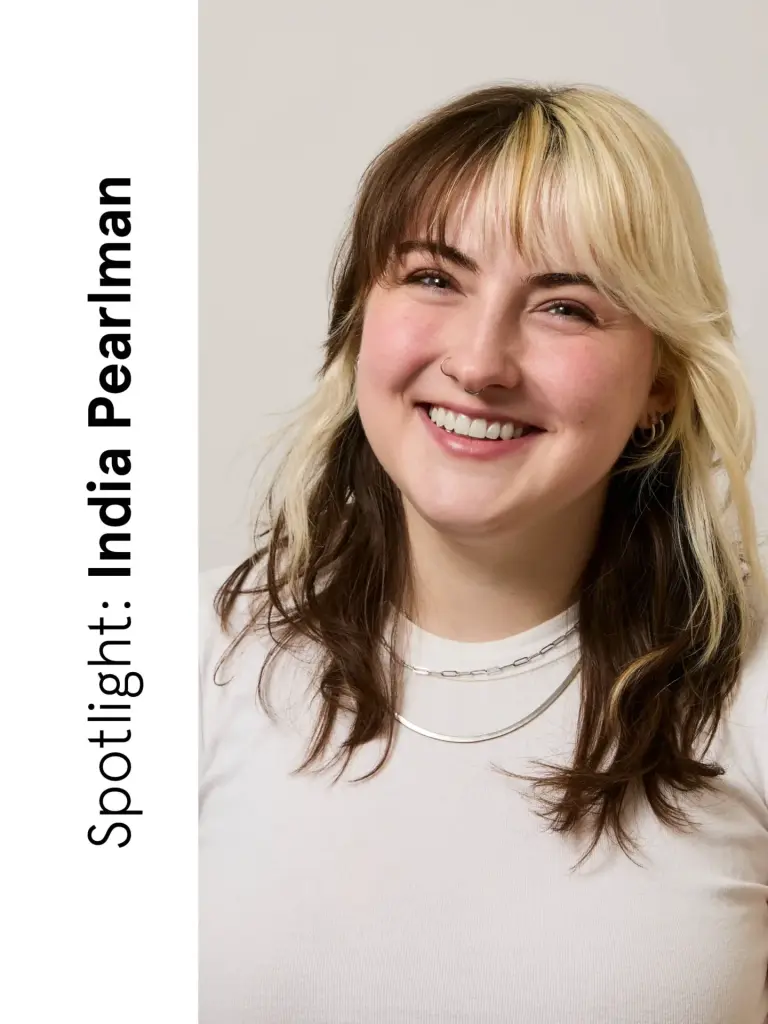
Spotlight articles shine a light on designers and engineers we admire, asking leaders in the field about their work and their creative journey. This month’s Spotlight focuses on the world of wellness and beauty through the lens of India Pearlman, a packaging designer whose work sits at the intersection of industrial design, branding, and product experience.
India Pearlman, packaging designer based in New York and Pratt Institute graduate.
A graduate of Pratt Institute, India brings a distinctly three-dimensional, systems-driven mindset to a field often perceived as purely graphic. Her approach reflects a broader shift in design—where packaging is no longer just a container, but part of a larger ecosystem shaping how products are experienced, displayed, and lived with over time.
We spoke with India about how she found her way into packaging, how industrial design continues to inform her work, and the details she notices that most people miss.
Q:
Can you tell us a bit about your background and what led you into the wellness and beauty space?
A:
I’m a designer based in Queens, currently living in Ridgewood. I graduated from Pratt in 2020 with a degree in industrial design, which was honestly a wild time to enter the workforce. A lot of traditional industrial design roles were hard to find, especially because so much of that work is hands-on.
At the same time, there were a lot of packaging roles opening up. I hadn’t studied packaging in school and wasn’t initially interested in it, but I ended up falling into it because of the timing.
Looking back, it makes sense. My dad works in marketing, and growing up he would show me different pieces of packaging and ask which one I liked more. I think that kind of thinking was always there, even before I realized it.
Eva NYC Freshen Up Invisible Dry Shampoo, a hair care product that combines stock packaging with custom graphics and color application.
Q:
Do you specialize in a particular area of packaging?
A:
I primarily work in beauty and wellness. I got my start in hair care, and the work tends to involve a mix of stock and custom packaging, with a strong focus on graphics, color, and application.
Q:
Do you think industrial design is becoming broader again as categories like beauty and wellness evolve?
A:
I definitely think so. At first, it felt strange to move from identifying as an industrial designer to working as a packaging designer, but over time I’ve seen how closely those disciplines are connected.
There’s a strong overlap between graphic thinking and the physical object—how something exists in space, how it’s held, how it’s experienced. Packaging and industrial design really do belong to the same world.
Q:
How does your industrial design background show up in your work today?
A:
I still rely on it constantly. Having that three-dimensional understanding has allowed me to go further in my role and take on more than just packaging. I often work on retail displays and spatial elements as well, which are very much rooted in industrial design.
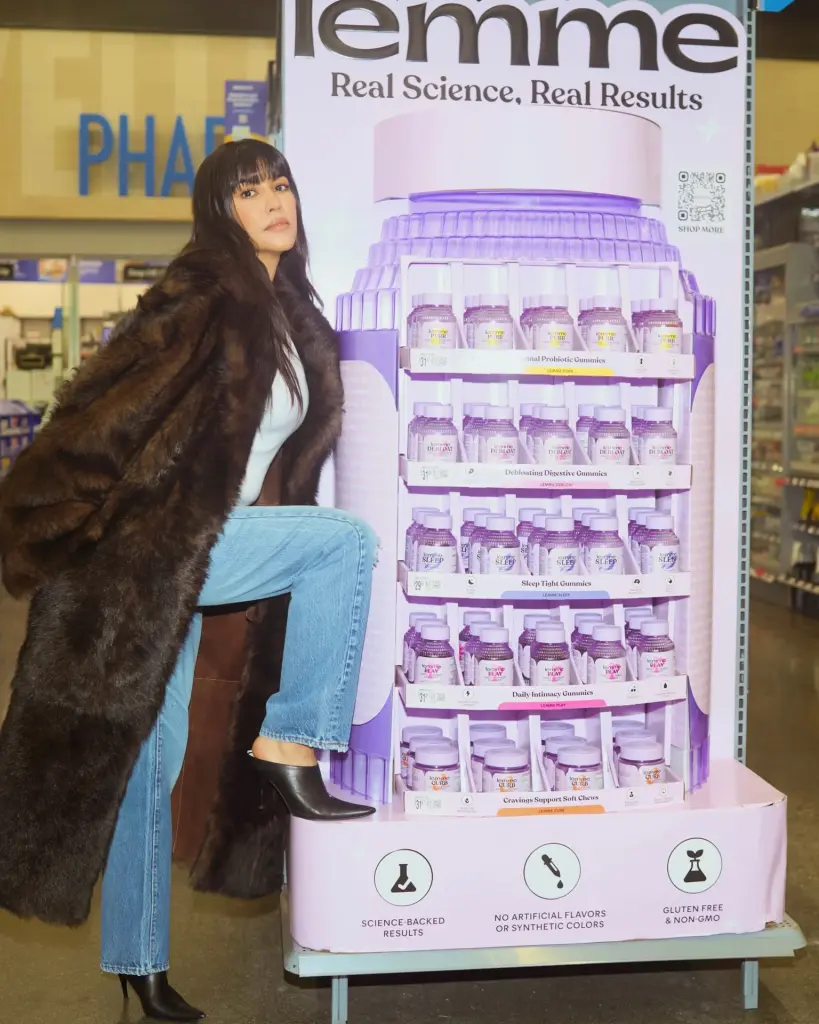
Lemme’s Walmart retail display, where packaging extends into spatial and retail design.
My understanding of materials also helps me collaborate more effectively with other teams. I’m able to bring ideas that are creative but also feasible, and sometimes even anticipate challenges before engineering gets involved. That foundation makes a big difference in how projects move forward.
Q:
What usually comes first for you: visual idea, tactile experience, or story?
A:
I typically work under the brand design team, and branding involves a lot more story-based thinking. I like to start with that because it gives me a direction and purpose. Because I work closely with brand teams, there’s often a strong narrative behind the product, and that gives me direction and purpose.
Packaging design involves a lot more brand thinking. Working within brand guidelines might seem limiting, but I actually find it freeing. It allows me to focus more deeply on the design itself, knowing that I’m working toward a clear and intentional goal.
Q:
Beauty trends move fast. How do you think about what lasts versus what’s fleeting?
A:
It can be tricky. Right now, we’re seeing a lot of minimal, sans-serif typography and simple, blocky forms, and that’s been around for a while.
I look at a lot of references. I scroll through Pinterest, study retail environments, and look at other brands, but I also rely heavily on intuition. One of the biggest considerations for me is how a product will live in someone’s home. Is it something they’ll want to keep and display, or something more temporary?
I also look to interior design trends for inspiration. There’s a movement toward more expressive, colorful spaces, what people call ‘dopamine interiors’, and that’s influencing packaging as well, especially for younger brands.
Q:
What’s a packaging detail most people never notice, but you always do?
A:
I immediately notice when things don’t align across a product line. If packaging isn’t proportionate or the typography shifts from one SKU to another, it really stands out to me.
A lot of my work has focused on refining those details. In one role, I did a full packaging revamp that addressed inconsistencies most people wouldn’t consciously see, but that make a big difference in how cohesive the line feels. I’m always thinking about how everything works together as a system.
Q:
NEST x Drawbertson Holiday Collection, an example of packaging that functions as a unified system across an entire product line.
When you’re shopping, are you able to enjoy it? Or are you redesigning everything?
A:
It depends on where I am. In a typical grocery store, I’m definitely redesigning things in my head and questioning a lot of decisions.
But I love going into smaller markets that carry emerging brands. Those spaces tend to have really thoughtful, exciting packaging, and I find them genuinely inspiring. I also take a lot of photos when I’m out, especially in places like Sephora, whenever something catches my attention.
Grocery stores are hard. there’s a lot of packaging that’s been around a long time where I’m like – we could do this better.
Q:
What materials or sustainability approaches are you most interested in right now?
A:
Post-consumer recycled plastic has become much more standard, which is great to see. Beyond that, I’m really interested in paper-based and refillable packaging systems.
Refillable design is especially exciting because it allows you to create a more permanent, beautiful object that people want to keep, paired with a more sustainable refill system.
I’m also paying close attention to finishes. For example, traditional foil treatments make packaging harder to recycle, so I try to push toward alternatives that achieve a similar effect while remaining recyclable. You can also get a lot out of embossing and debossing. There’s a lot of innovation happening there right now.
Q:
If you could collaborate with any brand right now, what would it be?
A:
I would love to work with Prada, especially on fragrance. Their packaging is very architectural, which really resonates with me.
There’s also something interesting about their fashion and accessories, like their bags that translate into form and function. I think there’s a lot of opportunity to bring that same thinking into packaging design. It would be interesting to see how their fashion informs cosmetics, and how something like a handbag, which is itself a functional industrial design object, could inform packaging.
A Q&A with Digital Design Expert Priyankaa Krishnan
A Q&A with Digital Design Expert Priyankaa Krishnan
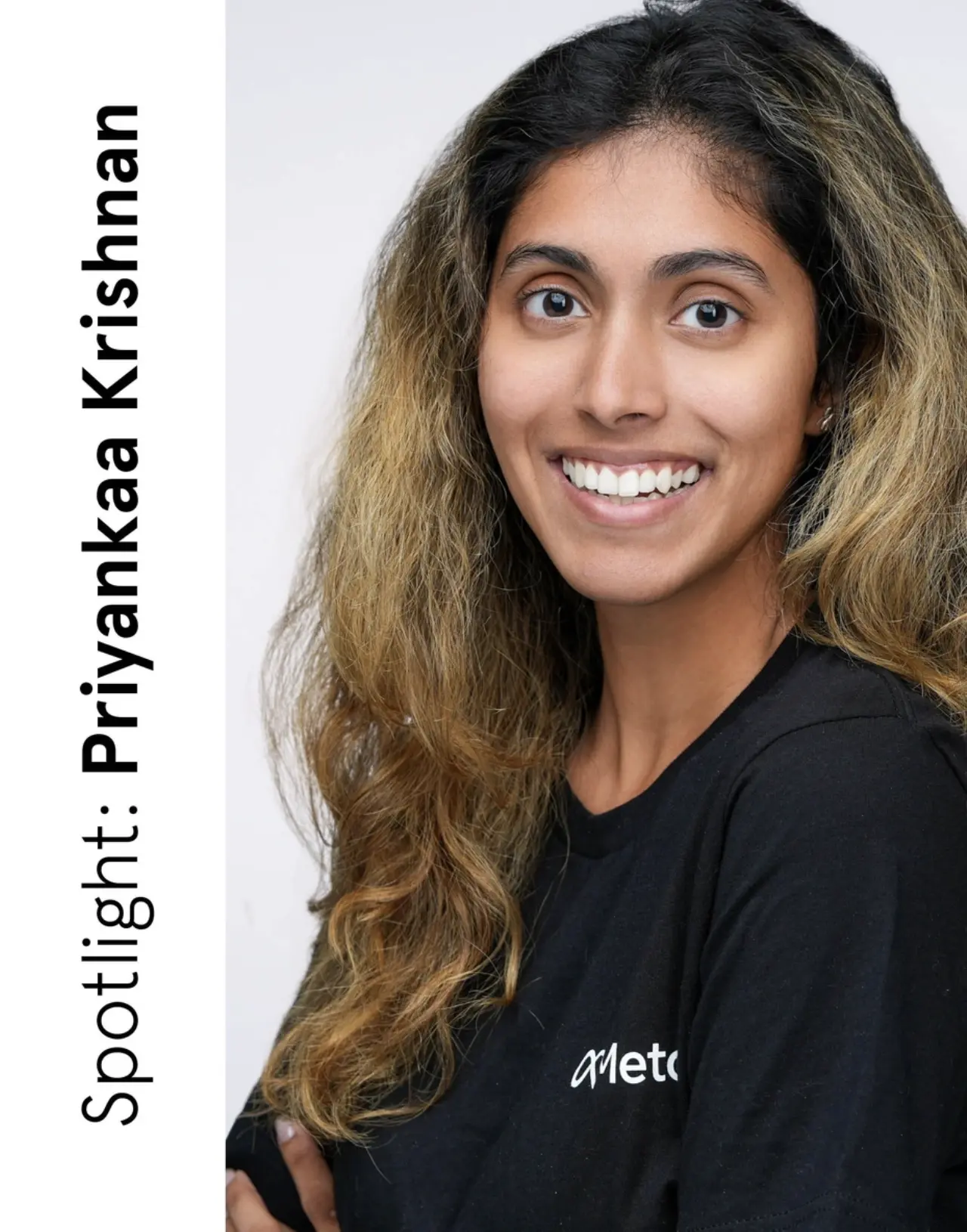
Spotlight articles shine a light on designers we admire, asking leaders in the field about their work and their design journey. For this installment of our Spotlight series, we sat down with digital product designer and change-management leader Priyankaa Krishnan. Trained in product design and instructional design, Priyankaa now works on complex, internally-facing tools within the supply-chain organization at a large west coast based tech company—one known for building its own systems from the ground up. Her path from international student to designer and change leader is defined by curiosity, systems thinking, and a relentless focus on user adoption.
Photo courtesy of Prinyankaa Krishnan.
In this conversation with Interwoven founder Rebeccah Pailes-Friedman, Priyankaa shares how she weaves user insights into strategy, balances business priorities with human needs, and runs rigorous testing cycles that turn ideas into durable, real-world solutions. She also offers candid, actionable advice for emerging designers.
Priyankaa Krishnan is a program manager, and in her job she pairs digital product design with change management to launch and scale internal supply-chain tools. She earned a master’s in Industrial Design from Iowa State University, and is pursuing a PhD in Human–Computer Interaction at her alma mater. An international student turned design leader, she blends UX strategy, analytics-driven decision-making, and Prosci-informed change practices—translating BRDs into measurable outcomes and guiding cross-functional teams through rigorous testing (E2E, QA, SIT, UAT) so new processes become everyday habits.
Q:
Could you start by sharing a bit about your career path—how you found your way into digital product design and change management?
A:
I came to the U.S. as an international student, which meant a lot of my early choices were constrained by visas and timing. I studied product design at Iowa State and discovered I loved teaching, so I completed a graduate certificate in instructional design. That opened the door to my first role—building learning experiences and micro-learnings inside a large enterprise.
So many of my early decisions weren’t really choices. Because of my visa status, I often had to pick from whatever options were available and run with them, and that shaped me. The instructional design credential led to an offer for the job she currently holds. At the same time, I had an entry-level product design offer from Ford and was waiting to hear back from Sac State (California State University, Sacramento). I even asked the my interviewers for a week so I could wait on Sac State. On my mentor Ana Luz’s advice—“take the tech job!”—I accepted. I call myself an “accidental” instructional designer: I didn’t know the corporate toolset at first, but I learned by doing, practiced hard, and that’s how I landed and grew in the role.
Q:
So, what exactly is an instructional designer?
A:
An instructional designer builds learning experiences—often micro-learnings—for a learning management system, guiding people from not knowing to knowing. In corporate settings that also means unlearning and relearning. The courses I built focused on changes to systems, processes, people, and tools. That’s where “change management” comes in: when something changes, you have to educate people so they can adopt it. Early on, my job was to create courses, publish them to Cornerstone (our LMS), and track participation. But I kept wondering about the bigger picture: I can design beautiful courses because I’m a designer—but are people actually adopting the change, and to what purpose? Leadership was asking the same question.
A mentor at work, Mikki Lee, introduced me to Prosci and change management. I took the workshop, earned my certification, and transitioned from instructional designer to change manager. I came to see instructional design as a subset of change management. Knowledge is just one part of it; you also build awareness, gauge desire, develop knowledge, assess ability, and ensure reinforcement—from the top down and the bottom up—so adoption actually sticks.
While I was driving end-user adoption, I also became a critical part of designing the solution itself. I work in the supply-chain space with internal users, making sure our products are ready for customers while our systems, processes, and tools continually improve for employees. That only works if our teams stay current with the changes we’re designing for them.
Q:
You specialize in Design Thinking and UX strategy—how do you weave user insights into your process from the very beginning?
A:
In an established corporate environment, we don’t go hunting for problems—the business brings them to us through Business Requirements Documents (BRDs) that outline use cases and current pain points. In parallel, we run periodic audits of existing tools, collect in-product quick-feedback surveys, and use a “bug nub” (a small bug icon in the UI) so anyone can file bugs or request features. Because the ecosystem is mature, we’re usually redesigning or improving something rather than building from scratch; about once a year we do ship a completely new tool for a team and then manage onboarding.
When a BRD comes in, we map the pain points and triage them: what’s a nice-to-have vs. what’s P0. P0 means the business cannot function without it—if a P0 breaks, the business breaks—so we tackle those first.
From there, the design process is standard: we identify the stakeholders who submitted the requirements and run quick interviews to confirm the five W’s and H (who, what, when, where, why, how) and close any gaps. Then we publish a plan: the three things we will accomplish this half, clearly separating what must happen immediately to keep the business running from what belongs in the long-term roadmap.
Q:
When you’re working on change management, how do you balance business goals with the human experience of design?
A:
Change is tricky. When we roll out new ways of working, the business often resists—people are used to doing things one way, and we’re asking them to do it another. The most effective lever is top-down alignment. We take a proposed solution to leadership and, when it maps to organizational goals, secure a clear mandate. That makes the change mandatory, not optional, and leaders can communicate, “This change is coming and we need to adopt it.”
Not every rollout is mandatory, though. I distinguish between mandatory tools and reference tools (nice to use, not required). For reference tools, we run a “rally” approach: we visit teams during their regular meetings and give a focused 15-minute demo—“Here’s the tool; here’s exactly how it benefits your team.” Crucially, we aim to have the team’s manager deliver and reinforce the message. If the instruction comes from a manager, people do it; if I pop into a room and say, “Stop using this button, use that one,” it doesn’t land the same way. When the message comes from the business, via the right manager, adoption accelerates.
A recent example (kept high-level due to sensitivity): shifting government-driven costs have impacted pricing. We built a reference tool to visualize pricing changes, but some teams still rely on spreadsheets out of habit. In these cases, I partner with the group that’s accountable for those expenses and have them champion the tool to the affected teams—so they can answer to leadership with confidence and the organization gets consistent, accurate data.
All of this is deeply cross-functional. I sit between engineers and software developers, design, the business, and end users—coordinating requirements, aligning incentives, and making sure the right people carry the right messages at the right time.
Q:
What role does collaboration play, and how do you bring cross-functional teams into the process?
A:
It’s highly cross-functional—solution leads, engineers, analytics, QA, and business stakeholders. Honestly, it’s “a lot more talking than doing” at the start—on purpose. We align on use cases, metrics, and constraints before we build. Weekly feedback loops let us present options (never a blank page) and tradeoffs. I don’t ask, “What do you want to see?”—I bring two or three viable concepts and facilitate a decision.
Q:
In digital product design, how do you gather and interpret insights to keep a concept on track?
A:
Gathering insights: I lean strongly on analytics. Because we’re often improving existing systems rather than starting from scratch, we begin by measuring current performance and identifying gaps. We partner closely with our (very large) Analytics team.
From each Business Requirements Document (BRD) we produce two artifacts: (1) product development requirements, and (2) an analytics requirements spec. Working with solution leads for the supply chain, we define which metrics matter and the exact definitions for each (numerators/denominators, business rules, segments). All relevant event and system data is stored in a central data repository.
Analytics uses the spec to build dashboards that map gaps to requirements. They’ll literally chart, “this metric is low here, that one is high there,” against our targets. If the organization says the goal is 95%, and we’re at 87%, we run root-cause analysis using taxonomy slices (flow, geography, vendor, tool, milestone, etc.). For example, we might see in-transit delays spike and discover a missing milestone between a supplier and our system.
Q:
Physical product design leans on iterative prototyping. How do digital testing methods compare or complement that process?
A:
In our ecosystem, the UI kits and brand patterns reduce surface-level design decisions, so we can focus on solution design. For new tools, we still iterate: weekly reviews, side-by-side concepts, test environments, and structured test scripts. We run multiple layers before production: end-to-end team testing, QA, systems-integration testing (SIT) across upstream/downstream tools, and user acceptance testing (UAT). It’s iterative—just like physical prototyping—only the fidelity is software builds instead of foam and muslin.
Q:
Can you share an example where testing or validation revealed something surprising and shifted direction?
A:
We built a data-collection feature and tested single-record flows successfully—then discovered we hadn’t prepared the environment for multi-record scenarios. Everything failed, and we had to push the project by three months. Another time, notification settings weren’t validated in the dev environment; when we went to prod, thousands of emails failed over a weekend. Painful—but those misses made us tighten our checklists and guardrails.
Q:
What advice would you give designers who want to strengthen their testing and validation skills—digital, physical, or hybrid?
A:
Communicate early. Build awareness that change is coming and invite feedback while it still matters.
Detach your ego. Don’t treat the work like your baby—critique is data.
Timebox and prioritize. Fix the P0 issues immediately; queue lower-priority requests for later.
Make it real. Whether it’s a clickable prototype or a rough build, tangible artifacts unlock better conversations than slides.
Q:
Anything else you’d like to share with young designers getting started?
A:
Apply steadily—even 15 minutes a night. You never know who’s looking. And practice showing unfinished work. Confidence grows when you iterate in public, learn fast, and move on.
Spotlight articles shine a light on designers we admire, asking leaders in the field about their work and their design journey. In this interview, we spoke with renowned industrial designer Linda Celentano. Based in New York, Linda has built a remarkable career spanning many decades and disciplines, creating work for iconic brands like Nambé, Smart Design, Knoll, Alessi, Dansk, and Rosenthal.
Photo courtesy of Linda Celentano.
A graduate of Pratt Institute and a longtime professor of Industrial Design there, Linda studied under legendary educators Rowena Reed Kostellow, Dr. William Fogler, and Gerald Gulotta. Her work is defined by its elegance, clarity, and human-centered innovation. She is famous for designing everyday objects that invite interaction and reflect her belief that “good design beckons the human touch.” She has been awarded many prestigious design awards and her work is part of the permanent collections at The Cooper-Hewitt National Museum of Design and The Chicago Athenaeum. We asked her about defining moments as a designer, continuing to push creative boundaries after decades in the industry, and the experience of collaborating with young designers.
Q:
How did you become an industrial designer?
A:
I woke up one day as a student and I learned that real people design yoyos and church interiors and everything. Wow, that was such a wakeup moment. My father was a mold maker for injection mold-making. He made steel molds for companies like Chanel and Donna Karan. It’s so fascinating when you’re a kid, anything your parents do is compelling. He would come home when I was 5 years old with stuff from work and we were always so impressed. We had no idea what he was talking about, it was just a chance to hang out with dad and see what he does when he goes to work. So, I’ve been around people that work with their hands a lot. There are a lot of engineers and teachers in my family and they all had an influence on me.
I loved playing in the woods, making little houses in the field, making and building things. When I got to Pratt, I learned that there was a way to actually make things three-dimensionally that were real products for the world. I became fascinated with art and industry. Making one-of-a-kind things just didn’t tickle my fancy.
Q:
You’ve had a remarkable career designing for brands like Nambé, Alessi, and Knoll. Looking back, what are the defining moments that shaped you as a designer?
A:
One of the most defining moments for me was working in a factory. I was designing, but I was also in a factory environment. I encourage my students to work in a factory as a summer job. The miracle of manufacturing becomes a reality once you see products being prototyped, manufactured, and going through quality control. You get to see the whole process from beginning to end. It is about process, not just the event of a produced final product. Once you understand working in the factory environment, you understand manufacturing all over, in all realms. The factory was out here in Passaic, New Jersey, and we manufactured products for orthopedic surgery. I spent a lot of time in the operating room, observing surgical procedures and then I went back into the factory and worked with the men and women in the shop where we develop prototypes. I would run down to Canal Street and get pieces of wood, plastic or foam or metal or whatever and bring them back to mock something up first.
What was so cool was that once you three-dimensionalized the idea, you could jump into the computer, start creating the manufacturing drawings, bring that to the prototype department, and start getting things actually made. It’s all experimentation until it gets to the assembly line. That’s seeing something come to fruition. The assembly line thing gets me every time.
Another defining moment was, asa child, seeing the table being set every day for each meal—going through that ceremony of choosing settings for the table. That was an important design experience. Seeing cooking and everything involved, and seeing my parents treasure something beautiful would really capture my attention; seeing that moment that they would admire something. After washing a glass, they would hold it up to the light to see the clear crystal. Moments like that were so important.
Q:
Many of your designs have become iconic design objects. Could you share the story of one that is particularly meaningful to you?
A:
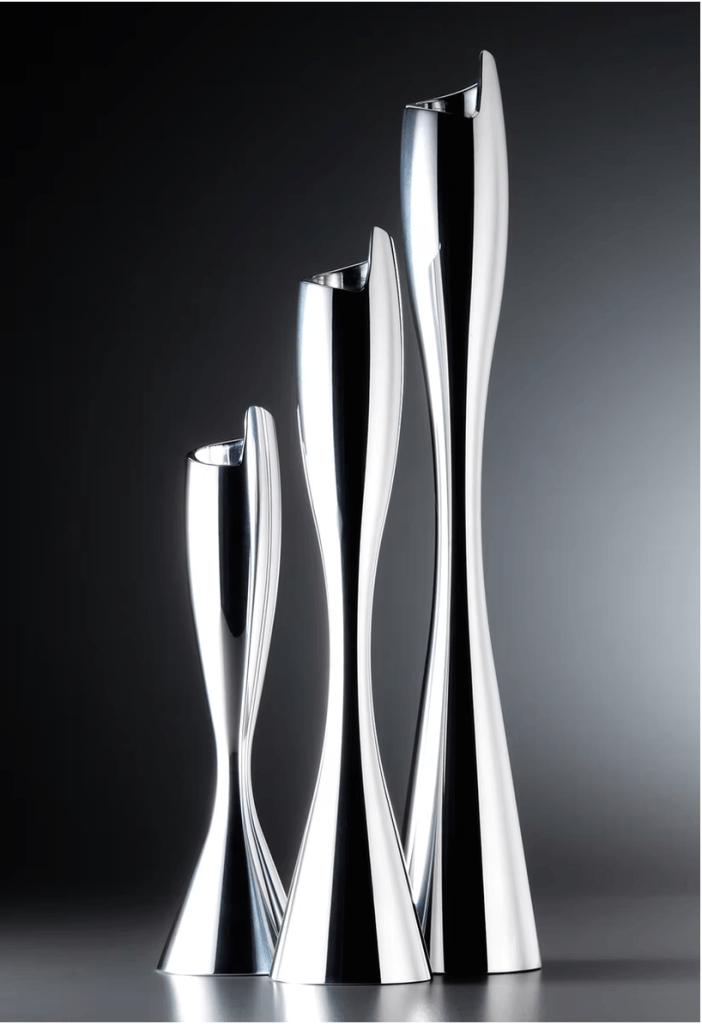
Candlesticks for Nambé, designed by Linda Celentano. Photo courtesy of Linda Celentano.
One of my favorite stories is from when I was designing for Nambé. I love designing initially in three-dimensions. So, I bought a lathe and I dragged it up to my old apartment and put it in the dining room—because that’s the only place I had for it—and turned candlesticks on the lathe in my dining room. There were chips and material all over the place! It was so funny but, for the sake of good design, it was worth upsetting my whole home. I just love that, to be young and kind of nuts. It was exciting, and they went on to be very successful designs.
I remember coming from a meeting from Dansk one day with my business partner, Lisa Smith, and everything went poorly. Nothing went right. So we’re in the elevator and we’re complaining about how the meeting went, and there was some guy in the elevator. We’re carrying our bags and everything, our goods, and he looks at us and he says, I’ll look at your work. It turns out that he was the marketing director for Nambé and that little complaining session led us into a 30-year working relationship with a client. So, you never know how things can come together.
Q:
Your work embodies abstraction, elegance, and innovation. How do you continue to push creative boundaries after years in the industry?
A:
I love working experimentally and coming up with new designs, whether it’s in glass or metal or ceramic or whatever material. When you’re working experimentally, boy, you just don’t know if it’s going to sell. You have to hit it right with marketing and everything that’s going on in the world and what people are looking for. You may be showing the most beautiful thing in the world and if it’s not fitting into the marketing plan, then you have to move on.
I depend very much on my colleagues, particularly Karen Stone, Jeff Kapec, Deb Johnson, Lisa Smith, and Gina Caspi. I’m forever running designs by them to get feedback. This experience is dear to me because I really value their feedback and opinions. I will also run things by Bruce Hannah and Tucker Viemeister, and they’re very patient with me. I work by myself and I hire freelancers, so getting that feedback is really critical as well.
Q:
You’ve said that “good design beckons the human touch.” Can you elaborate on that?
A:
As a child, I was always drawn to the warmth and kindness of others. Design is wanting to be close to the things you love. It’s that simple.
Q:
How has your design philosophy evolved over the years? What principles have remained unchanged?
A:
In the beginning, we would start things three-dimensionally and really develop them in three dimensions. The things we came up with to make things three-dimensional were quite remarkable, we didn’t have the advantages of all these computer programs to make something feel real even before it was a product. Back then we were working conceptually in three dimensions: plaster-spinning, making things out of wood, cardboard, spackle, museum board, ceramic, plastic, so many different materials. We did pencil drawings of everything that we needed to manufacture. And then, eventually, we were working on the computer, which was amazing. Today the computer gets us to so many interesting levels as far as manufacturing, marketing, and being able to show beautiful renderings. What’s essential for me is to have a 2D/3D/2D/3D process. I’ll come up with a doodle or a ceramic shape or a clay form and then I’ll work with my freelancers. I’m certified in Solidworks but I remember Gina Caspi telling me, “Linda, you can’t be excellent at everything. Why not just be a 10 at the things you’re good at and then hire people that are all 10s.” That was some of the best advice I was ever given by Gina.
Now I work with young, up-and-coming designers. We draw up the design in Solidworks and then we get a 3D print. I see the 3D print, which is half scale, and I’ll make my markings on it to note the changes. Then we’ll go back to the computer, improve the model, do another 3D print, take another look, make improvements, and so on. So, it’s a 2D/3D thing. Ultimately, after everything’s refined, you get a full scale 3D print.
When you do the first Solidworks model and pop it into a keyshot rendering, it’s so powerful. The client sees that and they say, Let’s do it! Let’s make a sample right away! And I have to tell them, No, we really need to backtrack and make these smaller refinements before we can go ahead and make a sample. There’s so much process work that needs to be done on the road to that goal. So, how things have changed is that you have to work with the computer and with people and go back and forth. Once again, design is a process, not an event.
Q:
If you could go back and give advice to yourself as a young designer, what would you say?
A:
I would say that it’s okay to be an introvert. The world is full of extroverted people. Susan Cain, who wrote the book Quiet, said that introverts are many of the real workhorses of the world. It’s good to have an understanding of this, within yourself and with others, that it’s okay to be an introvert. Why try to make an introvert into an extrovert? On a scale of one to ten, I’m a four or five, on average. But, over the course of my day, I might be a one, a two, a three, a nine, a seven, a six, and then a five. I try to encourage students to be okay with where they’re at for the day and for the moment.
Q:
What excites you most about working with younger designers, and what challenges come with it?
A:
Old school and new school. It’s so exciting to work with young designers. It can be sad, though, for some old school designers. They’ve had to hang up their slippers because they don’t have the technology to support themselves any longer. They know how to make things by hand. They know how to turn things on the lathe but they don’t have the technology. I feel that teaming up with young people who have that technology makes for a great team between old school and new school. And I work exclusively with young people. I learn from them and they learn from me. I work with my team at home here in my studio, over Zoom. I am texting them or I’m on my iPad, sending them doodles, 2D and 3D drawings, or photographs. We pull up Solidworks, and they will model the idea.
We’ll be designing something and I’ll use Rowan Reed Kostellow’s principles and language. They, too, are from Pratt, so they also know Rowena’s principles and language. It is not just about looking at something and saying, I like it. I don’t like it as much. It’s not good enough. Rowena taught us the language of three-dimensional literacy. So the two of us will be looking at the work and I’ll say, You need to make the concave and negative space of the volume of the form deeper to improve the overall proportion. Or, The curve on the spline needs to be a faster curve with more accents towards the end of the curve. Or, the negative volume could be more horizontal instead of vertical, so it relates better to the other objects in terms of the overall proportions. This kind of language. I encourage all designers and design students to read Rowena’s book, Elements of Design, to take workshops with us at The Rowena Group, to follow our newsletter, and to follow us on Instagram. I want them to understand that being able to communicate in three dimensions with real language is the way to go today. It creates so much freedom. The freelancer I’m working with completely understands everything I’m talking about. I could talk to anyone who’s a designer from anywhere in the world and they would understand. Anybody can understand that language, if they really listen to it, but not everyone can speak the language. Pratt students, when they get out there, they really sound like geniuses. Learn a new language!
Of course, you are not only speaking to other designers. You might be working with marketing, and they might have a background in art history or some creative field that led them there, giving them some kind of visual understanding of things. To be able to say things like, That space should be more concave so the liquid can flow more, right now it’s too shallow, that’s valuable. To be able to describe the qualities of a design with someone outside the design team while using this language is really important, too. Certainly in terms of working with people in quality control in the factory. The language is beautiful. It’s not just something that you do in class.
Q:
Can you share a time when collaborating with a younger designer changed your perspective?
A:
There are many examples, but I’ll mention one. I was working on a deadline. There were a couple of us working on the project and we sprayed a large print of a render to lay it onto a board. When it went down onto the board it didn’t lay flat and I nearly lost my mind. No! What are we going to do! I’ll never forget what the young student said. He said, “There’s always a way.” And he managed to undo it, lay it down flat, and it was perfect and everything was fine. Whenever I run into a problem or a challenge like that, I hear his voice and I think, There’s always a way.
Q:
How can emerging designers best leverage the wisdom of design veterans while still asserting their own vision?
A:
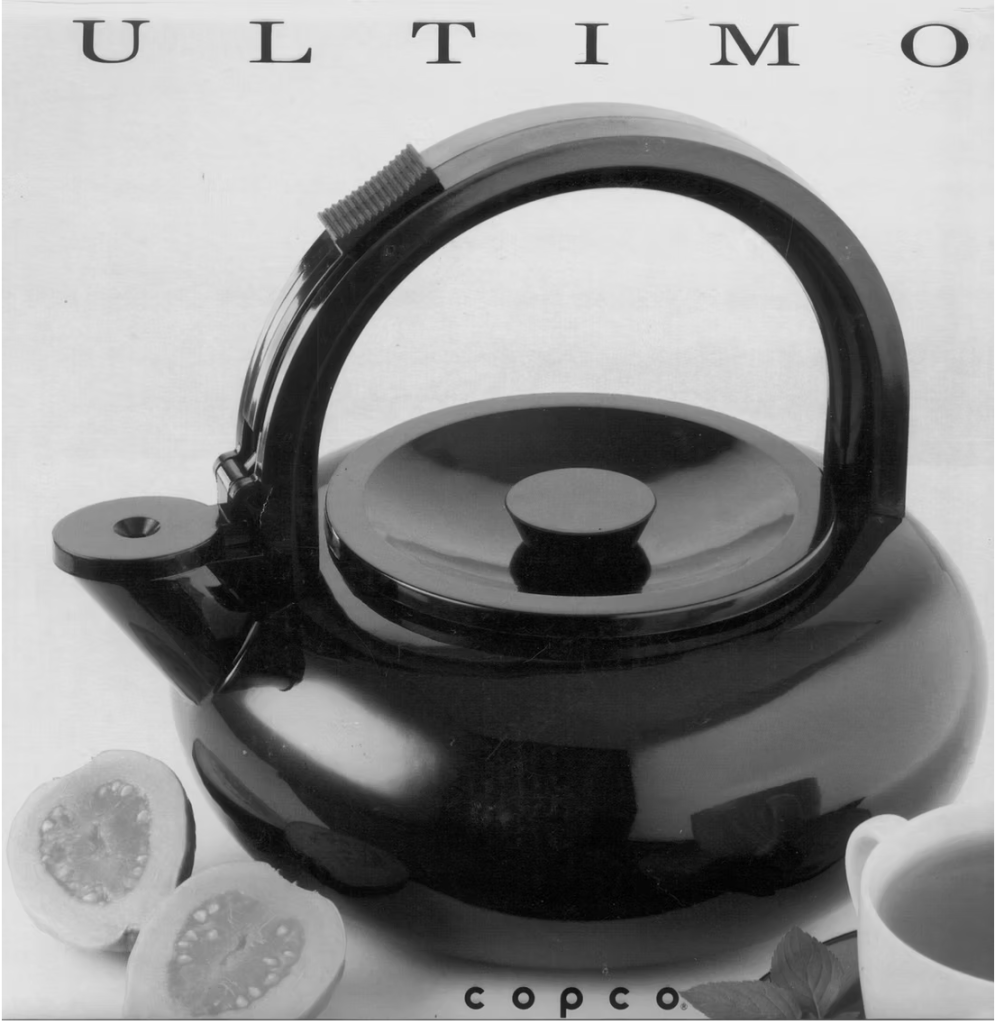
The Ultimo Whistling Tea Kettle for COPCO, designed by Linda Celentano and Sam Lebowitz. Photo courtesy of Linda Celentano.
You’ve got to be working with people that are open-minded and let people in. I try with my freelancers to really hear them, what they have to contribute. I love being able to say, What do you think is best? Or, How do you see this going? Or, What do you think is better, transparent or opaque? Which do you like better? I love getting their feedback. They’re visual people, just like I am. It’s a gift to be able to work in a team setting, not only because of their incredible skills but because of what we have in common. When I was a senior at Pratt I was working with Sam Lebowitz. He taught me so many things. He taught me the difference between a 32nd of an inch and a 16th of an inch. When I designed eyewear, boy, that became really important. I designed a whistling tea kettle for Copco with him. I was just a senior in college, and here we were. He gave me so much leeway. It was wonderful. That tea kettle was a great seller for over 25 years, which is almost unheard of in housewares unless you are an OXO product!
Q:
What are the most significant shifts you’ve seen in the design industry over the course of your career?
A:
Everything changed with computers and digital work. Everything changed dramatically, and definitely for the better. But I’m worried that many things are being designed for a Keyshot render. It’s unbelievable. I have a Calphalon coffee pot. It makes no sense. I have to open the lid this way to pour the water over the top of the lid. It’s all backwards and crazy. And then the filter paper holder is not tall enough, so when you swivel the cone shaped paper it gets all jammed up and the water doesn’t drip through it properly. I had to work with it . Reason why I didn’t return it is because the quality of the coffee it made was good.
On the other hand, when I went to Turkey, I was in a museum and I saw a pair of boots that were gorgeous. They were handmade and they were so beautiful. There’s no way they could have been designed on a computer. They were designed on the foot, there’s no question about it. We can’t lose the old ways but we also can’t deny ourselves the advantages of modernism.
Q:
Many industries experience ageism—have you faced this in design? How do you think the industry can better value experience?
A:
Ageism is a serious problem. For me personally… people open the doors more for me now as I’ve gotten older. Gray hair will encourage that! I haven’t really experienced it in my life other than the beautiful experience of hearing someone like Patricia Moore talk about how we don’t say the word ‘elderly’, we say ‘elders’. There’s such beautiful meaning in the wording that she uses in terms of human beings. There used to be a bench near the elevator in Pratt Studios and they took it away. I don’t know why, but that elevator is quite slow and it was so nice having a bench there. I remember Lenny Bacich used to say, Try being human. He, along with Rowena, Dr. Fogler, Gerry Gulotta, Ralph Applebaum, Lenny Bacich, they were all mentors and friends, and they spoke their wisdom!
Q:
What do you think separates a good designer from a great one, especially after decades in the field?
A:
Some designers are trainable and others have raw talent. Great designers are both. Maybe I could substitute the word ‘training’ for ‘designers who know how to educate themselves’ because it’s all a learning process. It’s all a process from beginning to end, and understanding that, once again, it is a process and not an event. Keyshot is an event. The process of designing something is an educational process. It comes along with being inspired, getting good feedback, and exploring; pulling in years and years of training and then being as open as a child when you first design something. I can be stubborn at times, but I definitely still get into that child-state when I’m designing.
Bill Fogler, when he was ill with terminal illness, asked me to take over his class. That was the hardest experience I ever went through; going through his illness with him. He taught for 35 years. I said, “How can I fill your shoes? That would be impossible.” And he turned to me and said, “Linda, all you have to do is love them.” And that’s all you have to do with people in life, just love them. Students especially, because they’re really struggling. They’re really trying to make it work and make it happen. If you approach them with that kind of care and openness, it’s a wonderful thing. There are times you just want to shake them! Every time I want to shake them a little bit I think, No, no, that’s not the right approach.
Q:
Do you see a generational divide in design thinking, or do core design principles remain universal?
A:
I’m experiencing people being drawn to each other because of their common interests. It’s like writing a good script. It takes time, you’re crafting it from the beginning, and there are so many players involved. It’s like a good dance performance, right? Everyone’s in relation to one another. I don’t think I ever feel like, Those young kids, what do they know? It’s time to really applaud the youth in the world. They have so much to give and they’re incredibly optimistic. Thanks to them, I feel a lot of hope for the future.
I do that in my own little world on a local level. I can change the world in my day-to-day thinking and exchanges with people, whether it’s talking to my mom or my neighbors or my client—just taking a real interest in them and in what’s going on in my world; living more in the present, in the moment. If everyone lived their life fully in a local way , society would be a better place. Someone said to me recently, When you’re on the phone, and someone’s just said something that interests you or pleases you, smile. Don’t save that for an audience. Try to capture more joy in your life.
I think it’s important to encourage the youth. Don’t break their spirit. There are times when we just need to know that we’ve been listened to. A young person is so amazed when you ask them about themselves.There is a family that lives across the street from me and the young son just applied for colleges. I helped him with some of his applications, and his whole world opened up when he knew I was there for him. There are different speeds to how people respond to things in life. I think of my grandfather so often, of him just nodding and saying, Show me more. He had very few words to respond to me as a young kid. There was more of an outpour from me because his interests were so broad and he wasn’t judgmental. There is a great generational divide if we’re not open-minded. No matter where we are, no matter how old we are, no matter what generation we are, we need to be open-minded.
From Sketch to Shelf: The Soft Goods Industrial Design Process in 6 Steps
From Sketch to Shelf: The Soft Goods Industrial Design Process in 6 Steps
Bringing a product from an idea to reality is an exciting journey—one that blends creativity, technical expertise, and user-centered thinking. In the world of wearable technology, great design isn’t just about aesthetics; it’s about crafting solutions that seamlessly integrate into people’s lives. From the first sketch to the final product on the shelf, every step in the industrial design process plays a crucial role in shaping a wearable that is functional, comfortable, and market-ready. There are a lot of ways to break down the design process, and they all have their uses: the double diamond, the design thinking cycle. Search ‘design process’ and you’ll find endless diagrams and breakdowns. In this Insight article, we’ll walk you through the key stages of industrial design, giving you a behind-the-scenes look at how innovative products come to life.
Step 1: Research & Discovery
The journey of creating a standout product starts with diving deep into the world of research and discovery. This initial phase is all about truly understanding the problem at hand—getting to know the needs of the users, the latest trends in the market, and how competitors are shaping the landscape. By mapping out these elements, designers can pinpoint where opportunities for innovation lie, crafting solutions that stand out in a crowded market. This phase is about more than just solving a problem; it’s about creating something that resonates with users and is perfectly positioned to make an impact.
The SABER Military Exosuit
A key part of this research involves ethnographic studies and interviews with the target user community, which allow us to step into the shoes of the users. Through ethnography, we spend time in the real world with the people we’re designing for, understanding their habits, behaviors, and challenges. We did extensive research for our SABER Military Exosuit to understand the key tasks and body positions required of the soldiers who would be wearing the suit. This research was critical to understanding how to create a suit that would move effectively with the user. It’s a deeply immersive way of discovering what truly matters. Later, we’ll use these insights to develop testing protocols for our prototypes, ensuring that the design is not just functional, but also intuitive and user-friendly.
Step 2: Concept Development & Ideation
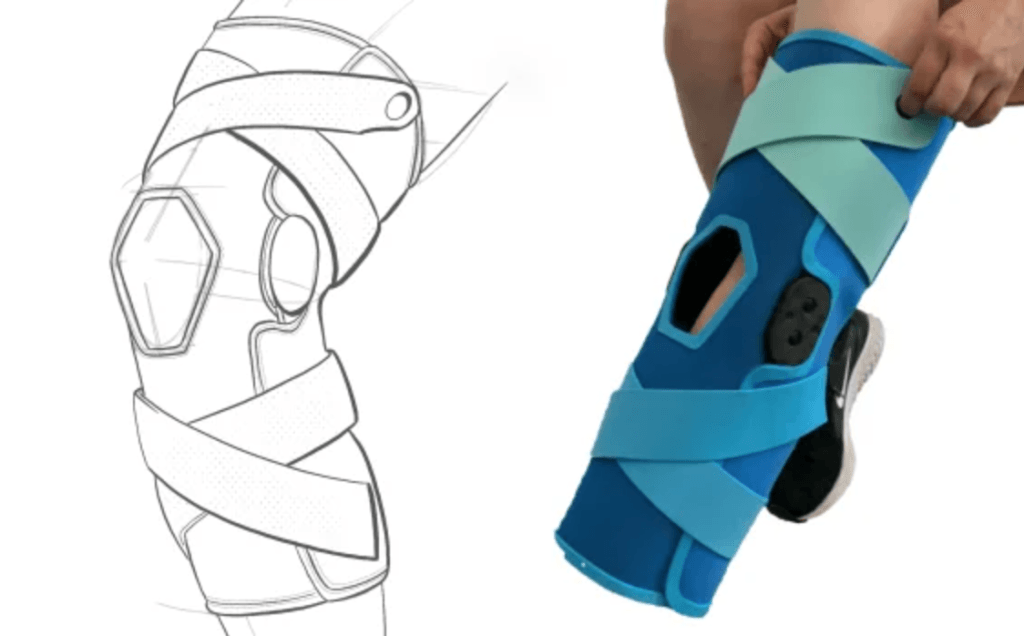
Once we’ve gathered our insights, it’s time to bring ideas to life through concept development and ideation. This stage is where creativity thrives, as designers explore different possibilities for form, function, and aesthetics. Sketching and early visualizations allow us to experiment with various design directions, refining the product’s overall look and feel. The goal is to create something that not only meets user needs but also resonates emotionally, balancing beauty with functionality. Sketching is a big part of every project we do at Interwoven Design, a great example being the Breg CrossRunner Knee Brace. We were open to many strategies for meeting the project requirements, and we sketched dozens of ideas before moving on to the prototyping stage. Every sketch brought us closer to finding the ideal design that would work both in concept and in reality.
A sketch and prototype for the Breg Knee Brace project by Interwoven Design Group.
To refine our ideas further, we use mood boards, storyboards, and collaborative brainstorming sessions. Mood boards help convey the visual direction, pulling together textures, colors, and inspiration that guide the aesthetic choices. Storyboarding helps illustrate how users will interact with the product in real life, showcasing key moments in the user experience. Throughout this process, we collaborate closely with engineers, material scientists, and stakeholders to ensure feasibility. This interdisciplinary approach ensures the designs are not only innovative but also practical, considering technical limitations, material possibilities, and market needs from the outset. When working on our projects, which often involve collaborating with engineers, we find that integrating interdisciplinary teamwork from the outset helps refine concepts, making sure we’re not only dreaming big but also designing something that can be successful in the real world.
Step 3: Prototyping & Iteration
With the initial concepts solidified, the next step is to bring those ideas into the physical world through prototyping and iteration. This is where sketches and ideas begin to take shape in low fidelity mockups, allowing us to visualize proportions, details, and mechanics in a more tangible way. Whether it’s through 3D printing, foam models, or soft goods mockups, these prototypes give us the opportunity to test ideas early on, making it easier to spot potential issues with form or function before committing to more complex production processes. We create dozens—in some cases far more than dozens—of prototypes for every project. The Whitecloud Medical Utility Bag is a great example of this; we created a broad range of soft goods prototypes to experiment with how we could fit a specific set of tools and objects that nurses need at all times. Early prototyping is a crucial stage that allows us to keep iterating quickly and efficiently, staying agile throughout the design journey.
As prototypes are developed, user feedback becomes a vital component of the refinement process. Testing prototypes with real users provides invaluable insights into how the product feels, operates, and resonates in everyday use. Functional assessments help determine whether the design meets its intended purpose, from ease of use to durability. Based on this feedback, the design undergoes continuous refinement, adjusting features, ergonomics, or materials as needed. This iterative cycle ensures that the product evolves to better meet user needs and aligns with both aesthetic and functional goals before moving into the final stages of production.
Step 4: User Testing & Validation
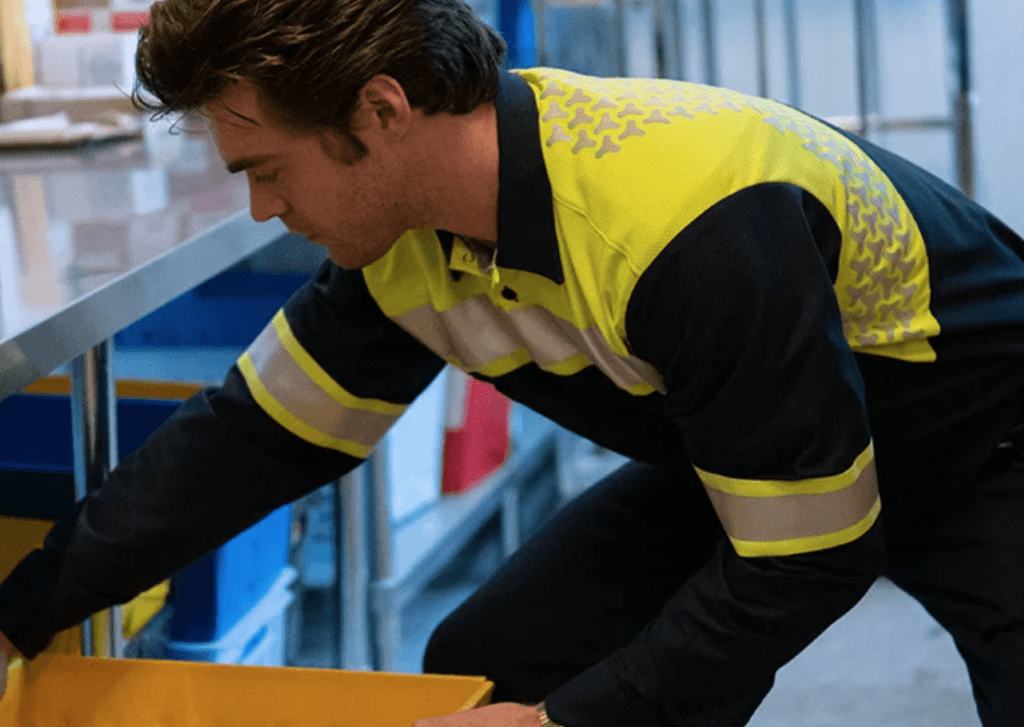
Once the prototype is ready for real-world interaction, the next step is user testing and validation. At Interwoven Design, we consider user testing and validation to be an integral part of prototyping and ideating. User testing is crucial for ensuring that the design not only meets user expectations but also performs seamlessly in everyday use. By testing the product with a target group of users, designers gather valuable feedback on comfort, usability, and overall user experience. This hands-on testing helps identify any areas where the product may need adjustments—whether it’s improving ergonomics, simplifying functionality, or enhancing the user interface. In our Firefly workwear project, we had warehouse workers wear prototypes during their work day to observe the quality and durability of the jacket’s reflective coating. It’s all about making sure the design feels intuitive, comfortable, and effective in real-world scenarios.
The Firefly workwear garmentby Interwoven Design Group.
Alongside user feedback, long-term wearability and durability are evaluated to ensure the product stands up over time. This involves rigorous testing to assess how the product holds up under everyday wear and tear, as well as ensuring it meets regulatory standards for safety and compliance. Based on the data collected, the design is refined to address any issues that arise, ensuring that it not only delights users but is also safe and reliable. This iterative process guarantees that the final product is both functionally sound and compliant, offering an exceptional experience that users can trust and enjoy over time.
Step 5: Technical Design & Sourcing
With a refined concept in hand, the next step is transitioning from idea to a manufacturable product. This phase focuses on engineering the design for production, ensuring that all aspects of the product can be realized efficiently and at scale. In this step, we generate all of the technical documentation to allow the manufacturer to understand every aspect of the design. In our Even Adaptive Lingerie project, we created additional technical design documentation to support the patent application for the custom clasp we designed.
Material sourcing is also important at this stage. The right materials must be chosen for both their functional properties—such as strength, flexibility, and weight—and their aesthetic qualities. Along with material considerations, wearability testing and durability assessments are conducted to guarantee that the product will stand up to everyday use while maintaining comfort and performance. These evaluations help refine the design, ensuring that it’s not only visually appealing but also reliable and practical in real-world conditions.
Collaborating with suppliers and manufacturers is a key part of this stage. Designers work closely with these partners to optimize production processes, ensuring that the design can be reproduced with consistency and efficiency. This includes refining techniques for assembly, tooling, and quality control, while also exploring opportunities to reduce costs or improve sustainability in the construction or in the manufacturing process. By maintaining an open dialogue with manufacturers and keeping an eye on potential production challenges, we can ensure that the design moves smoothly from the drawing board to the final product, ready for the market. This phase solidifies the design’s viability, ensuring it can be brought to life with precision and quality.
Step 6: Production & Launch
As the product nears completion, the focus shifts to the final stages of production and launch. This phase begins with finalizing manufacturing processes, ensuring that all production methods are optimized for scale and consistency. Quality control measures are put in place to maintain high standards throughout the production run, from material checks to final inspections. The goal is to ensure that each unit meets the exact specifications, preserving the integrity of the design and delivering a product that matches the vision set out at the beginning of the process.
Simultaneously, preparations are made for the product’s mass production, taking care to balance efficiency with design integrity. It’s essential that the product remains true to its initial concept, even as it moves into full-scale manufacturing. While this is happening, the marketing team works to build excitement for the launch, developing a compelling product narrative that connects emotionally with consumers. Product storytelling helps create a connection, communicating not just the features and benefits, but the values and story behind the design. This connection builds consumer trust and generates buzz, ensuring the product’s success in the market from day one.
Bringing it All Together
From the initial spark of inspiration to the final product launch, each stage of the industrial design process plays a critical role in creating wearable technology that not only looks good but works seamlessly in the lives of users. Every step—whether it’s research, prototyping, or technical design—helps shape a product that balances creativity, functionality, and user experience. A thoughtful, well-rounded design approach ensures that the product is not only technologically advanced but also user-friendly, making it easy for customers to integrate it into their daily lives with confidence and excitement.
At Interwoven Design, we believe that the best designs come from collaboration and a shared vision. We invite you to work with us to bring your ideas to life, whether you’re looking to refine an existing concept or develop an entirely new wearable tech solution. With our expert design and product development process, we’re here to guide you through every step, ensuring your product stands out in the market while meeting the highest standards of usability, functionality, and sustainability. Do you have a project you’d like to see come to life? Reach out!
The Dual Identity in User-Centered Product Prototyping: Navigating the Roles of Artist and Designer
The Dual Identity in User-Centered Product Prototyping: Navigating the Roles of Artist and Designer
The line between artist and designer often blurs, marrying two distinct yet complementary identities in the creative world. Both roles thrive on innovation, imagination, and a deep understanding of the human experience. That said, their purposes, approaches, and impacts often differ. This duality presents a fascinating interplay of challenges and opportunities for those who navigate both worlds, raising an important question: how can the distinct roles of artist and designer complement one another to create meaningful work? Here at Interwoven, we are especially interested in how the identity and approach of the artist can enhance our work as designers. In this Insight article we outline the key aspects of the artist and the designer, noting where they align and where they converge, and discuss the challenges and benefits of a dual identity.
Understanding the Core Roles
To appreciate the dual identity, it’s important to explore the foundations of these roles and how they differ in intent and execution.
The Artist: A Voice of Expression
Artists are creators of culture, crafting works that communicate ideas, emotions, and critiques of society. Their work stems from a deep well of personal expression and exploration, often unbound by external limitations. Artists revel in ambiguity and invite their audiences to interpret their creations freely. A painting, sculpture, or installation may not serve a direct functional purpose, but its power lies in its ability to evoke emotions, provoke thought, and inspire dialogue.
Think of artists like Frida Kahlo, whose paintings delve into personal pain and identity, or Jean-Michel Basquiat, who used his art to challenge racial and social inequities. Their work is timeless, not because it solves a problem, but because it captures the human experience and prompts an emotional response from the viewer.
The Designer: A Problem Solver
Designers, in contrast, take a more structured approach to creativity, aiming to solve specific problems or improve an experience. Their work must meet functional, aesthetic, and practical requirements, often operating within constraints like budgets, material limitations, deadlines, and client specifications.
Designers create for utility and accessibility, ensuring their products or solutions align with the needs of the audience. The work of Dieter Rams, with his “less, but better” philosophy, exemplifies this ethos. Every curve, button, and material choice in his designs is intentional, aimed at enhancing usability and delighting the user.
Points of Intersection
Despite these differences, artists and designers share several key similarities that can serve as bridges between their practices, or as common territory for those artist designers who wear both hats and live in both worlds.
1. Creativity as a Core Driver
At the heart of both roles lies a deep well of creativity. Whether an artist is sketching a concept for a mural or a designer is iterating on a prototype, both rely on imagination and out-of-the-box thinking to bring their visions to life. They are both admired for their ability to think differently, to see what has previously been overlooked, and to present the familiar in a way that makes it feel new.
2. Mastery of Tools and Mediums
Artists and designers often share tools and techniques, though their applications differ. Both might work with digital software, physical materials, or even artificial intelligence to explore their ideas. The difference lies in intent: while an artist might use 3D modeling software to sculpt a conceptual piece and the intent to make a political statement, a designer might use the same software to perfect the ergonomics of a new chair to meet the needs of a niche user group.
3. A Deep Understanding of Human Experience
Both artists and designers connect with people, albeit in different ways. Artists aim to provoke emotion, spark curiosity, or challenge perceptions, while designers focus on improving daily lives through functional and user-friendly creations. In either case, the human experience is central to their work, and deep empathy and insight are core skills.
Contrasting Mindsets
The differences between artists and designers are often most evident in how they approach their work and the mindset they bring to their practice:
1. Purpose vs. Process
For artists, the process of creation can be as meaningful as the final product, or even more so. Many artists begin their work without a predefined goal, letting their intuition and emotions guide the journey. Designers, however, are inherently purpose-driven, working toward a clear objective: solving a problem, fulfilling a need, or meeting a client’s expectations. This objective is typically approached with a consistent process, pre-defined and used, at least to some degree, across challenges.
2. Constraints as Catalysts
Constraints play very different roles in these disciplines. Designers thrive on limitations—time, budget, materials—which often inspire innovative solutions. Artists, in contrast, may set their own constraints, such as working within a particular medium or theme, but they often enjoy greater creative freedom.
3. Audience and Feedback
The relationship with the audience also differs significantly. Artists typically create with a broad, undefined audience in mind, inviting subjective interpretation. Artists are also free to create with a single, specific audience in mind, a pitfall for designers. Designers cater to a specific user base, relying on research and feedback to refine their work and ensure it meets practical needs.
The Power of Synergy
The intersection of art and design offers rich opportunities for innovation and expression. By blending the two disciplines, creatives can elevate their work, creating pieces that are both functional and emotionally resonant.
Zaha Hadid’s architectural masterpieces stand as a prime example of art and design coexisting harmoniously. Her structures are not just functional spaces but also sculptural works of art that transform urban landscapes. Similarly, Virgil Abloh’s approach to fashion blurred the line between streetwear and high art, using Off-White as a platform for cultural commentary and design innovation. In product design, companies like Apple have embraced this duality. The sleek, minimalist aesthetics of their products reflect artistic sensibilities, while their intuitive functionality speaks to rigorous design principles.
Artists who adopt design thinking bring intentionality and structure to their work. For example, when an artist creates a public mural, they may consider the surrounding environment, community needs, and the logistics of scale—elements rooted in design thinking.
Designers who embrace an artist’s mindset can imbue their work with deeper meaning and originality. By allowing room for experimentation and intuition, they push the boundaries of conventional design, creating products and experiences that resonate emotionally.
The Challenges of Duality
Balancing the roles of artist and designer comes with a unique set of challenges. The freedom and introspection of artistic expression can often feel at odds with the structured, outcome-driven nature of design. Artists may feel constrained by the demands of functionality, client needs, or market trends, while designers might struggle to embrace the unstructured, exploratory process that defines art. This tension can lead to creative friction, where satisfying both the emotional depth of art and the practicality of design becomes a difficult balancing act.
Another challenge lies in audience perception and reception. The open-ended, interpretive nature of art might conflict with the clarity and direct usability that design often requires. A creative work that tries to blend both may risk alienating audiences—being too abstract for functional purposes yet too utilitarian to evoke profound emotional impact.
The duality can also create internal conflict for creatives who wear both hats. Switching between the roles of artist and designer requires significant mental flexibility. An artist may need to step away from personal expression to meet a design brief, while a designer must sometimes abandon the comfort of structure to embrace uncertainty. Navigating this mental shift can be draining, particularly when projects demand the coexistence of both mindsets simultaneously.
Collaborations can add another layer of complexity. When artists and designers work together, differing priorities and communication styles can lead to misunderstandings. Artists may prioritize originality and autonomy, while designers may focus on functionality and user feedback, potentially leading to compromises that feel unsatisfactory to both parties.
Finally, external pressures, such as commercial viability or societal expectations, can exacerbate these challenges. The art world values risk-taking and personal authenticity, while the design industry often prioritizes scalability and consistency. Striking a balance between these external demands can stretch creatives thin, requiring them to manage not only their dual identities but also the expectations of their audiences and stakeholders.
The Benefits of Duality
Embracing the duality of being both an artist and a designer opens up a world of creative possibilities and offers a unique edge in the creative industries. This fusion enables individuals to approach their work with a balance of emotional depth and practical problem-solving, combining the imaginative freedom of art with the structured logic of design. By blending these perspectives, creatives can produce work that is not only visually compelling but also highly functional, creating solutions that resonate on both aesthetic and practical levels.
This duality encourages innovation by allowing for a broader exploration of ideas. Designers can push the boundaries of convention by borrowing an artist’s willingness to experiment with form, texture, and abstraction. Meanwhile, artists who embrace design thinking can make their work more accessible and relevant by considering usability, audience needs, and real-world applications. This synergy often leads to the creation of groundbreaking work that bridges the gap between personal expression and universal appeal.
Another significant benefit of duality is the ability to foster emotional engagement in practical contexts. A designer who thinks like an artist can infuse their work with narrative and meaning, elevating a product or space beyond mere functionality. Whether it’s a beautifully designed object that tells a story or an interactive experience that evokes an emotional response, the combination of artistic storytelling and design utility creates a powerful connection with users.
Duality also cultivates versatility, allowing creatives to navigate diverse types of projects and roles. From designing user-centered products to crafting emotionally resonant campaigns, the ability to shift seamlessly between these identities makes individuals more adaptable in a rapidly evolving creative landscape. It also enables collaboration across disciplines, as dual practitioners can serve as bridges between artistic and design-focused teams, fostering richer, more integrated projects.
Finally, duality nurtures a deeper personal fulfillment in creative practice. By incorporating both the introspective, expressive aspects of art and the purpose-driven, problem-solving nature of design, individuals can experience the satisfaction of creating work that is both deeply meaningful and broadly impactful. This holistic approach allows for the cultivation of a dynamic, multidimensional creative voice that stands out in today’s saturated market.
What Designers Can Learn from Artists
Designers can greatly enhance their work by adopting certain practices from the world of art. One of the most valuable lessons is the power of embracing ambiguity and intuition. Artists often dive into the creative process without a clear end goal, allowing their instincts and emotions to guide them. This openness can help designers break free from rigid constraints and explore unconventional solutions. Additionally, artists prioritize storytelling and personal expression, which can inspire designers to infuse their projects with deeper meaning and narrative. By viewing their designs as not just functional objects but also as opportunities for emotional connection, designers can create work that resonates on a human level. Exploring abstraction, experimenting with mediums, and challenging traditional norms—hallmarks of artistic practice—can lead to innovative breakthroughs in design.
Conclusion
Navigating the dual identity of artist and designer is both a challenge and an opportunity. By embracing the strengths of each role, creatives can unlock new dimensions in their work, enriching their practice and leaving a lasting impact.
In this convergence lies a powerful truth: art and design are not opposites but companions, offering unique lenses through which to view and shape the world. Whether through a masterpiece that moves hearts or a design that changes lives, the synergy of these roles continues to drive humanity forward—proof that when art and design meet, magic happens.