Redefining Design Education: Bridging Tradition and Transition

Redefining Design Education: Bridging Tradition and Transition

This article, co-written by Rebeccah Pailes-Friedman, Elham Morshedzadeh, Ph.D., and Annie Abell, was published in the Winter 2024 Issue of IDSA’s INNOVATION Magazine.

Design education today stands at the crossroads of tradition and transformation, demanding that we prepare young designers with both timeless skills and cutting-edge tools to address society’s most wicked problems. Traditional competencies- design research, drawing, 3D form exploration, materials expertise, and problem solving — provide an essential foundation, yet they remain insufficient if students are not also trained to critically assess which challenges merit their attention. It is not enough for aspiring designers to master techniques; they must also cultivate the curiosity, resilience, and analytical acuity necessary to navigate a rapidly changing landscape.

In an ideal setting, education serves as the launchpad for industrial design innovation, nurturing visionary thinkers who blend art with engineering to craft transformative solutions. However, equipping students with this comprehensive skill set is a persistent challenge, especially when many academic institutions struggle to adapt their curricula to the fast pace of industry change.

Bridging the gap between theory and practice is an opportunity layered with complexities. As an active member of both IDSA and academia, I witness firsthand the struggle to define exactly what our future leaders need to learn.

IDSA champions educational approaches that break tree of traditional disciplinary silos, advocating for rigorous, interdisciplinary models that merge conceptual insights with tangible, real-world applications. Yet the hard question remains: How, exactly, do we implement this vision in educational practice?

To do so, we must reexamine and modernize our current educational models, ensuring that they integrate diverse fields and instill a spirit of innovation rooted in practical experience.

This modern imperative requires rethinking our approach to instruction and embracing a model that values both technical proficiency and the soft skills of critical thinking. Beyond merely teaching students how to execute design methods, we must guide them to question underlying assumptions, evaluate potential impacts, and decide which challenges are worth pursuing. Lifelong curiosity and resilience are as crucial to their development as technical expertise. Though this strategic direction presents significant challenges, it lays the groundwork for nurturing designers capable of tackling them. In an era where technology and market needs are in constant flux, evolving our design education is not just beneficial—it is essential for cultivating leaders skilled in both analysis and creative expression.

IDSA continues to advocate for curricula that move beyond conventional boundaries, promoting interdisciplinary approaches that merge conceptual insights with real-world applications. This vision requires educators to collaborate with industry professionals and integrate cross-disciplinary knowledge, drawing from fields such as sociology, environmental science, and computer science. For example, some pioneering programs now embed project-based learning, giving students firsthand experience in problem-solving, ethical design, and innovation management.

Today, boundaries between disciplines are increasingly blurred. Creativity, technology, and cultural understanding converge to create fertile ground for innovation-a phenomenon some have termed “expanding horizons.” Furthermore, emerging technologies such as artificial intelligence Al are reshaping the design process itself. Al is not merely a tool; it is revolutionizing the way we think about customization, efficiency, and user-centric design. By integrating Al and other innovative technologies, educational models can empower future designers to harness data, optimize processes, and even predict trends- pushing the boundaries of what is possible within our field.

Reflecting on this evolution, Elham Morshedzadeh, PhD, IDSA, Assistant Professor of Industrial Design at the University of Houston, says, “I believe industrial design has had a decent history in creative and adaptive teaching methods over decades of its existence. What began as hands-on practice within four-walled studios has expanded into immersive learning experiences that take students to streets, homes, hospitals, and even the depths of human thought and emotion.”

For Morshedzadeh, this journey highlights design education’s capacity as a catalyst for innovation, empathy, and societal impact. She emphasizes that design education is fundamentally about training designers to “understand, adopt, [and] evolve to create the most fit solutions.” Moreover, she argues that, with an emphasis on adaptability and observation-based solutions, design educators must structure projects and curricula to allow students to integrate new tools and technologies as project needs and industry advancements emerge.

Adding another dimension to this discussion, Annie Abell, IDSA, Associate Professor of Practice in the Department of Mechanical and Aerospace Engineering at Ohio State University, offers a parallel perspective from engineering education. She explains: “I am part of a team conducting a years-long project to modernize and completely redevelop the undergraduate mechanical engineering curriculum at Ohio State. A major hurdle is the speed of a comprehensive curriculum redevelopment project compared to the speed at which technology and industry is changing. For example, if it takes us four years… to develop and implement a new curriculum, what has changed in those four years? We will likely already be behind the times.”

Abell’s insights underscore the inherent tension between the deliberate pace of academic bureaucracy and the rapid evolution of the commercial world. She stresses that the solution is to create curricula that are “agnostic to specific software, specific tools, or specific technologies” and focused instead on adaptable skills and a mindset of active learning and problem solving.

Ultimately, as we reimagine design education, it is essential to create learning environments that foster collaboration, adaptability, and forward-thinking strategies. By embracing an interdisciplinary framework that values robust technical training alongside the nurturing of critical soft skills, we can prepare designers-and engineers -to lead, innovate, and drive meaningful change in a complex, ever-evolving world. The bridge between academia and industry grows stronger when educators are not isolated in their ivory towers but remain actively engaged in the professional realm. Many academic programs already benefit from part-time professors who work full-time in industry; these educators bring first-hand experience and up-to-date insights that help schools stay in tune with the rapidly changing demands of the market.

When academics actively participate in industry projects, research collaborations, and professional networks, they not only enrich their own teaching but also inspire their students to embrace real-world challenges. This symbiotic relationship ensures that classroom theories are constantly informed by the latest trends, technologies, and practices from the field. It transforms the educational journey into one that is dynamic, relevant, and immediately applicable-a crucial factor in an era where change is the only constant.

As we build and reinforce this bridge, it becomes clear that the future of design education relies on a model in which industry and academia work side by side, each challenging and informing the other. In doing so, we create a feedback loop that continually updates curricula to reflect emerging trends, nurtures innovation, and ensures that graduates are equipped with both the timeless wisdom of foundational skills and the agility to adapt to new technologies and market realities.

Looking for more design InsightsSign up for our newsletter and follow us on Instagram and LinkedIn for design news, multi-media recommendations, and to learn more about product design and development!
The Power in Numbers: The State of Women in Design

The Power in Numbers: The State of Women in Design

This article, written by Rebeccah Pailes-Friedman, was published in the Fall 2024 Issue of IDSA’s INNOVATION Magazine.

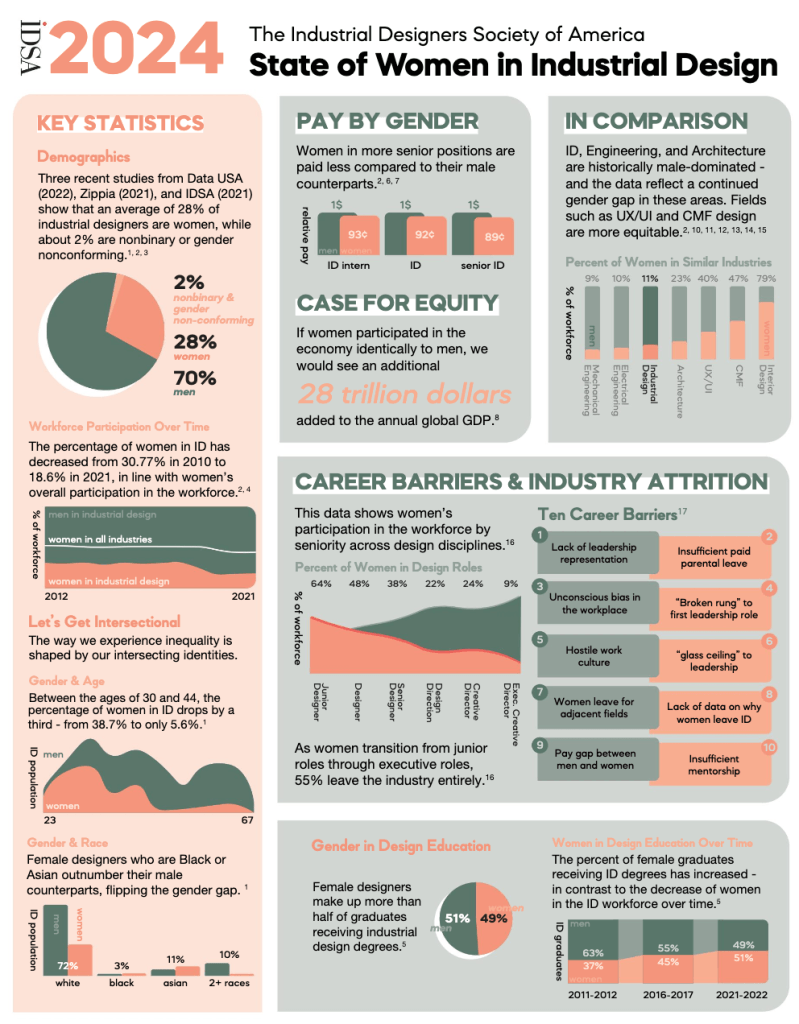
There is power in numbers—whether through data, collective action, or the growing presence of women in the field of industrial design. As our industry continues to evolve, conversations around gender equity have gained traction, especially in the face of persistent challenges such as underrepresentation, career progression barriers, and pay inequality. While we’ve made strides, there’s still a lot we need to dig into and figure out. This article explores key statistics on women in industrial design, takes a look into the troubling mid-career drop-off many women experience, and highlights the urgent need for concrete data to drive systemic change. Understanding the state of women in industrial design is critical, not only for those currently in the field but for the future of the profession itself.

Last spring, the Women in Design Committee gathered as much information as it could find to take the temperature of the state of women in ID. We found some eye-opening statistics. One of the striking statistics is that 70 percent of industrial designers are men, and unfortunately that trend is not getting better. Three recent studies from Data USA (2022), Zippia (2021), and IDSA (2021) show that the percentage of women and nonbinary designers has decreased from 30.77 percent in 2010 to 18.6 percent in 2021. Though this is in line with women’s overall participation in the workforce, the numbers get even worse as women progress in their careers. Between the ages of 30 and 44, the percentage of women in ID drops precipitously, from 38.7 percent to only 5.6 percent.

As women progress from junior to executive roles, an alarming 55 percent leave the industry altogether. By mid-career, many women leave the profession, a shift that raises important questions. Current data on where these women transition after leaving ID is limited, but evidence points to a range of barriers: lack of leadership representation, unconscious bias in the workplace, insufficient mentorship, limited opportunities for advancement into leadership roles—and, of course, the persistent pay gap between men and women. Feedback from industry professionals suggests that many women feel isolated or undervalued, leading them to pursue careers in adjacent fields or leave design altogether.

women in design statistics chart 1

This is something that Dalal Elsheikh, a first-generation Sudanese-American, car enthusiast, and keynote speaker at this year’s IDC in Austin, Texas, has experienced first-hand. Committed to creating opportunities for women and girls of color in traditionally male-dominated spaces, Elsheikh shared insights that provide a valuable perspective on the barriers faced by women, especially women of color, and how we can work to overcome them. One barrier that can be challenging to overcome is the feeling of belonging. When the majority of the people you work with don’t look like you and haven’t had your life experiences, it can be intimidating to take on a leadership role. When discussing advocating for oneself, she shared her thoughts:
“In a creative field like industrial design, it’s so important for designers of all levels and backgrounds to feel heard and respected. I know for women and those of us who don’t see ourselves reflected in the workplace, it can be a daunting task to advocate for ourselves and our ideas. Confidence is a muscle that takes constant exercise to grow. The first time you stand up for your work, share a radical idea, or dare to oppose the status quo, it will feel awkward.”

She added that reflecting on your work and how far you’ve come can help you gain perspective:
“The fact that you have been accepted into this role or program for no reason other than that you are qualified. That knowledge alone should give you the sense of authority you need.”

It is becoming increasingly important to include a diversity of thought and ideas in the work we do as industrial designers. In my role as the founder and principal designer at Interwoven, it has become a key selling point that we are a woman-led and primarily women-staffed design consultancy. This diversity has allowed us to approach design challenges with fresh perspectives, resulting in more innovative solutions. However, it wasn’t until I led my own firm that I truly felt people were actively listening when I spoke, and open to the ideas I put forth. At Interwoven, I’ve witnessed first-hand how creating a space where women’s voices are not only heard but valued leads to richer, more inclusive design outcomes. Our team’s unique perspectives have helped us tackle complex problems in ways that wouldn’t have been possible in a more homogeneous environment. It has reinforced my belief that diverse teams aren’t just good for equity—they are critical for creativity and pushing the boundaries of design.

Elsheikh shared a similar experience. When she first entered the automotive industry, she worked on a car interior project focused on enhancing rider comfort, specifically considering where a woman rider might prefer to place her purse. The design team, which was primarily composed of men, brainstormed many ideas: “Maybe it’s a hook she can hang her purse on, or maybe a compartment, or a shelf she can position a bag on, or how about under the seat?” Elsheikh didn’t feel qualified to share her insight with this group of seasoned designers, so she kept quiet and didn’t share that these suggestions seemed unlikely; most women, she believed, would want to keep their bag in their lap or on the seat beside them, and don’t feel comfortable keeping their bags out of sight. “I felt unqualified, but in actuality I was at that moment the most qualified,” Elsheikh said. “I had the lived experience of being a woman, being someone who used ride-hail services, and someone who carries a purse.” This experience illustrates how essential it is for women to feel empowered to share their unique perspectives, as they often bring invaluable insights that others may overlook.

women in design statistics chart 2

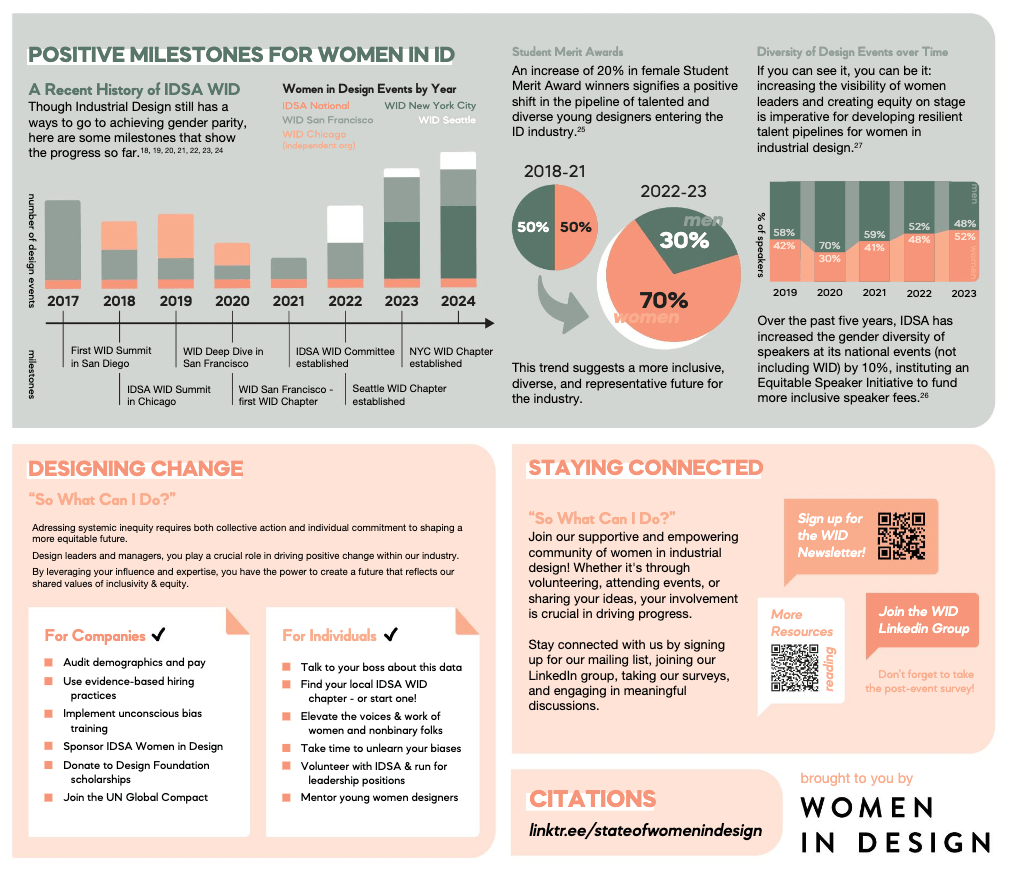
It is critical to cultivate and support women and nonbinary designers in becoming thought leaders within our field. To bring attention to these concerning trends and other key statistics, the Women in Design (WID) Committee created a large data visualization poster for the International Design Conference (IDC). This interactive exhibit encouraged attendees to engage directly with the data through various prompts aimed at gathering qualitative feedback. In one exercise, we asked attendees to vote on which question the community believes is most crucial to explore further. In others, we invited reflections on allyship and workplace inclusion.

From this exercise, we learned that one of the most concerning trends in industrial design—the dramatic mid-career drop-off of women—was a key issue that many attendees wanted to understand better. While women make up more than half of the graduates receiving industrial design degrees, this promising start doesn’t translate into long-term careers. The Women in Design (WID) Committee has recognized the need for more concrete data to fully understand the reasons behind this drop-off. By collecting more precise data on where these women transition, and by identifying the barriers that push them out of industrial design, IDSA and the WID committee aim to develop targeted solutions. These findings will guide future initiatives, from mentorship programs to policies addressing work-life balance and leadership pathways, all designed to support women through the most challenging phases of their careers.

In collaboration with IDSA’s Research Committee, we are working to scope out future research that will explore these transitions and uncover root causes, with the goal of developing strategies to retain female talent and foster long-term career growth in the field. While conversations around gender equity have helped raise awareness, the WID Committee believes it’s time to move beyond dialogue and take action. Ultimately, the goal is to use this data to inform industry-wide changes that will create more inclusive environments, foster diversity in leadership, and ensure that women not only enter industrial design but thrive throughout their careers. As Elsheikh said: “As we continue to see women entering (and more importantly, staying in) design roles and moving up the corporate ladder, we can only hope that the strength in numbers will put forward the importance of the female perspective.”

The conversation around women in industrial design is not just about representation. It’s about creating meaningful, lasting change in the industry. The data is clear: Women enter the field in strong numbers, too many leave by mid-career, driven by barriers such as lack of leadership opportunities, mentorship, and pay equality. Through efforts like the Women in Design Committee and their collaboration with IDSA’s Research Committee, we are beginning to take the necessary steps to move from dialogue to action. By gathering concrete data and addressing the root causes behind the mid-career drop-off, we can develop targeted strategies to retain and elevate women and nonbinary designers. This is about more than equity—it’s about the future of industrial design itself. As Dalai Elsheikh reminds us, “the strength in numbers will put forward the importance of the female perspective,” and that perspective is vital to pushing the boundaries of creativity and innovation in our field. It’s time to ensure that women not only enter industrial design but thrive throughout their careers, shaping the future of the industry.

—Rebecca Paikes-Friedman, FIDSA
rpf@getinterwoven.com

References

Bartlett, Kristin, “Women in Industrial Design: A Review,” Proyecta56 an Industrial Design Journal, https://www.zippia.com/industrial-design-internship-jobs/demographics, June 2023.

Data USA, “Commercial and Industrial Designers,” https://datausa.io/profile/soc/commercial-and-industrial-designers, 2022.

Industrial Design Society of America, “2021 Membership Survey Findings Report,” https://www.idsa.org/2021-membership-survey-findings-report, 2021.

Federal Reserve Bank of St. Louis, “Labor Force Participation Rate: Women,” https://fred.stlouisfed.org/series/LNS11300032, 2024.

Zippia, “Industrial Design Internship Demographics and Statistics in the U.S.,” https://www.zippia.com/industrial-design-internship-jobs/demographics/, 2021.

Looking for more design InsightsSign up for our newsletter and follow us on Instagram and LinkedIn for design news, multi-media recommendations, and to learn more about product design and development!

Creativity as a Natural Pathway

Creativity as a Natural Pathway

This article, co-written by Rebeccah Pailes-Friedman and Elham Morshedzadeh, Ph.D., was published in the Summer 2024 Issue of IDSA’s INNOVATION Magazine.

As industrial designers, we often rely on the natural flow of creativity to fuel our work, drawing inspiration from our surroundings, cultural experiences, and intuitive processes. However, sticking exclusively to these familiar paths can sometimes limit our potential for truly groundbreaking innovation. In this discussion, five talented women industrial designers explore the concept of creativity as a natural pathway as well as the benefits of embracing less conventional approaches. By stepping out of our comfort zones and experimenting with new techniques, we can uncover disruptive solutions and push the boundaries of design, opening up a world of possibilities that may have otherwise remained hidden.

We began by defining natural versus unnatural paths to creativity. The discussion revealed diverse perspectives among the six of us. A natural path to creativity was generally seen as an organic process, drawing on intuition, personal experiences, and iterative design. Celeste Greenbaum, Human Centered Researcher and Industrial Designer at Philips, highlighted this by explaining that natural creativity stems from “things that you derive from your skill set from, or from iteration.” This type of creativity is intrinsic and emerges from the designer’s own abilities and observations, grounded in traditional and learned methods in the design process.

An unnatural or supernatural path to creativity, on the other hand, was thought to involve external influences or unconventional methods. For example, generating an algorithm or using AI was considered an unnatural pathway. An unnatural approach leverages technology and other external tools to stimulate creativity, pushing beyond the innate capabilities of a single human mind. Elham Morshedzadeh, Ph.D., Assistant Professor, University of Houston and IDSA WID Committee member, expanded on this by noting that unnatural creativity “can have a broader interpretation” and includes learned techniques that may not come intuitively. By embracing these unexpected and often abstract and not fully explored methods, designers can uncover innovative solutions that might not arise from traditional processes alone. As Dr. Mary Beth Privitera, M.Des., PhD FIDSA  Principal, Design & Human Factors at Sentiar and Professor, Biomedical Engineering University of Cincinnati, pointed out, the interplay between natural and supernatural pathways can lead to unique and diverse design outcomes, enriching the creative process through a dynamic exchange of ideas and methods.

The design process is fluid and knowing when to shift your thinking is critical. As the conversation shifted to pinpointing the moment when a designer realizes that it’s time to change up the way they are thinking, the group brought forth a rich tapestry of experiences and insights. Greenbaum reflected on challenges wherein traditional methods fell short, such as designing a product for children that initially seemed uncomfortable and unappealing. She shared, “I get really stuck when the design requirements lead to something that looks like a torture contraption.” Changing up the approach can lead to fresh ways to think about a design. This change often requires reaching outside conventional techniques and incorporating elements that transform the product into something playful and engaging. 

Privitera underscored the designer’s responsibility to think differently, stating, “It’s almost like your responsibility to think differently.” When assessing any project, it’s essential to ask ‘is this something that’s desirable?’ The drive to infuse unique, appealing elements into designs is necessary , whether developing medical tools or everyday kitchen items. By embracing diverse approaches, designers can break free from conventional constraints and create products that resonate on both functional and emotional levels.

Katie Lim, Senior Industrial Designer, frog & Chair of IDSA Women in Design NYC Chapter, emphasized the importance of storytelling in guiding clients and users through innovative changes, noting that “if you can tell somebody a really good story you can hook them in from the beginning.” Storytelling helps mitigate resistance to change and makes new ideas more accessible. It can be a valuable tool when faced with resistance to thinking differently. Morshedzadeh expanded on the significance of storytelling, particularly in today’s technologically advanced landscape. She pointed out that “having these technologies helps us to create more realistic stories” and has revolutionized how designers communicate their visions. This blend of narrative and visual tools fosters a deeper emotional connection between a product and its users.

The conversation then shifted to examining how natural and unnatural methods might influence user experience. This part of the discussion highlighted the importance of empathy, attention to detail, and the inherent biases that designers must navigate. Lim emphasized the significance of stepping outside of personal design perspectives to truly understand user needs, sharing an example of designing an unboxing experience for cancer patients. She noted that “going through the actual motions to understand all those in-between moments of the key touch points” is imperative for creating a user-centered experience. Greenbaum concurred, adding that meticulously mapping out every detail of user interaction is essential, even if it feels “unnatural” due to the depth of analysis required. 

A rigorous approach to understanding user experience ensures that designers can identify both the strengths and weaknesses of a design. On the other hand, Privitera highlighted the challenges of qualitative research, pointing out that it’s inherently biased by personal interpretations and selection criteria. She stressed that navigating these biases requires “taking that leap of faith and looking at it from another perspective” to achieve an optimal solution. She also described the complexity of designing for future technologies, such as augmented reality in medical applications, where traditional design tools and prototype testing fall short. Privitera aptly summarized this dynamic tension: “I’m designing a new future, but I’m not in that future. And so I’m predicting again what I think that future might be.” This underscores the iterative nature of design, where natural intuition and unnatural, innovative methods must work in tandem to enhance user experiences in the most effective way.

Balancing intuition and critical thinking in design, especially when using generative tools, was a topic that sparked diverse perspectives among the group. Yi-Ping Wong,  Director of Operations for IN2 INNOVATION believes that the balance lies in using generative tools for improvements, validations, and inspirations. “If we can feed generative tools with information and parameters derived from intuition and critical thinking, they can help generate ideas that we might not have thought of ourselves. While these ideas may not be the final solution, they can push the boundaries of our approach”  Greenbaum highlighted the importance of understanding both personal and stakeholder biases. She emphasized that designers must introduce innovations in ways that respect users’ autonomy and expertise.

Morshedzadeh echoed the need for designers to embrace scientific methods to enhance decision-making reliability, despite the resistance this approach might face within the design community. She argued that using established tested methods would help us avoid making biased decisions. This integration of scientific rigor can help designers navigate their preconceived notions and produce more robust outcomes.

Privitera discussed the fluid interplay between unstructured intuition and structured critical thinking. She illustrated this balance with a personal example: “In my own head, I am a superhero with the cape and I can come up with really creative ideas that are wacky and fun.” Yet, these ideas are then rigorously evaluated to ensure feasibility. This interplay is pivotal, as designers oscillate between unfettered creativity and practical constraints, depending on whether they are refining existing products or conceptualizing entirely novel ones. Starting with broad, imaginative concepts before refining them with practical constraints allows designers to avoid being constrained by existing paradigms. Lim noted, “If you start off with the constraints, you’re designing the same thing everyone else is designing.”  This process of shifting from unstructured to structured thinking fosters innovation while ensuring practical yet creative viability.

When discussing how to stay up to date with emerging technologies and tools in the design field using both natural and unnatural approaches, the panel offered a range of strategies. Lim emphasized the value of looking beyond the traditional design sphere: “I like to look outside of the design.” This approach broadens the scope of inspiration and keeps designers informed about trends in various industries.

Privitera highlighted the importance of attending conferences to gain exposure to unexpected innovations: “Attending conferences, you see a whole host of different things that you wouldn’t even expect.” She noted that events like the Industrial Designers Society of America (IDSA) conferences offer diverse insights that can inspire new design approaches. Industry conferences and tradeshows, such as CES (Consumer Electronics Show), and SXSW (South by Southwest), have always focused on the latest technologies, tools, and industry trends. These events provide an excellent opportunity to learn about a wide range of topics and perspectives in one setting. Wong added, “Networking with professionals who are passionate about these subjects is also valuable. Whether you agree or disagree on certain topics, it is important to maintain an open attitude towards discussion and new perspectives.”

Other participants also shared their methods for staying informed. Greenbaum mentioned the benefits of interdisciplinary learning that arose from her interest in cognitive psychology, which has now extended into nursing training to deepen her clinical knowledge. This point was emphasized by other panelists who shared examples of designers that sought additional training in fields like acupuncture and surgery. These experiences provide valuable perspectives that significantly enhance their design capabilities in their chosen field.

Morshedzadeh, sharing an academic perspective, emphasized the importance of continuous learning: “When I come across something that I believe I can teach or incorporate into one of our courses and it piques my interest, I’ll incorporate it into the curriculum, starting with elementary basics. This way, we can practice and explore its potential.” This approach not only keeps her skills sharp but also ensures that new graduates are well-equipped with the latest tools and technologies, boosting their confidence and employability.

In conclusion, the discussion among this group of industrial designers, all with a wide variety of experience and specialization,underscores the importance of embracing both natural and unnatural paths to creativity in the design process. While drawing from personal experiences and intuition forms the foundation of design, integrating unconventional methods and technologies can unlock new pathways of innovation. By challenging conventional thinking and experimenting with diverse approaches, designers can break free from limitations and uncover disruptive solutions that resonate deeply with users. Furthermore, maintaining a balance between intuitive creativity and critical analysis, as well as staying informed about emerging technologies through avenues like industry conferences and interdisciplinary learning, are essential for driving continuous growth and pushing the boundaries of design excellence. As we navigate the ever-evolving landscape of design, it is this dynamic interplay between tradition and innovation that fuels our journey towards creating impactful and meaningful experiences for users worldwide.

Looking for more design InsightsSign up for our newsletter and follow us on Instagram and LinkedIn for design news, multi-media recommendations, and to learn more about product design and development!

Insights from the Women in Design Committee

The article “Insights from the Women in Design Committee”, written by Rebeccah Pailes-Friedman, was published in the Winter 2023 Issue of Innovation Magazine.

The Women in Design Committee comprises a rich tapestry of individuals hailing from diverse backgrounds and experiences. Our membership is a dynamic mix of practitioners and academics spanning young professionals and seasoned designers, including entrepreneurs and those employed by large corporations. We proudly represent gender and racial diversity.

We represent five distinct regions across the United States. Marcelle van Beusekom, IDSA, senior designer at Aruliden, represents the Western district. Elham Morshedzadeh, PhD, IDSA, assistant professor at the University of Houston, represents the Southern district. Annie Abell, IDSA, associate professor of practice at Ohio State, represents the Central district. Priyankaa Krishnan, IDSA, design and change manager at Meta represents the Midwest district. I, the founder and principal of the Interwoven Design Group and Professor at Pratt Institute, represent the Northeast district, and Lea Stewart, IDSA, senior manager at Newell Brands, leads the committee.

In this article, the six of us come together to engage in a conversation about our experiences. Our objective is to uncover shared experiences, explore our differences, and, ultimately, convey our collective wisdom, which we are excited to share with you. The following features excerpts from our conversation.

Breaking Barriers 

Entering the field of industrial design can be a challenge, and landing that first job can be a pivotal moment in one’s design career. We all have experiences to share about that transition. My path is rather unconventional. I came from a highly successful corporate career in apparel design, having held design director positions at Nike, Fila, and Champion. However, transitioning to industrial design proved to be exceptionally challenging. After completing my MID, I faced difficulty finding a job. Ultimately, I charted my own course, combining my skills and reimagining myself as an expert in wearable technology and smart textiles. I leveraged my experience, merging it with product design to jumpstart my career as a design consultant.

Setting yourself apart is the key to standing out in a job search. Van Beusekom recalled a disheartening comment she received during an interview for her first internship: “They said, ‘Oh, they still have you design this device in your school?’ It was then that I realized not all schools support students in building a strong, distinctive portfolio. Fortunately, I learned this before graduating and spent a year studying abroad at a different school. This allowed me to create unique and relevant case studies, learn from others, and enhance my foundational skills. A stronger, more distinctive portfolio helped me secure my first full-time role.”

Many of us on the committee had to be creative in our entry into the profession. Morshedzadeh, for instance, did not secure her first job solely due to her design skills. She networked extensively during her undergraduate years, and once she landed the job, continually had to prove her value. “In my position, I had to work diligently to earn the respect of my co-workers, especially as a woman and an immigrant with a different appearance, perspective, and communication style,” she explained.

Abell reflected that “women can encounter various hidden and invisible barriers ingrained in society and workplace cultures.” However, one of the toughest challenges is recognizing that you can also be a barrier to yourself. Imposter syndrome is real. This same sentiment resonated with Krishnan, who faced significant pressure in an orthodox Indian family where the expectation was to become a doctor or engineer, or else face social ridicule. “I applied to over 700 jobs over three years, completing two degrees while struggling to secure employment until I finally received a life-changing offer from a renowned company,” she shared. Perseverance paid off, but the journey was long and arduous.

Navigating the Field

Historically, women have been underrepresented in industrial design, and navigating this landscape has required us to employ various strategies to overcome gender-related obstacles. Van Beusekom initially had a degree of naivety about this issue. Her graduating class was gender-diverse, and it was only after graduation that she realized the industry’s disparities. “I decided to turn the difference into my advantage, lean into my strengths and unique perspective, and have continued to build on those ever since,” she explained.

Abell emphasized the importance of finding your support system, explaining, “Having a support system is critical. Identifying allies in your workplace can be invaluable. Building positive relationships with peers or, even better, those with authority, can greatly assist you when facing various obstacles.”

Morshedzadeh found herself working harder, keeping a lower profile, and being less outspoken, both in her home country of Iran and when she immigrated to the U.S. She experienced discrimination as the norm. Krishnan also encountered discrimination, particularly when expressing her dream of working for IDEO while pursuing her master’s degree. Two male professors discouraged her, saying, “Women designers from the Midwest do not get jobs at IDEO and Silicon Valley.” However, she ultimately succeeded in landing a coveted job in Silicon Valley.

Krishnan’s advice to aspiring designers, especially young women entering the industry, is to “never let anyone discourage you from pursuing your dream. Keep pushing towards success.” Morshedzadeh stresses her advocacy for designers, especially her students, by helping them find their unique voice in design, igniting a deeper drive for their future, and empowering them.

Aspiring designers should be aware that there are various paths to success within the field of design and product development, spanning industrial design, user experience, product management, and more. Van Beusekom suggests, “My advice is to get started, whether at a consultancy or a company. Rather than trying to define success up front, I have often found it more valuable to try something new, learn from the people around me, and reflect on the role, team, or environment I enjoyed the most. Following your joy and keeping it at the forefront is the most motivational way to move forward.”

Balancing Act

We are all well aware that balancing a career, personal life, and family commitments can be particularly challenging for women in male-dominated design offices. In such settings, women often find themselves navigating a work culture that may not fully understand or appreciate their unique life commitments and responsibilities.

One significant challenge stems from the differing life commitments and home responsibilities between men and women, which often go unnoticed or unacknowledged. Women in these environments may fear that taking time off or requesting flexibility to fulfill their home responsibilities could make them appear less committed to the team. The pressure to conform to the perceived standard of putting work first can be overwhelming.

Conversely, some women may worry about putting too much into work at the expense of their personal lives. The fear of losing the balance between work and life is a genuine concern, as it can lead to burnout and negatively impact well-being. In this context, it’s important to acknowledge that working at a large company can have benefits, including established leave policies that provide a sense of security. However, smaller companies can also be suitable places for women to work, as they may provide more opportunities to create flexible schedules, customized flexibility plans that cater specifically to individual needs.

I have embraced a flexible working schedule for Interwoven Design that allows designers to pursue other interests. About five years ago, I established a four-day workweek. We are all in the office Monday through Thursday and off on Friday, which we call Flexible Fridays. People in the office have this time to pursue outside interests, teach classes, play and coach sports, and have room in their schedule for life. Our productivity has not decreased, and everyone is happier to be at work when they are in the office.
Abell has found balance in her life and success in her career as an academic. She explained, “Working in academia gives me a very flexible schedule, and I have the freedom to schedule or tend to life matters anytime I’m not in class or in a meeting.” She also maintains healthy boundaries with work, particularly email, by turning off notifications to avoid constant distractions.

Defining Success

Success in the field of design takes on various forms, and many of us grapple with defining what success means while striving to achieve a fulfilling work-life balance. Achieving equilibrium between your design career, personal life, and family commitments is a continuous journey that necessitates self-awareness and adaptability. It’s about feeling empowered to allocate your time and effort according to your priorities, rather than comparing yourself to others.

Stewart shared her evolving perspective on success throughout her journey. Initially, success was tied to personal growth through learning and project completion. As she progressed and assumed leadership roles, her definition of success transformed. She explained, “Early on, success meant acquiring skills and accomplishing design projects. Yet, as I became a mentor and manager, I found deeper fulfillment in fostering the growth and achievements of my team members. Witnessing their development and career progression became a significant measure of my success.” While project completion remains important, it’s now seen as a collective effort tied to team growth. Success has shifted from an individual pursuit to a shared journey. Today, her greatest satisfaction lies in empowering fellow designers, supporting their goals, and contributing to their success.

Van Beusekom’s view of success has also evolved over time. She initially measured success by the ability to bring exceptional products to the market and earn design awards. However, her perspective on success and successful design broadened as she gained a deeper understanding of what makes a product truly great, qualities such as desirability, attractiveness, delightfulness, meaningfulness, responsibility, impact, and differentiation. She continues to refine this perspective as she grows as a designer and creative leader.

In conclusion, I want to express my heartfelt thanks to the dedicated members of the Women in Design Committee. Their unwavering commitment, honesty, and openness have been the driving force behind this insightful discussion. Our committee is a tapestry of diverse individuals, representing a broad spectrum of experiences, from different regions of the United States, backgrounds, and design roles. Through this article, we came together to share our personal journeys, challenges, and wisdom.

Our experiences have revealed the evolving definition of success, the significance of support networks, and the importance of flexibility in our professional and personal lives. We believe that our stories will inspire and empower others in the design community, particularly those facing similar challenges. I extend my warmest thanks to each member for their contributions, and we eagerly anticipate sharing more of our collective insights in the future. Together, we are forging a path toward a more inclusive and diverse design world.

Looking for more design InsightsSign up for our newsletter and follow us on Instagram and LinkedIn for design news, multi-media recommendations, and to learn more about product design and development!

Views on the Impact of AI

The article “Views on the Impact of AI”, written by Rebeccah Pailes-Friedman, was published in the Spring 2023 Issue of Innovation Magazine.

The IDSA Women in Design Committee’s vision is to have gender parity in our industry. One way we work toward this goal is to amplify voices. In this article, Views on the Impact of AI, we have view points from women and nonbinary designers who are emerging into the profession and establishing their career. The WID Committee welcomes thought, support, and feedback at wid@idsa.org.

INNOVATION is the voice of the industrial design profession, providing in-depth coverage of industrial design issues and communicating the value of design to business and society at large. This award-winning quarterly is generously illustrated with images of cutting-edge designs and features a clean yet dynamic layout that brings editorials and top-notch content to life. The magazine was first published in 1982, and IDSA members consistently name INNOVATION as a primary benefit of their membership experience to this day. Want to read more? Access to the latest issues of INNOVATION magazine here!

From Sci-Fi Fem-Bots to Sustainable Design

When the topic of artificial intelligence comes to mind, I can’t help but think of the sci-fi fem-bots that have been featured in movies like Blade Runner, Ex Machina, and Her. These films, among others, have often portrayed women as the conduit for artificial intelligence. As a result, I became curious about how women industrial designers view the impact of Al on their profession, so I decided to ask a group of women in the field for their thoughts.

What’s the Consensus?

Overwhelmingly, the message I heard was that artificial intelligence is not a replacement for human designers. While Al can automate routine tasks and provide data driven insights, it cannot replace the creativity, intuition, and empathy that are essential to good design. Rather, Al should be viewed as a tool that complements and assists human designers, enabling them to produce more compelling and innovative products. As Milja Bannwart, an industrial design consultant and creative director based in Brooklyn, NY, explains, “There are many aspects that a designer incorporates into the design of a product. There is a story to be told, the emotional impact on users, consumer testing and research, form and color, the quality of materials used, and craftsmanship.” By using Al in combination with human creativity, designers can unlock new possibilities and produce products that are both functional and aesthetically pleasing.

Furthermore, according to Lorraine Justice, PhD, FIDSA design researcher, author, and professor of industrial design at RIT, Some people believe that Al will transform designers into mere curators or arbiters of design, rather than original creators. However, this is only one aspect of the potential options for this technology. The human desire to create will always exist, and designers will continue to use any available tools to create better designs.

According to Yukiko Naoi, principal at Tanaka Kapec Design Group in Norwalk CT, Al could serve as a valuable tool for collaboration in industrial design. She believes that in any creative process, any input or specific angle of seeing things is valuable and that Al could provide a viewpoint that individual designers may overlook. “Al’s ability to offer fresh perspectives could be particularly useful in industrial design,” says Naoi.

Al is a great tool to automate many of the routine tasks involved in industrial design, such as creating 3D models, rendering product images, and analyzing user data. This can free up designers’ time to focus on more complex and creative aspects of the design process. According to Ana Mengote Baluca, IDSA, a faculty member at Pratt Institute, designers should approach the use of Al with a healthy dose of skepticism. While relying too heavily on Al may be risky, Mengote Baluca acknowledges that the technology shows promise in exploring new forms for products: “My big concern about Al is that it will drive trends and affect the aesthetics of what we create. If the algorithms are written in a way that promotes what is popular, then that wilI become the next big thing. I worry that we will lose diversity in style and in aesthetics if we rely on Al too much.” Naoi adds, “Just like any tool, it depends on how we use it. If we rely only too heavily then some of the outcomes will be too obvious computer driven.”

Image generated with DALL-E using the prompt “A female industrial designer dressed as a sci-fi fem bot standing in a design office retro 60’s art.”

Challenges and Opportunities

Naturally, there is a lot of apprehension about how AI will affect the design process. Al has the potential to transform our lives in many positive ways, from improving healthcare and transportation to enhancing education and entertainment. However, there are also valid concerns about the impact of Al on humanity, including job displacement, privacy concerns, and ethical issues. To address these concerns and ensure that the use of Al in industrial design is responsible and beneficial, it’s essential to establish ethical guidelines and standards for Al development and implementation. It’s also important to involve all stakeholders, including designers, engineers, consumers, and policymakers, in the conversation about Al’s role in design. By doing so, we can maximize the potential benefits of Al while minimizing the potential risks and unintended consequences. When discussing the impact of Al on industrial design, Jeanne Pfordresher, partner at Hybrid Product Design in Brooklyn, NY, adds, “Al has tremendous potential for creativity, and if we can address the ethical issues surrounding it, even better.” Ultimately, the successful integration of Al in industrial design will require collaboration, transparency, and responsible innovation.

One of the biggest challenges facing designers today is how to create products that are both functional and environmentally responsible. Al has the potential to enable more sustainable and environmentally friendly product design. For example, Al can be used to model a product’s life cycle and predict its carbon footprint, allowing designers to identify areas where they can reduce emissions and improve sustainability. Additionally, Al can help designers to optimize material use, design products for disassembly and reuse, and create more energy-efficient designs.

Finding efficiencies in massive amounts of data is a time-consuming task that is ideally suited for Al. Industrial designers can leverage this technology to create more sustainable designs and more efficient supply chains, which can help to mitigate the negative impact of human activity on the environment.” Al can help us manage supply chains and reduce inefficiencies,” says Mengote Baluca, adding that “by creating decision-making tools for designers, we can make more conscious choices.”

Al can significantly improve the design process by leveraging vast amounts of data on user preferences, market trends, and product performance. This enables designers to create more efficient and effective designs that better meet the needs of customers. Bannwart recommends “integrating Al at the outset of the design process to analyze data and identify trends, conduct consumer and competitor research, and even generate concept ideas. In later phases, Al can also be useful for creating design variations, accelerating the process, and experimenting with form generation for the sake of exploration.”

Many products in the market today have used Al in their design and development. Adidas used Al to design and manufacture the Futurecraft 4D shoe. The shoe’s midsole was created using a 3D printing process that was optimized with Al algorithms to create a lattice structure that is both lightweight and strong. Apple used a combination of machine learning and acoustic simulations to design the AirPods Pro. Al algorithms helped optimize the fit and seal of the earbuds and create the noise-canceling technology that is one of the AirPods Pro’s key features. Al also has great potential for creating better user experiences in products. For example, Dyson used Al to design the Pure Cool Link air purifier, which can automatically detect and respond to changes in air quality. Al algorithms were used to optimize the performance of the air purifier and create a user interface that is intuitive and easy to use.

Al is rapidly becoming an integral part of the industrial design process. While I don’t believe Al will or should replace human designers, I do think that by establishing and following ethical guidelines for Al development and usage, we can leverage Al into helping designers create products that are not only functional and aesthetically pleasing but also sustainable and environmentally responsible.

Looking for more design InsightsSign up for our newsletter and follow us on Instagram and LinkedIn for design news, multi-media recommendations, and to learn more about product design and development!