A Q&A with Technical Designer Ryu Tomita

A Q&A with Technical Designer Ryu Tomita

Photo courtesy of Ryu Tomita.

This month’s Spotlight turns to Technical Design — the quiet, intricate work that transforms ideas into products that actually perform. We sat down with Ryu Tomita, a former member of the Interwoven team and one of the most precise technical designers we’ve had the pleasure of working with.

Ryu’s career bridges industrial design, soft goods, wearables, and fashion, his strength lies in the details: how materials behave, how components integrate, and how thoughtful engineering elevates user experience. In this conversation, he reflects on his path, his process, and the craft behind technical design.

Q:

You’ve had a really dynamic career, spanning fashion, industrial design, soft goods, and wearables. What originally drew you into design, and what keeps you excited about it now?

A:

I’ve always just loved making things—assembling pieces, figuring out how they fit together, and then seeing something take shape from nothing. That’s really the common denominator across all those fields. You start with an idea you can’t fully see yet, and through the process you discover what it becomes. That moment when everything comes together is incredibly satisfying. That’s what pulled me into design in the first place, and it’s still what keeps me excited about the work today.

Q:

When you think back on your time at Interwoven—it’s been about four years now, which is wild—what are the projects or moments that really shaped you? What have you carried into your current career?

A:
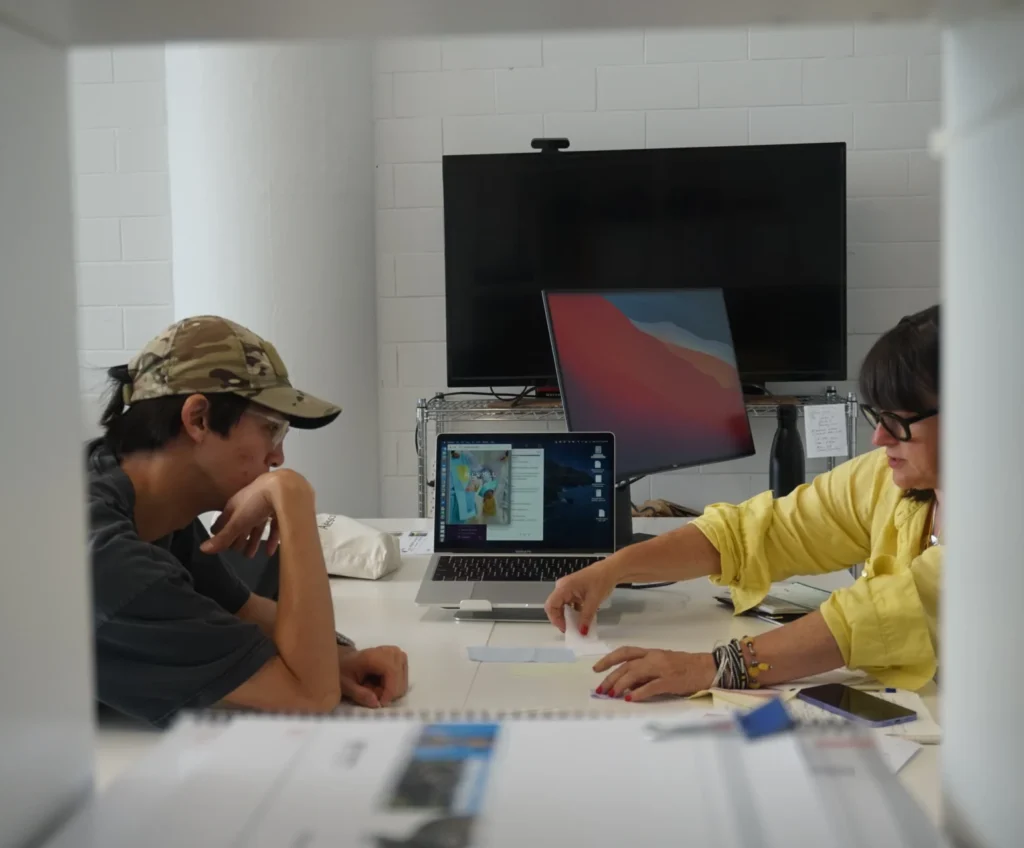
Definitely HeroWear and working on the Apex. I had no idea what to expect because we were designing a product none of us had ever seen before, and we had almost no information in the beginning about what it should ultimately be. We had to research everything: going into warehouses, understanding what the end users were doing, what they needed, and how a solution might actually support them.

From there it was really just creating something step by step, little by little, and trusting the process—that if we kept working, we’d eventually land on the right product. Embracing that unknown, and not being afraid of it, was a huge learning experience for me.

Ryu’s time at Interwoven taught him to design through ambiguity — a skill that continues to shape how he approaches complex technical challenges today.

Q:

Do you still approach your work the same way today—observing the user, embracing the unknown, and figuring things out step-by-step?

A:

I don’t have as many opportunities now to do direct user observation, but yes—the mindset is still the same. Embracing the unknown and taking things one step at a time was such a valuable lesson, and it’s something I still rely on in my work today.

Q:

What’s one thing people often misunderstand about the work of a technical designer?

A:

People sometimes get caught up in the tiny details and forget that technical designers always have to hold the big picture. You have to step back and think about how everything will come together and what the overall goal is—not just where a piece of Velcro lands. Remembering that bigger vision is really important.

Q:

How would you define technical design for someone outside our industry? People don’t always understand how valuable it is or how it differs from concept design or styling.

A:

Honestly, it’s hard to define because so much of it happens in your head. But for me,

Q:

Why do you think technical design matters, especially in categories like wearables, medical devices, and soft goods?

A:

Everyday items require a lot of thought because people use them constantly. Even something simple—like a belt or a holster—needs a slight curve so it hugs the hips instead of sitting straight. Those small decisions make a big difference when something is worn daily. Technical design is what makes those details functional and comfortable in real life.

Q:

You’re known for being incredibly detail-oriented—something I always appreciated in your work ethic. How does that mindset translate into the work you do now compared to more conceptual work?

A:

Believe it or not, I’m not as detail-oriented as I used to be. Things move so fast here that I’ve had to learn to let go of some of the minutiae. But I still think details are incredibly important. In tailoring, for example—where the hem goes, how the fusible is shaped inside a sleeve—those choices really affect how the final garment looks and performs. Even when the big picture matters more, the details still play a role in shaping the outcome.

Q:

Do you have an example—without breaking any NDAs—of a project where the details really drove the success of the design, or where you had to let go of details?

A:

I do, actually. I’m looking at the sample right now. We were working on a pleated dress, and the director wanted it to fit closely around the hips. With individually pleated pieces, it’s much easier to sew everything straight. But if you add a small dart to each pleat, the dress hugs the body much better. It was more work for the seamstresses and definitely more tedious, but it made a noticeable difference in the final result.

Q:

When you start a new project with big technical unknowns, where do you begin? And how is that process different from the product-focused work you did at Interwoven?

A:

Fundamentally, it’s the same. You lay out all the pieces, look at the sketch, and try to understand the big picture first—how the shape forms, where you need more volume, how things come together. Then you work through the smaller issues as you see the prototype.

The difference now is scale. In fashion, I’m working on collections with 120–140 styles, split between two people, instead of a single deep-dive product. But the mindset is the same: start broad, then solve the details.

Q:

What kinds of fabrics or garment types do you prefer working with?

A:

Wovens. I’ve learned to appreciate them more. Knits can be easier because there’s less room for error, but I work with both.

Q:

Tell me about your iterative process. How do you move from prototype to final sample?

A:

We usually make an initial prototype in a comparable fabric—we almost never use muslin. We fit it, review it, and make adjustments. If there’s a major design change, we start over. If not, we refine it and then move into a final salesman sample.

Q:

How much of the pattern work do you handle, and how long does a garment take?

A:

I draft from start to finish. A simple dress with four or five panels might take two and a half to three hours. A jacket could take three-quarters of a day to a full day. It really depends on the style.

Understanding the hidden architecture of a product — whether a wearable or a tailored jacket — is where technical design becomes almost invisible, yet absolutely essential.

Q:

Most people don’t realize how much inner structure goes into a tailored garment. Can you walk us through that?

A:

I didn’t realize it either until I opened up a men’s jacket. There’s a lot inside: canvas, padded chest pieces, Heimo, shoulder pads to hold the shape, sleeve structuring, and fusible layers that add support.

The heaviest structure is on the upper body—chest and shoulders. Fusible can run through the whole front and usually across the back shoulder blade. Anywhere there’s a turned hem, you’ll often find fusible to hold the shape.

Q:

Is that construction similar between men’s and women’s garments?

A:

The sewing is similar, but the fit is completely different because of physiological differences—especially the bust. You have to alter patterns significantly to account for that.

Q:

Can you give an example of a small technical detail that makes a big impact?

A:

A two-piece sleeve. People don’t notice it, but it feels so much more natural because the sleeve can actually follow the bend of your arm. A one-piece sleeve is basically a tube—it doesn’t guide the arm forward in the same way.

Q:

What’s next for you? What are you exploring personally right now?

A:

I’ve been experimenting with denim washes at home—doing potassium permanganate treatments on my patio, which is probably dangerous but fun. There’s so much science behind wash techniques that I never knew. I’m not inventing a new wash, but I’m trying to create my own personality in how the denim wears and ages.

Q:

What advice would you give to young designers starting out in technical design?

A:

I’d say it’s important to keep one eye on the bigger picture while you’re deep in the details. You have to be able to zoom out and look at the whole garment or product, then zoom back in to solve the small problems. It took me a while to learn that balance, but having both perspectives is essential.

Q:

Last question: if you had to start all over again, would you still choose to be a designer?

A:

Yes, absolutely.

Check out the rest of our Spotlight series to hear more from leaders in the design industry. Sign up for our newsletter and follow us on Instagram and LinkedIn for design news, multi-media recommendations, and to learn more about product design and development!

Please reach out!

Sustainable Materials in Soft Goods and Wearable Product Design: The Search for Innovation

How New Materials are Shaping Industrial Design

In recent years, industrial designers have been challenged to find new materials that can meet the demands of today’s ever-changing world. With an emphasis on sustainability and functionality, the search for new materials has intensified, leading to innovative and inspiring discoveries that are changing the way products are designed, manufactured, and used. In this article, we will explore some of these new materials, including their functions and the impact they have on industrial design.

New Materials: An Introduction

New materials refer to the novel substances, composites, or combinations thereof, that possess properties and characteristics that make them suitable for use in the design and development of products. These materials may offer enhanced mechanical, electrical, thermal, or optical properties, as well as features such as biodegradability, sustainability, and reduced environmental impact. New materials may be developed through various approaches, such as advances in material science, biotechnology, nanotechnology, and additive manufacturing, and can lead to innovative products that address real-world challenges in industries ranging from healthcare to transportation to consumer goods. As such, new materials play a critical role in enabling product designers to create sustainable and high-performance products that meet the evolving needs of society.

The development of new materials has become essential in addressing environmental concerns and creating sustainable solutions in industrial design. One approach is to integrate living organisms into building materials, as seen in the bio-concrete tiles developed by Brigitte Kock and Irene Roca Moracia. These tiles are an innovative example of how new materials can address real-world issues by absorbing water and reducing urban heat island effects. On the other hand, bio-plastics offer an eco-friendly and biodegradable alternative to traditional plastics, significantly reducing plastic waste and its harmful impact on the environment. The use of these new materials demonstrates a shift towards a more sustainable approach to industrial design, leading to a greener and healthier future for our planet.

Bio-Plastics

Bio-plastics are a category of materials that are derived from renewable resources and have gained popularity in recent years due to their sustainability and eco-friendliness. These materials are made from plant-based sources such as corn starch, potato starch, and sugarcane, which makes them biodegradable and environmentally friendly.

One of the most significant advantages of bio-plastics is that they can significantly reduce the amount of plastic waste that ends up in landfills and oceans, which is one of the biggest environmental issues we face today. Unlike traditional plastics, which can take hundreds of years to degrade, bio-plastics are biodegradable and break down much faster, leaving behind fewer harmful residues.

In addition to their environmental benefits, bio-plastics also have numerous practical applications in industrial design. They can be used to create a wide range of products, including coffee cups, cutlery, and packaging materials. These products are not only more sustainable, but they also offer a range of unique features and properties, such as heat resistance, water resistance, and durability.

One example of footwear that uses bio-plastics is the “Futurecraft Loop” sneaker, developed by Adidas. The sneaker’s upper is made from 100% reusable thermoplastic polyurethane (TPU), which is a type of bio-plastic derived from natural materials like corn and castor beans. The unique design of the sneaker allows it to be easily disassembled and recycled, with the recycled TPU being used to create new shoes. This innovative approach to design and materials creates a closed-loop system that minimizes waste and reduces the environmental impact of the footwear industry.

Overall, the impact of bio-plastics on the environment and industrial design is significant, and they represent a promising solution to the plastic waste problem. By using bio-plastics in their designs, industrial designers can create products that are both functional and sustainable, contributing to a more eco-friendly future.

Natural Fiber Welding: A New Material

Natural Fiber Welding is a technology that uses plant-based materials, such as cotton and flax, to create new sustainable alternatives to traditional synthetic materials like plastic and leather. The company behind this technology has developed a patented process that transforms natural fibers into a durable, flexible, and customizable material that can be used in a wide range of applications, including furniture, apparel, and automotive products.

The process involves using enzymes and natural chemistry to break down the plant fibers into their basic components, which are then reassembled into a new material that has similar properties to leather or synthetic fabrics. The resulting material is biodegradable, non-toxic, and more sustainable than traditional materials, as it requires fewer resources to produce and has a lower environmental impact.

One example of a product that uses Natural Fiber Welding is the “Mirage” chair by the furniture company Steelcase. The chair features a unique backrest and seat made from the company’s patented plant-based material, which is created using Natural Fiber Welding technology.

The material used in the chair is made from natural fibers like flax and cotton, which are processed using enzymes and natural chemistry to create a material that is both durable and flexible. The resulting material has a similar look and feel to leather but is much more sustainable and ethical, as it is biodegradable, non-toxic, and requires fewer resources to produce.

The Mirage chair is an excellent example of how Natural Fiber Welding can be used to create innovative and sustainable products that meet the needs of today’s consumers while minimizing the environmental impact of the manufacturing process.

Sustainability: Sourcing New Materials

One of the biggest challenges that industrial designers face when sourcing new materials is sustainability. With an emphasis on creating a more sustainable future, it is important that new materials are sourced responsibly and ethically. This includes ensuring that materials are not harmful to the environment or contribute to deforestation, pollution, or exploitation.

To overcome these hurdles, designers can use databases that provide information about the sustainability of materials. These databases can be found online and offer information about the environmental impact of materials, including their carbon footprint, water usage, and more. By using these databases, designers can make informed decisions about the materials they use, ensuring that they are sustainable and ethical.

Here are three databases where you can find information about new materials:

  1. Materials Project: This is a database that provides information on the physical and chemical properties of materials. It includes data on more than 100,000 materials and is free to use for academic and research purposes.
  2. MatWeb: This is a searchable database of materials and their properties. It includes data on metals, plastics, ceramics, and other materials, and is used by engineers, designers, and researchers to find materials that meet specific requirements.
  3. SciFinder: This is a database that provides access to a vast collection of scientific research, including information on new materials. It includes data on materials science, engineering, chemistry, and other related fields, and is used by scientists, researchers, and engineers to stay up-to-date on the latest developments in their fields.

In addition to databases, designers can also work with suppliers and manufacturers who prioritize sustainability. This includes sourcing materials from local or ethical sources, using renewable energy, and reducing waste and emissions. By working with these suppliers, designers can ensure that their materials are sustainable and contribute to a more sustainable future.

Getting Materials in House: Ordering and Cost

Another challenge that industrial designers face when sourcing new materials is getting materials in house to prototype and cost. This can be difficult, as many new materials are not readily available or can be expensive to source.

To overcome these hurdles, designers can work with suppliers who offer samples or small quantities of materials. This allows designers to test and prototype their designs

without committing to large quantities of expensive materials. Designers can also work with manufacturers who offer custom material development services, allowing them to create materials that meet their specific needs and requirements.

When it comes to cost, designers can explore alternative materials or look for ways to optimize their design to reduce material usage. For example, using lightweight materials can reduce transportation costs and lower the carbon footprint of the product. Designers can also explore ways to use recycled materials or incorporate waste materials into their designs, reducing the overall cost and environmental impact.

Conclusion

In conclusion, the search for new materials is an essential part of industrial design. New materials offer unique properties and features that can improve product performance, aesthetics, and sustainability. Bio-concrete tiles, bio-plastics, and natural fiber are just a few examples of new materials that are changing the way products are designed and manufactured.

To overcome the challenges of sourcing and using new materials, designers can use databases, work with sustainable suppliers and manufacturers, and explore alternative materials or design optimization. By embracing new materials and sustainable practices, designers can create products that are both functional and environmentally responsible, contributing to a more sustainable future.

Looking for more design InsightsSign up for our newsletter and follow us on Instagram and LinkedIn for design news, multi-media recommendations, and to learn more about product design and development!

New Material Databases

The Smart List is a monthly list of multi-media recommendations on everything design, curated by Interwoven Design. As a group of aesthetically obsessed designers, there are a lot of beautiful products, objects, and resources that we love and enjoy. These products improve the quality of our daily lives and we want to share them with you. This issue is a collection of material databases, incredible tools to help you find new and sustainable materials for prototyping and manufacturing!

Smart List: New Material Databases

PlasticFree

plasticfree.com

At the beginning of 2023, A Plastic Planet unveiled an innovative online platform, PlasticFree, aimed at assisting designers of all industries in their quest for plastic-free materials while navigating the complex realm of sustainable options. By subscribing to this service, users gain access to comprehensive reports on over 100 plastic alternatives, offering valuable insights into their properties, production methods, and sourcing.

The PlasticFree database caters specifically to sectors heavily reliant on plastic, such as packaging and textiles, with plans to expand its coverage to buildings and construction later this year. This unique platform serves as a valuable resource, combining a material library with a design tool. It not only presents case studies showcasing how these materials are already being utilized across five continents but also allows users to create mood boards to gather inspiration for their projects.

The development of PlasticFree is the culmination of over two years of dedicated research and collaboration with a council comprised of esteemed scientists, business leaders, and industry experts. A Plastic Planet’s goal is to empower architects and designers with the knowledge and resources necessary to make informed choices that contribute to a plastic-free future.

via Dezeen

Materiom

materiom.org

Materiom is a free online resource that enables everyone to make their own raw materials, as long as you can follow a recipe. By making this knowledge accessible, Materiom accelerates material development and lowers barriers to entry for makers around the world.

Materiom offers recipes of varying complexities on a scale of 1 to 5. These recipes can be found organized in different categories based on their material type and composition. Similar to a cooking recipe, the instructions are broken down into easy steps that are comprehensive and detailed. 

The recipes yield all types of materials, including a 3D printing paste that is made of egg shells. Check out the database HERE!

via Core77

MaterialDistrict

materialdistrict.com

MaterialDistrict is the foremost platform for connecting innovative materials worldwide. As a premier source of inspiration for high-end materials, MaterialDistrict is invaluable to research and design experts across industries who utilize the platform to explore fresh material solutions.

The extensive database presents a multitude of articles introducing novel materials to global audiences. These articles not only delve into the characteristics and potential applications of the materials but also provide insights into the manufacturing process. By effectively presenting accessible materials to designers worldwide, MaterialDistrict opens up a realm of boundless possibilities.

MaterialDistrict fuels global innovation by bridging material requirements with suitable solutions. Through the MaterialDistrict network, collaborative innovation is encouraged to foster a superior, more sustainable, and higher-quality society.

via MaterialDistrict

Material ConneXion

materialconnexion.com

Material ConneXion, established more than two decades ago, originated as a valuable resource catering to furniture and architectural design. Today, it has evolved into a global materials library and consultancy, earning recognition for its pioneering problem-solving capabilities across many industries and brands such as Adidas, Target, BMW, and Puma.

Alongside the curation of material libraries and collections worldwide, MCX specializes in assisting companies in identifying materials that elevate the performance, aesthetics, and sustainability of their projects. With its headquarters in New York, the company boasts additional branches in Bangkok, Bilbao, Daegu, Milan, Skövde, and Tokyo, while simultaneously maintaining an extensive online materials database.

At the heart of Material ConneXion lies a physical library housing an impressive collection of over 10,000 materials and processes. These resources are meticulously categorized based on their chemical composition, encompassing polymers, naturals, metals, glass, processes, ceramics, cement-based, and carbon-based options.

via Material ConneXion

Follow us on Instagram for design news, multi-media recommendations, and to learn more about product design and development!