The Power in Numbers: The State of Women in Design

The Power in Numbers: The State of Women in Design

This article, written by Rebeccah Pailes-Friedman, was published in the Fall 2024 Issue of IDSA’s INNOVATION Magazine.

There is power in numbers—whether through data, collective action, or the growing presence of women in the field of industrial design. As our industry continues to evolve, conversations around gender equity have gained traction, especially in the face of persistent challenges such as underrepresentation, career progression barriers, and pay inequality. While we’ve made strides, there’s still a lot we need to dig into and figure out. This article explores key statistics on women in industrial design, takes a look into the troubling mid-career drop-off many women experience, and highlights the urgent need for concrete data to drive systemic change. Understanding the state of women in industrial design is critical, not only for those currently in the field but for the future of the profession itself.

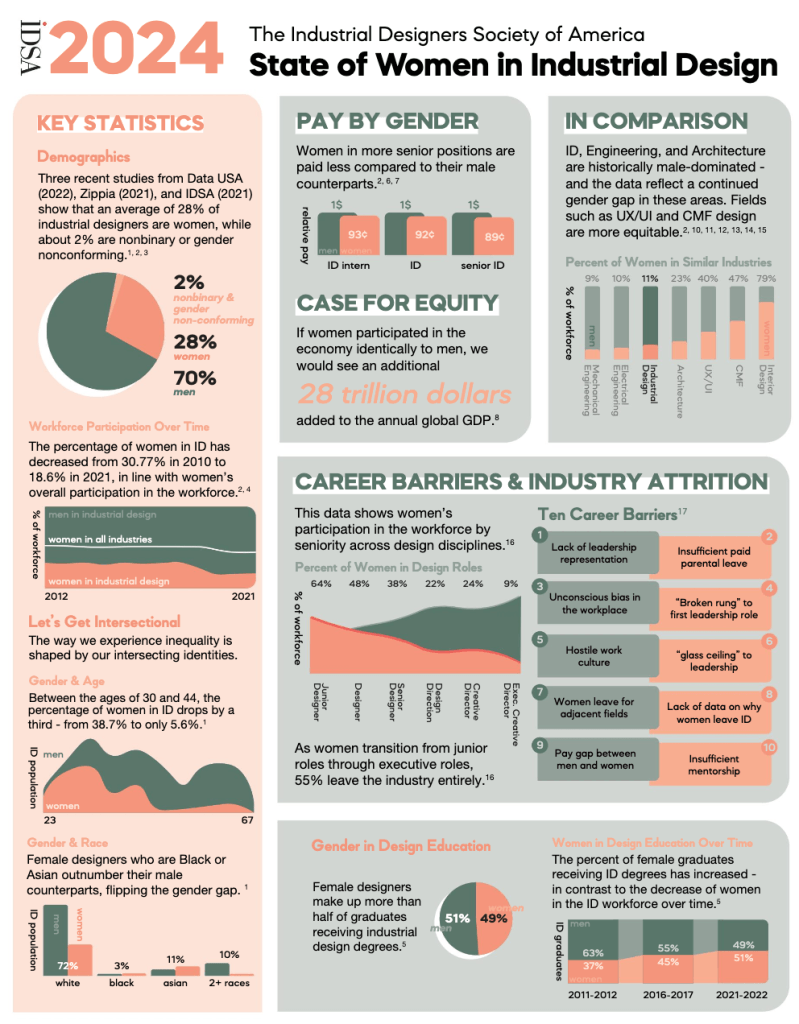
Last spring, the Women in Design Committee gathered as much information as it could find to take the temperature of the state of women in ID. We found some eye-opening statistics. One of the striking statistics is that 70 percent of industrial designers are men, and unfortunately that trend is not getting better. Three recent studies from Data USA (2022), Zippia (2021), and IDSA (2021) show that the percentage of women and nonbinary designers has decreased from 30.77 percent in 2010 to 18.6 percent in 2021. Though this is in line with women’s overall participation in the workforce, the numbers get even worse as women progress in their careers. Between the ages of 30 and 44, the percentage of women in ID drops precipitously, from 38.7 percent to only 5.6 percent.

As women progress from junior to executive roles, an alarming 55 percent leave the industry altogether. By mid-career, many women leave the profession, a shift that raises important questions. Current data on where these women transition after leaving ID is limited, but evidence points to a range of barriers: lack of leadership representation, unconscious bias in the workplace, insufficient mentorship, limited opportunities for advancement into leadership roles—and, of course, the persistent pay gap between men and women. Feedback from industry professionals suggests that many women feel isolated or undervalued, leading them to pursue careers in adjacent fields or leave design altogether.
women in design statistics chart 1

This is something that Dalal Elsheikh, a first-generation Sudanese-American, car enthusiast, and keynote speaker at this year’s IDC in Austin, Texas, has experienced first-hand. Committed to creating opportunities for women and girls of color in traditionally male-dominated spaces, Elsheikh shared insights that provide a valuable perspective on the barriers faced by women, especially women of color, and how we can work to overcome them. One barrier that can be challenging to overcome is the feeling of belonging. When the majority of the people you work with don’t look like you and haven’t had your life experiences, it can be intimidating to take on a leadership role. When discussing advocating for oneself, she shared her thoughts:
“In a creative field like industrial design, it’s so important for designers of all levels and backgrounds to feel heard and respected. I know for women and those of us who don’t see ourselves reflected in the workplace, it can be a daunting task to advocate for ourselves and our ideas. Confidence is a muscle that takes constant exercise to grow. The first time you stand up for your work, share a radical idea, or dare to oppose the status quo, it will feel awkward.”

She added that reflecting on your work and how far you’ve come can help you gain perspective:
“The fact that you have been accepted into this role or program for no reason other than that you are qualified. That knowledge alone should give you the sense of authority you need.”

It is becoming increasingly important to include a diversity of thought and ideas in the work we do as industrial designers. In my role as the founder and principal designer at Interwoven, it has become a key selling point that we are a woman-led and primarily women-staffed design consultancy. This diversity has allowed us to approach design challenges with fresh perspectives, resulting in more innovative solutions. However, it wasn’t until I led my own firm that I truly felt people were actively listening when I spoke, and open to the ideas I put forth. At Interwoven, I’ve witnessed first-hand how creating a space where women’s voices are not only heard but valued leads to richer, more inclusive design outcomes. Our team’s unique perspectives have helped us tackle complex problems in ways that wouldn’t have been possible in a more homogeneous environment. It has reinforced my belief that diverse teams aren’t just good for equity—they are critical for creativity and pushing the boundaries of design.

Elsheikh shared a similar experience. When she first entered the automotive industry, she worked on a car interior project focused on enhancing rider comfort, specifically considering where a woman rider might prefer to place her purse. The design team, which was primarily composed of men, brainstormed many ideas: “Maybe it’s a hook she can hang her purse on, or maybe a compartment, or a shelf she can position a bag on, or how about under the seat?” Elsheikh didn’t feel qualified to share her insight with this group of seasoned designers, so she kept quiet and didn’t share that these suggestions seemed unlikely; most women, she believed, would want to keep their bag in their lap or on the seat beside them, and don’t feel comfortable keeping their bags out of sight. “I felt unqualified, but in actuality I was at that moment the most qualified,” Elsheikh said. “I had the lived experience of being a woman, being someone who used ride-hail services, and someone who carries a purse.” This experience illustrates how essential it is for women to feel empowered to share their unique perspectives, as they often bring invaluable insights that others may overlook.
women in design statistics chart 2

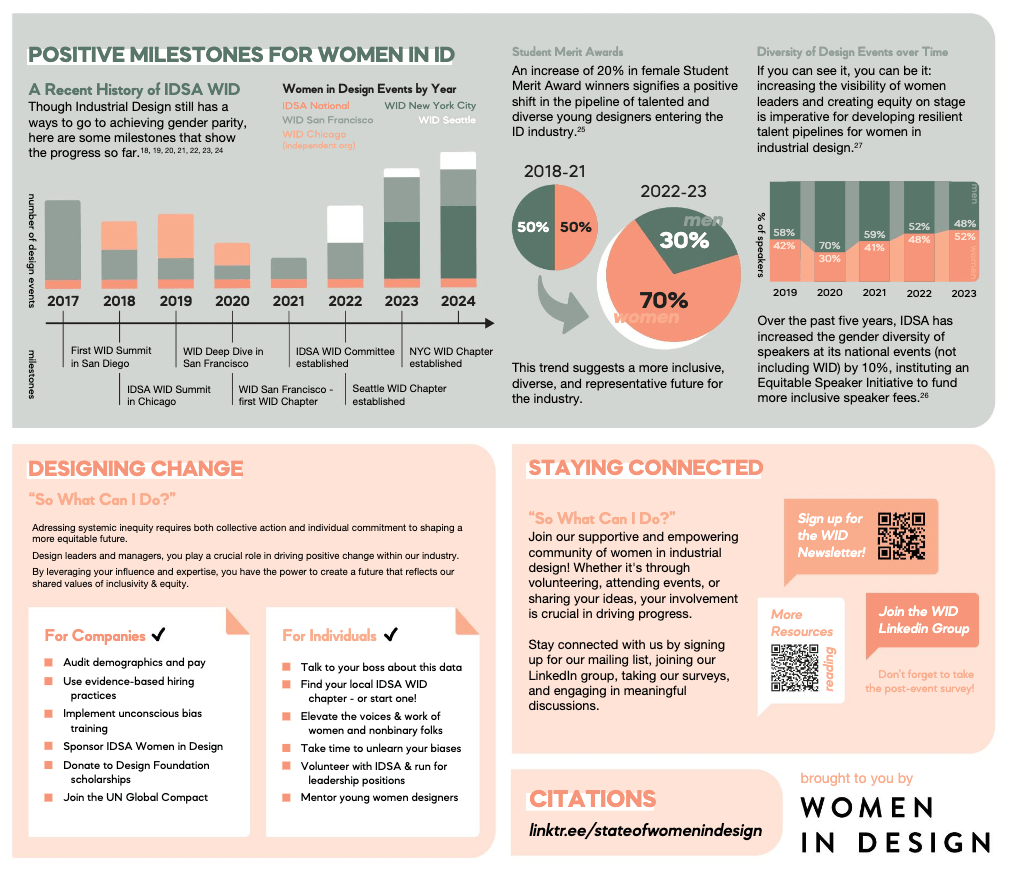
It is critical to cultivate and support women and nonbinary designers in becoming thought leaders within our field. To bring attention to these concerning trends and other key statistics, the Women in Design (WID) Committee created a large data visualization poster for the International Design Conference (IDC). This interactive exhibit encouraged attendees to engage directly with the data through various prompts aimed at gathering qualitative feedback. In one exercise, we asked attendees to vote on which question the community believes is most crucial to explore further. In others, we invited reflections on allyship and workplace inclusion.

From this exercise, we learned that one of the most concerning trends in industrial design—the dramatic mid-career drop-off of women—was a key issue that many attendees wanted to understand better. While women make up more than half of the graduates receiving industrial design degrees, this promising start doesn’t translate into long-term careers. The Women in Design (WID) Committee has recognized the need for more concrete data to fully understand the reasons behind this drop-off. By collecting more precise data on where these women transition, and by identifying the barriers that push them out of industrial design, IDSA and the WID committee aim to develop targeted solutions. These findings will guide future initiatives, from mentorship programs to policies addressing work-life balance and leadership pathways, all designed to support women through the most challenging phases of their careers.

In collaboration with IDSA’s Research Committee, we are working to scope out future research that will explore these transitions and uncover root causes, with the goal of developing strategies to retain female talent and foster long-term career growth in the field. While conversations around gender equity have helped raise awareness, the WID Committee believes it’s time to move beyond dialogue and take action. Ultimately, the goal is to use this data to inform industry-wide changes that will create more inclusive environments, foster diversity in leadership, and ensure that women not only enter industrial design but thrive throughout their careers. As Elsheikh said: “As we continue to see women entering (and more importantly, staying in) design roles and moving up the corporate ladder, we can only hope that the strength in numbers will put forward the importance of the female perspective.”

The conversation around women in industrial design is not just about representation. It’s about creating meaningful, lasting change in the industry. The data is clear: Women enter the field in strong numbers, too many leave by mid-career, driven by barriers such as lack of leadership opportunities, mentorship, and pay equality. Through efforts like the Women in Design Committee and their collaboration with IDSA’s Research Committee, we are beginning to take the necessary steps to move from dialogue to action. By gathering concrete data and addressing the root causes behind the mid-career drop-off, we can develop targeted strategies to retain and elevate women and nonbinary designers. This is about more than equity—it’s about the future of industrial design itself. As Dalai Elsheikh reminds us, “the strength in numbers will put forward the importance of the female perspective,” and that perspective is vital to pushing the boundaries of creativity and innovation in our field. It’s time to ensure that women not only enter industrial design but thrive throughout their careers, shaping the future of the industry.

—Rebecca Paikes-Friedman, FIDSA
rpf@getinterwoven.com

References

Bartlett, Kristin, “Women in Industrial Design: A Review,” Proyecta56 an Industrial Design Journal, https://www.zippia.com/industrial-design-internship-jobs/demographics, June 2023.

Data USA, “Commercial and Industrial Designers,” https://datausa.io/profile/soc/commercial-and-industrial-designers, 2022.

Industrial Design Society of America, “2021 Membership Survey Findings Report,” https://www.idsa.org/2021-membership-survey-findings-report, 2021.

Federal Reserve Bank of St. Louis, “Labor Force Participation Rate: Women,” https://fred.stlouisfed.org/series/LNS11300032, 2024.

Zippia, “Industrial Design Internship Demographics and Statistics in the U.S.,” https://www.zippia.com/industrial-design-internship-jobs/demographics/, 2021.

Looking for more design InsightsSign up for our newsletter and follow us on Instagram and LinkedIn for design news, multi-media recommendations, and to learn more about product design and development!

A Q&A with Color Expert Rebeccah Pailes-Friedman

A Q&A with Color Expert Rebeccah Pailes-Friedman

Spotlight articles shine a light on designers and design materials we admire. We ask designers about their work, their design journey, and what inspires them. In this issue we speak to Interwoven’s founder and principal designer, Rebeccah Pailes-Friedman, a design consultant and educator with expertise in wearable technology, functional apparel, and soft goods design. In addition to her work at Interwoven, Rebeccah Pailes-Friedman is a co-founder of SEArch+, Space Exploration Architecture, a professor of industrial design at Pratt Institute, and worked for over 20 years as a corporate Design Director for premium athletic brands, including Champion, Fila, and Nike. She is the author of Smart Textiles for Designers: Inventing the Future of Fabrics and speaks internationally on design and innovation. She also recently launched a handmade ceramics company. She is passionate about color and it shows in everything she does. We asked her about her color design process, the cultural context of color, and how to be an advocate for color.

Portrait of industrial designer Rebeccah Pailes-Friedman
Photo courtesy of Rebeccah Pailes-Friedman.

Q: When do color considerations come into the design process for you?

A: I want to back up because I think it’s got to be said that I absolutely love color. It’s my favorite part of the design process. So when I think about integrating it into my process, it’s more like my process starts with color. Not only does it define the context but it also can set the mood, it can determine your very first impression of the product or environment or whatever it is you’re experiencing. Color is almost on a gut level. The first reaction that you have is going to be in response to the color, the texture, and the materials, they’re intertwined.

When I think about color, I start with a mood. I think, What is the mood that I want to feel when I’m looking at this product or this room or this environment? Once I have the mood, I start thinking about the colors that inspire that emotion, and then I start to analyze. If it’s a product for a client, I ask, Is this going to hit the right demographic? Is this going to communicate the right look and feel? But all of that stuff comes after the first initial emotional reaction to the color.

Q: What role does cultural context and user demographics play in your color palette development process?

A: Cultural context is core to the development of a product. It’s important because you want a product to be successful. When I was design director at Nike and I was developing the color story for a product, I would determine where and in what market that product was being sold. Even just in the United States there are micro markets. What should the palette be for a group of stores in the south of the United States? How is that different from the Pacific Northwest? How is that different from the New England region? Everybody has a different take on what feels culturally appropriate in that area, and you have to understand these nuances so that you can build a color palette that will answer to all of those different demographics. And this is not just in the United States, it’s global. In the Far East, there’s a different sort of flavor to color. It could be as fundamental as the quality of light. Depending on how close you are to the equator or how the Earth is rotating, the quality of light can really make a difference in the way that you perceive color. It can also be influenced by the vegetation in the area. Parks look different when you’re near the equator than they do when you’re in New England, so your idea of a green palette is different. All of these things play into determining the colors that people are going to be most receptive to. 

Q: Could you walk us through your process for researching potential color directions for a project?

A: There’s research and there’s inspiration. I’m a big believer in using forecasting in my research. I don’t just randomly pick a gray, the classic black-gray-white pop-up color palette. I start by thinking about the colors that have been most popular in the past three to five years. Forecasts predict trending color for anywhere between one and three years out. Where do they see color going? What do I see when I look at retail product? Each one of those is an area of research. There’s the color forecast. There’s historical reference of color progression. And then there’s the context of what is happening currently in the market. I take all of those things into consideration, then I mix it with inspiration. The inspiration is: what do I personally love? What am I trending towards and in terms of the colors that I’m finding interesting? Then I meld those two together and plunk it into the cultural context of where I think the product is going to be.

Q: How do you balance insights from color forecasting with insights from landscape surveys, design constraints, and client preferences to determine a color direction for a product? How do you weigh the importance of each element of the decision?

A:  The hardest thing for clients—when they’re thinking about color and don’t really have a lot of experience with color—is being comfortable with risk. Most people that are launching a product want it to be successful, so they tend to be conservative on the color front and they’ll want it in the most basic colors. That’s why there are so many products that are white or black or gray, because those are the most basic. I like to tell a story around color. I build evidence for a narrative of why these colors are good. That evidence can be successful products that have used color, and it may be a more risky approach than the client might have imagined. If I do a good enough job telling the story, they’ll take a chance. A really good example of that is the pop of yellow we used for HeroWear. I knew that they wanted a black and gray product and I thought, That’s not going to stand out in the marketplace. Then I thought about all the different pop colors that might be suitable. I realized that the best way to tell that story was around how that product is built for safety and how safety is associated with yellow. I started doing research into the particular type of yellow, hunting for a yellow that I thought would be brand appropriate for them: friendly and sunny but not necessarily danger-related. That’s how we developed that yellow color that we suggested for the HeroWear Apex Exosuit.

Q: What methods do you use to communicate color choices effectively with clients or stakeholders who don’t necessarily speak the language of color?

A: I spend a lot of time building the palette. I’m constantly looking at color and really thinking about how to develop it. Then the narrative is important, but showing examples of how the color could be used on particular products is critical for people to understand how a color palette could be applied. So there’s the development of the color palette, then there’s the narrative around the importance of that color palette, but the most important thing is the practical application; how that color palette can be applied to that particular product. And ‘product’ might be more than just the physical product. It could also be the branding and the marketing. Showing applications becomes a concrete way for the client to understand how we would want to use the color.

If I just showed a color palette, which is boxes of color with descriptions underneath, it’s really hard to understand what that means. Most people are literal, they see a box of color and they imagine the product painted that color. I need to show them a vision of just a hit of pink on the lining in this particular piece, so it will be a surprise when the client goes to put it on or take it off.  It builds on the narrative but also shows the context of how the color would be applied. That’s critical for the client to understand not only how the color palette was made and why it’s important, but also how we are going to use it. That gives them the comfort level to maybe take a color risk that they wouldn’t necessarily have considered otherwise.

For example, when we were asked to come up with a number of color combinations for a cooler product, I thought about a dark combination, a light combination, and a neutral combination. A combination for a person who drives a big pickup truck, a combination for someone who’s going to the beach in the Hamptons…colorways that would be appropriate for all of these different user contexts. When we showed them to the client, they responded quite well to three or four of the different colorways. I think that’s the most important thing, to show how the color would be used.

Q: What considerations do you take into account when designing for accessibility and inclusivity, ensuring that color choices are inclusive for all users?

A: That’s really a great question. Color is understood on a spectrum, and everybody understands color in a different way. When we talk about inclusivity, we have to think about people who are hyper color sensitive—and I would say that I fall into that category—as well as those who are less color sensitive, as well as those who are color blind, and can’t see much in terms of the contrast between red and green. That’s an especially difficult color combination for people who are color blind, and there are a surprising number of people who are color blind. For most people who aren’t in the creative profession, it’s not something that affects them except when they have to go pick out their clothing in the morning. But there are a surprising number of designers who are color blind. One of the things I try to do is have a sense of contrast. When somebody is less color sensitive, they really rely on the contrast between the colors as much as they do the color shift. 

The question is, how can you create products that speak with elegance and feeling and still have enough contrast so that people of all different abilities can process the surface and texture and composition of that product?

Q: To what extent is your hyper sensitivity to color ingrained as opposed to something developed over time as a designer?

A: I think I was born this way. I can share an anecdote. When I was maybe six, my mom was putting new wallpaper up in one of the rooms of her house, and she needed to match a paint color to the wallpaper color. She called me over to help! Rebeccah! It is something that people can develop but I definitely feel like it’s also something that has to be inherent to some degree. It’s physical. It’s about the way the cones in your eyes are built. I know that I am in the very small percentage of people who process color in high detail. Another anecdote: Pantone can come to your office and test the color sensitivity of all the designers. When I was design director at Champion, we had the entire design staff tested for color so that we would know who could approve the lab dips. I only got one wrong and that’s because I did the entire test that was supposed to be done in 20 minutes in 5, because I was too busy and I didn’t have time.

I think that applying color to a product is risky, and if you aren’t confident in your ability to choose colors that speak to multiple people and address a cultural context in the right way, it’s harder for you to be an advocate for that risk. In general, people think color is risky. The number one thing I hear from people is, I’m so afraid to use a color. Part of that comes from confidence. Yes, I think I was born with the ability to process color at a high level, but also, I think I learned how to apply color with confidence. That is something you can learn whether you feel like you’re good at color or not. You can learn to feel good about using color. You can learn to be confident in your color choices.

It can be hard for people to overcome fears around color, and that can create a bias against specific colors. There are some particular colors that I really don’t like very much, but then I always seem to find a way to use them. Invariably I can find a context in which I actually would kind of like that color. I don’t really like blue cheese…but there have been times when blue cheese tasted pretty good.

Q: How do you think about balancing time-tested or trusted colors with new, trending colors? 

A: Think of it like a layer cake. Your foundation always has to be in these classic colors. No one feels at risk with black, white, gray, and navy. And maybe, if you’re talking about clothing, some sort of neutral color. Think of that as the base of the layer cake. Then the next step up is the colors that you would pair with those colors (other than each other and navy or white). What would be something else that you could pair with one of those colors? That would make the palette feel still accessible but not too risky. And then, what are the right pops of color that you want to add to that palette? The pops don’t have to necessarily be literally bright colors but they could be, or they could be interesting or unusual in some other way. The pop color is not a color that’s going to last for 10 years in the marketplace, but maybe it’s a color that will last a year or a year and a half in the marketplace. You layer these on top.

 So you have this layer of the foundation colors, then you have a mid layer that’s going to be core colors that you can see lasting in a product for three to five years, and then you have the pops that will last one to two years. Then you think about how you are going to mix them in a way that will create a sense of comfort. Let’s say the navy gives the comfort of having something neutral, and you add an interesting secondary color that is still understandable while making that navy look a little fresher. Then you add the pop of something really unusual so that you can stand out in the marketplace.

I use this approach regardless of the product category. Most of the products that I’ve designed in my career are consumer products, so I tend to think of the end consumer using it, and then some of the products that we design are B2B. But even if they’re B2B and they’re wearables, then a person is eventually wearing it, so still it’s ending up with the consumer. Across product categories it’s a way to keep freshness in the product without it feeling like just another basic thing. You want the product to be able to stand out but you also want to give people this comfort level so that they don’t feel like they’re going to stand out. Not everybody, of course, because there are bold types and crazy influencers on Instagram that like to be photographed with their orange hair and their green sunglasses. But the majority of consumers don’t want to stand out to the point where people are staring at them. What they want is for people to almost do a double take and say, That looks kind of nice. Wow. You’ve got something new on. So the idea is to create interest that creates newness without alienating people.

Q: What advice do you have for designers looking to improve their color skills?

A: The advice that I would give people who are trying to figure out how they can expand their use of color is for them to just start. They should make notations to themselves about the things that they’re attracted to. I personally love to look at fine art because fine artists never think about color any other way than in abstraction. It’s another element to create their composition, whether it’s a sculpture or a painting. It’s there for a purpose, not to create a product. I look at the pieces of fine art that really speak to me and I think about the super unusual color combinations they feature and how I react to them. I take a thousand million photographs that have to do with color and how it’s used. I suggest that people look at a lot of things and take a lot of pictures to look back on what really spoke to them. Then, once they have a series of photos, they can see, Look, I went to the Whitney and I photographed 20 things. Of those 20 things, nine had this pink in them. Then they can start looking around, seeing where else they observe that pink.Or green, or blue, or whatever it is. Once you have an observation like this about yourself, you’ll start to wonder if you can use that color that is interesting to you in some way, and then you can start building a color palette around it.

Check out the rest of our Insight series to learn more about the design industry. Sign up for our newsletter and follow us on Instagram and LinkedIn for design news, multi-media recommendations, and to learn more about product design and development!

Design History Series N. 016

Beth Levine and American Footwear

In our Design History Series we highlight iconic women in design history and their innovative work. The historic contributions of women to design are many, and we aim to increase the awareness of these contributions in order to counteract a general trend of underrepresentation. In this issue we celebrate Beth Levine, the most influential and innovative American shoe designer of the twentieth century. 

Tiny Feet, Big Dreams

Beth Levine, dubbed “America’s First Lady of Shoe Design,” left an indelible mark on the world of footwear that continues to influence contemporary fashion. Born in Patchogue, New York, in 1914, Levine soon left Long Island for a shoe modeling career in New York City. She had incredibly tiny feet (US size 4, EU size 35) that were the sample size of the era, and developed a keen intuition for how shoes would fit. At the time, shoe designers were men, usually those descended from generations of cobblers. Levine realized that she understood just as much about what constituted a good shoe as these prominent designers, if not more, and was determined to design shoes herself.

Creating the Brand

In 1946, while applying to work at a shoe manufacturer, she met and married Herbert Levine, then a fashion executive. The two founded their shoe factory, Herbert Levine, Inc. in 1948 and Beth began making shoes under Herbert’s name. At the time, footwear had not yet been sold with a woman’s name on the product. The factory was known for its excellence, and talent was brought to New York from all over the world to ensure top quality. She was known for relishing the challenges of footwear, saying “Clothes designers have gravity on their side, but shoe designers work upside down. Ideas are easy to come by. Getting them realized is something else.”

The couple had a vision to create shoes that were not just functional but also captivating. Using strategic cutouts and careful material choices, Levine became known for shoes that made women’s feet appear smaller and were therefore perceived as more elegant. Levine is credited with repopularizing the mule silhouette with this approach. At the same time, she wanted her designs to be comfortable above all, and she wasn’t afraid to be playful and bold. Beth’s innovative designs and Herbert’s business sense propelled the brand to prominence, garnering attention from fashion icons like Barbra Streisand and America’s first ladies of the era; Lady Bird Johnson, Patricia Nixon, and Jacqueline Kennedy. 

Making History (Again and Again)

One of Beth’s most significant contributions to footwear design was her role in reintroducing boots to women’s fashion in the 1960s. Through her creative vision, boots transformed from utilitarian items into stylish fashion statements. Her stretchy stocking styles and vinyl Go-Go boots captured the spirit of the era and became iconic symbols of liberation and empowerment, epitomized by Nancy Sinatra’s hit song “These Boots Are Made For Walkin’.” The song not only propelled the demand for fashion boots but also led to the establishment of “Beth’s Bootery”, a dedicated fashion boot department at Saks Fifth Avenue. 

Beth’s designs were characterized by their whimsical charm and innovative use of materials. On a dare she designed “topless” or “upper-less” heels, shoes with no upper that would be affixed to the foot with adhesive pads. She called another style “Barefoot in the Grass” and lined the insole with AstroTurf. For the wife of a driver in the 1967 Indianapolis 5000, she designed a shoe that resembles (adorably) a race car, which became so popular that variations on the design were released for years afterward. Her creations pushed the boundaries of conventional footwear. She experimented with unconventional materials (hello, AstroTurf) like vinyl, acrylic, and laminate, creating shoes that were not only visually striking but also ahead of their time. She also developed the now universally standard practice of putting an illustration of the shoe on the outside of the shoebox. 

An Enduring Legacy

Throughout her career, Beth Levine received numerous accolades for her groundbreaking designs, including the prestigious Coty Award in 1967. Her ability to marry creativity with functionality revolutionized the shoe industry and paved the way for future generations of designers. Despite the closure of the Herbert Levine brand in 1975, Beth’s legacy endures through her iconic designs, many of which are housed in international costume collections. To Levine, who passed away in 2006, the only mistake in design is to “play it safe”. Today, her innovative spirit continues to inspire designers and fashion enthusiasts alike, reminding us of the enduring impact of her contributions to the history of footwear design.

Want more design history? Sign up for our newsletter and follow us on Instagram and LinkedIn for design news, multi-media recommendations, and to learn more about product design and development!

A Q&A with Footwear Designer Charlotte Logeais

A Q&A with Footwear Designer Charlotte Logeais

Spotlight articles shine a light on designers and design materials we admire. Our founder and principal designer Rebeccah Pailes-Friedman has met many wonderful designers as an educator and career designer, and in our Spotlight interviews we ask them about their work and their design journey. In this interview we spoke with senior footwear designer and art director Charlotte Logeais. Charlotte has been a designer at Nike* for over two years. She began in the kids division and is currently a senior designer on the Women’s Lifestyle team. To her, design has always been about storytelling and problem solving. With a bachelor’s degree in industrial design from Pratt Institute and a Master’s degree from USC integrating design, business, and technology, she is well versed in the power of design as well as the power of style. Her experience as a professional ballet dancer gave her an athlete’s mindset, and she knows the value of performance footwear firsthand. We asked her about the challenges of footwear design, emerging trends in the footwear industry, and what makes a great shoe.

Portrait of shoe designer Charlotte Logeais.
Photo courtesy of Charlotte Logeais.

Q: What is inspiring you at the moment?

A: The biggest thing that’s inspiring me at the moment are fashion week runway shows. I love  seeing all the runway collections and how each designer creates their own world while still aligning with the history of the brand. I also enjoy seeing how the runway trickles down into street style. 

Q: Could you tell us about your role at Nike? How do you fit into your team there?

A: I work on the Nike kids design team. I’m technically on the performance side, but the cool thing about the kids team—especially for me, being newer to the footwear industry—is that you get to work on a broad range of products. I’ve been able to work on lifestyle shoes, like the Air Max 1, and on performance product as well, like running. It’s been great to get to work on such a wide range of products and it’s  helped me discover what I’m most passionate about. It’s been a great team to first start on at Nike. 

On the kids team you can push the boundaries a little bit more and really have fun with the design. Kids love bright colors, they love shoes that are playful and energetic. They get super excited about designs that are colorful and vibrant – it’s the first thing they notice about a shoe. 

In footwear, we work two years out. The process is kicked off by a brief and then the design team begins pulling inspiration and sketching. Various priorities in the product brief will inspire the visual direction of the design. If it’s a shoe that needs to emphasize comfort, it’s probably going to be a more rounded form language. If it needs to emphasize speed, maybe it’s more angular. Those notes help us determine the visual language. 

My favorite part of the product creation process is when the team comes together to sketch together on a new project. It’s the most creative time we have each season. We go find a room—the whole kids team—and we sketch together all day for a couple of weeks on the projects of the season. Then each project lead will take all of those sketches, identify the common threads, and bring it to the finish line. 

Once the design has been finalized, we send out a tech pack and get our first samples back to revise. 

Q: What drew you to footwear design? 

A: I kind of stumbled upon it, which is funny considering I grew up in Portland, Nike’s backyard. When I was at Pratt doing my undergrad degree, I applied to a footwear design internship at Adidas and interned with them for six months. I’d never really sketched sneakers before and fell in love with it during that internship. I’ve always loved fashion and sport, and did classical ballet for 10 years, culminating in one year professionally before going to Pratt. In ballet, your feet are your main tool, but pointe shoes  have barely evolved since the 19th century. So it’s rewarding for me to be able to bring innovation to athletes through footwear design.  

Q: Of the skills that you learned at Pratt, which do you find most valuable in your work?

A: Design thinking is a big one, and the design process overall. In footwear, we’re given a product brief by our marketing team. That brief tells us who the consumer is, what they’re looking for, and what the priorities of the product need to be. Then it’s the designer’s job to take that information and create a design. At Pratt it was definitely drilled into us that you get your brief, you find inspiration, you sketch, you refine your idea, you present it, and then begin the development process.  

Q: Footwear is an industry known for inspiring cult followings. What are your main challenges as a footwear designer?

A: Being on the kids team is definitely a design challenge for me. I’m not the target consumer, and I think it’s a big challenge to design for someone who isn’t you while still wanting to imbue  the project with your personal aesthetic and sensibility. It’s a good challenge: to keep the consumer at the center of the product while still being able to bring in my perspective. Whenever we get to interact directly with the consumer it helps us to understand what they want from a product. As the kids team covers toddler through grade school, it’s a pretty large range and we have to tailor each design to what the specific age group needs. 

Q: From a personal standpoint, what makes a great shoe? One you’re excited to wear? 

A: For me, comfort is a huge thing. I want a shoe that I can wear all day long and it will be super comfortable. Also, a shoe that feels versatile and can transition between working all day at the office to going out for a drink or going to a pilates class. Having a shoe that can move with you throughout the day and keep you comfortable the whole day is the biggest thing for me. Beyond that, I like having some sort of icon on the shoe, a hero aspect of the shoe.

The shoes that I’ve been wearing the most right now are the Vomero 5s, they’re an old school running shoe that have now pivoted into lifestyle. 

Q: How does sustainability factor into design and production at Nike? 

A:  Sustainability is definitely a big priority. As a designer, I partner with material and color designers, and materials are usually the biggest sustainability play. We’ll often make sure to prioritize materials that have a certain percentage of recycled content to try to reduce the amount of new materials being brought in and reuse as much as possible. That’s a big priority, especially in the kids business. I think we’re one of the teams that is making the biggest effort with that. The youngest consumer really does care about the environment and about what their future is going to look like, so sustainability is especially important for them, and knowing that we also care. 

Q: What do you see as interesting emerging trends in the footwear industry today?

A: Some of the biggest trends are new digital tools. AI has been a huge one, getting to input a prompt and have ideas generated for you, often ideas that you couldn’t imagine or that are just super out there. AI is a powerful initial ideation tool for brainstorming and creating concepts. Midjourney is one of my favorites right now, I actually discovered it while pursuing  my master’s at USC. 

In the past, I’d just go on Pinterest and scroll for aesthetically pleasing imagery to create a mood board, but now you can create your own imagery for that mood board through AI. It makes each mood board a bit more unique, and you have the control to create the imagery that you want to work with. Now I do a bit of a combination of both, searching for inspiration images as well as generating them myself. I still do love Pinterest though… and I have so many boards.

Q: Are there other areas of design you would like to explore?

A: I purchased an apartment last May and have spent the last seven months renovating it. It’s in a hundred-year-old loft building in downtown Portland and it was a blank canvas, so I did all the interior design for it, working with the contractor and everything. That’s been a journey! But, It’s super rewarding to see it come together. The results of interior design are so physical. Whatever decision you make, you’re going to see it in real life. That has so much impact. Interior design is something that I’ve discovered I really enjoy doing, and I would love to do more projects like this.

Being in footwear, I’ve realized that lines are so important to me, when things align and how they are offset from each other. I think I’m driving my contractor a little bit insane, making sure everything is perfectly aligned and organized. Design to me is seeing how forms have relationships and fit together.

Footwear designers look at trends and forecasting. We are tied to the fashion world, so part of the job is keeping up with that, seeing what people are drawn to, whether that’s in person or through social media. On the performance side, we follow the different sporting events. In the NBA, there’s an interesting intersection of style and sport every time the athletes walk down the tunnel onto the court. Following influencers on Instagram is another good way to keep up with global fashion trends. Maybe I like their style or the way that they combine different clothing items in unexpected ways. Following those creators helps me stay connected to fashion and innovation. When I lived in New York, I could just go for a walk and see amazing street style everywhere. Living in Portland that’s a bit more difficult, so I rely on travel and Instagram.

Q: What do you see for yourself as a designer and for your career going forward?

A: I feel like I’m just getting started in footwear but I see a long future for myself in the industry. I’d love to work on more adult performance product. 

I also value  having my own design pursuits on the side, like interior design. I used to paint a lot and that’s fallen off in the past couple of years. I think it’s important to find the time to keep yourself fulfilled, to have those external pursuits that don’t involve the pressure to perform as much as your day-to-day work. The renovation project has been taking all of my energy so I think, once that is finished, I can find time to paint again. I also used to meditate every morning and I haven’t done that in a while. For me, finding the time for mindfulness and sport helps me stay balanced.

*Views are her own and do not reflect those of her employer.

Check out the rest of our Insight series to learn more about the design industry. Sign up for our newsletter and follow us on Instagram and LinkedIn for design news, multi-media recommendations, and to learn more about product design and development!

Appeal vs. Responsibility

The article “Appeal vs. Responsibility”, written by Rebeccah Pailes-Friedman, was published in the Spring 2024 Issue of Innovation Magazine.

In today’s design landscape, creators have moved beyond crafting products to shaping immersive product experiences. In this expanded field, narratives unfold through each curve and contour, blending aesthetics and emotions, and transforming designs into compelling and immersive stories designed to entice consumers. Welcome to the world of seductive design. This article will discuss appeal vs. responsibility in the work of the designer.

Seduction Redefined: A Deeper Dive

As important as functionality is, consumers today expect products to deliver more than function alone. They want products that they can connect to emotionally and that bring them joy. This is the definition of emotional design. We see designers trying to meet this demand across product categories. Take, for example, outdoor and sports products that exude a sense of speed and power, highlighting the sensations your body will experience during product use. The sleek design of a high-performance bicycle features an aerodynamic frame and vibrant colors not only to convey speed and power but also to emphasize the exhilarating feeling cyclists can expect when riding the bike.

Storytelling is a key component in creating a connection between a consumer and the product. The story connects the physical object to the consumer’s emotions. These emotional responses can be powerful, creating a bond between the consumer and the product as well as, crucially, cultivating brand loyalty. Packaging, in particular, has evolved to become part of the product experience, as demonstrated by the plethora of unboxing videos on TikTok, YouTube, and Instagram.

Both technology and the beauty businesses use packaging to define their brands. It is not just a container but an integral part of the overall seductive experience. Think of the similarities between your iPhone and a bottle of perfume; both promise the consumer an experience and are purchased as a part of a lifestyle the consumer desires as much as they are purchased for function. Consider the iPhone’s sleek, minimalist packaging, which resonates with the product’s promise of sophistication and innovation. Similarly, a bottle of perfume, adorned with carefully chosen materials and design elements, becomes a tangible embodiment of the sensorial journey it offers. Both purchases transcend functionality, entangling the consumer’s lifestyle aspirations with the allure of a unique experience.

The Role of Emotional Design

As consumer expectations evolve, emotional design emerges as the driving force behind product desirability, transcending the fulfillment of needs to nurture a profound connection. This shift toward emotional resonance elevates the functionality of products and establishes a deeper bond, transforming them into vessels that embody and reflect the users’ aspirations and sentiments.

Users perceive more aesthetically pleasing designs as easier to use and more effective. Beauty and usability are intertwined. Clean lines, intuitive interfaces, and straightforward user journeys contribute to the overall appeal of a product. The aesthetics of a product influence consumers’ expectations, fostering the perception that it will be easy to use and that it is superior to its competitors.

Two key questions about the significance of emotional design arise. The first is methodological: How does one effectively infuse products with emotional resonance? The second question is ethical: Given the potential extremes of emotional design, what is the designer’s responsibility to balance allure with transparent and conscientious design and manufacturing practices?

Engaging More Than the Eyes

How do designers go beyond surface-level aesthetics to create meaningful and captivating interactions? Designers can appeal to multiple senses to create an immersive and engaging experience. This might include tactile elements, sound design, or even scent. Material, color, and form are part of the overall product narrative and can be used to create an immersive and emotionally resonant experience.

Designing with an empathetic approach can also increase the emotional resonance of products. Products for new parents can connect emotionally to their ethos on child rearing. Lea Stewart, senior manager of design at Newell Brands, uses these emotional drivers to differentiate between brands like Graco and Baby Jogger, which she oversees. Stewart notes that “a product like a stroller can convey that you are the type of parent who believes the best thing for a child is for the adult to keep their adult life and bring the child along. That way, they get to experience more and see good modeling. The aesthetics then cater to that by appealing more to an adult sensibility: looking easy to take on the go and not impeding life. On the other hand, a different parent may believe that the family should center on the child and togetherness, so you, therefore, embed that in the product aesthetics to evoke security, comfort, and parent/child connection. This is all subconscious to the user when they purchase the product, which is the seduction.”

Another path to creating a connection is to infuse products with nature-inspired elements that evoke emotional connections. For instance, a packaging designer for a skincare brand might incorporate botanical illustrations, earthy textures, or eco-friendly materials to align the product with natural goodness and trigger a sense of tranquility and well-being in the consumer.

Customization is one tried-and-true way to connect the consumer to a product. Products that allow consumers to personalize or customize elements based on their preferences, experiences, or memories create an emotional bond. A furniture designer, for example, may offer customizable fabrics, colors, or engraved details, enabling customers to imbue the product with personal meaning and emotional significance.

Inclusivity is a particularly powerful catalyst in emotional design, transcending visual appeal to provide aesthetics and thoughtful, universal functionality. By embracing diverse perspectives and considering the needs of a broad audience, designers not only create universally appealing product experiences but also weave a narrative of allure that resonates on a profound and inclusive level, captivating users from all walks of life.

If you’re interested in going deeper, consider Don Norman’s Emotional Design: Why We Love (or Hate) Everyday Things and Designing Design by Kenya Hara. Norman explores the emotional impact of design on user experiences, delving into how aesthetics, usability, and emotional connections shape our perceptions of products, a perspective directly relevant to the nuanced realm of seductive design. Hara’s book is relevant to the broader topic of design, including elements of seductive design. While the book is more philosophical, exploring the mindset and principles of design, it provides valuable insights
into the foundational aspects of creating compelling and aesthetically pleasing designs.

The Ethics of Seduction

While strategies for creating seductive products abound, the ethical question of the designer’s responsibility hovers over all of them. Given the impact of technology and evolving consumer expectations on the field of industrial design, it is only natural to question how the use of multiple senses
in crafting seductive product experiences might lead to unwanted outcomes—think doom scrolling on any social media platform.

As designers, we need to examine the potential unintended consequences of crafting seductive product experiences. It raises a fundamental question: In whose best interest is it really to design an experience that immerses the consumer to an extreme, and possibly addictive, extent? Awareness of potential pitfalls is essential to creating products that enhance well-being and, at the very least, do no harm.

The shadow of ethical concern looms large over the art of crafting seductive products. The relentless pursuit of engagement and immersion may inadvertently lead to the exploitation of human vulnerabilities and the perpetuation of unhealthy behaviors. As designers, we must navigate the delicate balance between captivating our audience and respecting their autonomy and well-being. In an era dominated by evolving consumer expectations and technological advancements, the use of multiple senses to create captivating experiences raises profound questions about responsibility and accountability. This calls for a nuanced approach that acknowledges the power dynamics inherent in design and prioritizes the ethical imperative of fostering positive and empowering experiences.

We must confront the potential ramifications of immersing users in seductive experiences by considering the fine line between engagement and exploitation. Only by conscientiously weighing the ethical implications of our design decisions can we ensure that seductive products enrich the lives of users without compromising their dignity or agency. It is incumbent upon designers to adopt a proactive stance, diligently examining the unintended consequences of their creations and prioritizing the well-being and autonomy of users above all else. This heightened awareness of ethical considerations underscores the imperative to design products that not only captivate but also uplift and enrich the lives of individuals in a responsible and sustainable manner.

Advocate and Enabler

In the dynamic field of design, the shift from crafting products to shaping immersive experiences marks a transformative moment wherein aesthetics and emotions are consciously intertwined. As we navigate this seductive landscape, emotional design emerges as the linchpin, propelling product desirability beyond functional utility. The narrative unfolds through sleek packaging and glossy campaigns, transforming purchases into sensorial journeys that resonate with consumers’ aspirations.

The increasingly savvy incorporation of multiple senses in product design—the intersection of allure and functionality—beckons an ethical inquiry, prompting designers to balance the immersive experience with transparency and conscientious practices. Methodologies such as empathetic design, nature-inspired elements, and customization serve as tools for creating emotionally connected products. Inclusivity becomes the heartbeat, ensuring universal appeal, while heightened awareness becomes the compass, guiding designers to navigate the potential extremes of seductive experiences and prioritize the well-being of consumers. The world of design evolves, inviting creators to transcend boundaries and shape not just products but profound and inclusive narratives that captivate the diverse tapestry of human experience.

Looking for more design InsightsSign up for our newsletter and follow us on Instagram and LinkedIn for design news, multi-media recommendations, and to learn more about product design and development!